
Evaluating Banco de Sabadell's (BNDSY) Strategic Resilience Amid Hostile Takeover Dynamics
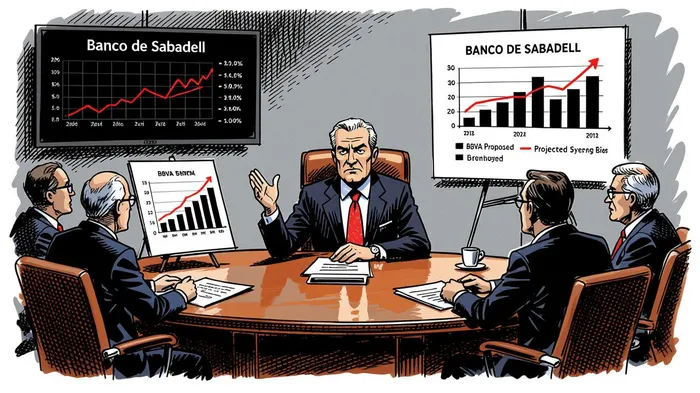
The ongoing battle for Banco de Sabadell (BNDSY) has become a focal point for investors seeking to balance short-term volatility with long-term value creation. As BBVA's €14.8 billion hostile takeover bid faces political and strategic hurdles, Sabadell's management, led by CEO Cesar Gonzalez-Bueno, has steadfastly rejected offers it deems inadequate. This resistance underscores a broader narrative: the bank's commitment to preserving shareholder value through organic growth and strategic independence, even as external pressures mount.
Sabadell's Q4 2024 Performance: A Case for Standalone Resilience
Banco de Sabadell's financial results for the full year 2024 provide a compelling case for its standalone viability. The bank reported a record net profit of €1.8 billion, translating to a robust return on tangible equity (RoTE) of 14.9% . This outperformed many European peers, reflecting disciplined cost management and a diversified loan portfolio. Commercial activity metrics further reinforced resilience: performing loans grew 4.7% year-on-year, while customer funds increased by 7.1% . Notably, asset quality improved significantly, with non-performing assets (NPAs) declining 16% and a coverage ratio of 59% . These figures suggest a bank that is not only weathering macroeconomic headwinds but actively strengthening its balance sheet.
Gonzalez-Bueno's rejection of BBVA's bid—valuing Sabadell at €14.76 billion—rests on the argument that the offer underestimates the bank's intrinsic value. The CEO has emphasized Sabadell's “standalone growth potential,” including an anticipated €0.50 per share dividend from the pending sale of its UK unit, TSB . This transaction, expected to close in 2025, would further bolster capital returns and reduce reliance on volatile European markets.
Strategic Implications: Independence vs. Synergy
BBVA's strategic rationale for the acquisition hinges on achieving €900 million in annual cost synergies and enhancing European scale through combined retail and SME banking expertise . However, Spain's government-imposed three-year merger restriction complicates this vision, limiting BBVA's ability to realize cross-functional efficiencies . Barclays' recent upgrade of BBVABBVA-- to “Overweight” acknowledges these challenges, noting that the bank retains flexibility to either adjust its bid or walk away—a move BarclaysBCS-- suggests could still be value-accretive .
Critically, Sabadell's independent roadmap prioritizes organic growth in its core markets. Its dominance in small and medium-sized enterprises (SMEs)—a segment less exposed to cyclical downturns—positions it to capitalize on Spain's recovering economy. Meanwhile, BBVA's Q2 2025 results, while strong (20.4% RoTE, 13.34% CET1 capital ratio ), highlight the risks of overextending in a consolidating sector.
Barclays' Perspective: Long-Term Value Creation
Barclays' analysis of the Sabadell-BBVA dynamic offers a nuanced view of long-term value creation. While the firm acknowledges the potential for 25% EPS accretion for Sabadell shareholders in a merger, it also underscores the bank's ability to generate returns independently. For instance, Barclays' proposed acquisition of TSB for €2.8 billion signals confidence in Sabadell's asset quality and its capacity to monetize non-core units. This transaction, if completed, would free Sabadell to reinvest in high-growth areas such as digital banking and green finance—sectors where its agility could outpace a larger, more bureaucratic merged entity.
Conclusion: A Test of Strategic Vision
The Sabadell-BBVA saga is more than a corporate takeover—it is a test of strategic vision in an era where scale and agility are both critical. While BBVA's bid promises immediate synergies, Sabadell's track record of disciplined growth and its CEO's resolve to avoid undervaluation suggest that independence may better serve long-term shareholders. As the Spanish government's conditions loom and market dynamics evolve, investors must weigh the risks of regulatory intervention against the rewards of a bank that has consistently outperformed expectations.
For now, the stage is set for a pivotal October 2025 decision. Whether Sabadell remains independent or succumbs to consolidation, its Q4 2024 results and strategic clarity have already demonstrated that its value extends far beyond the confines of a takeover premium.





Comentarios
Aún no hay comentarios