
Evaluating Apollo Commercial Real Estate Finance's Dividend Stability: A High-Yield Dilemma for Income Investors
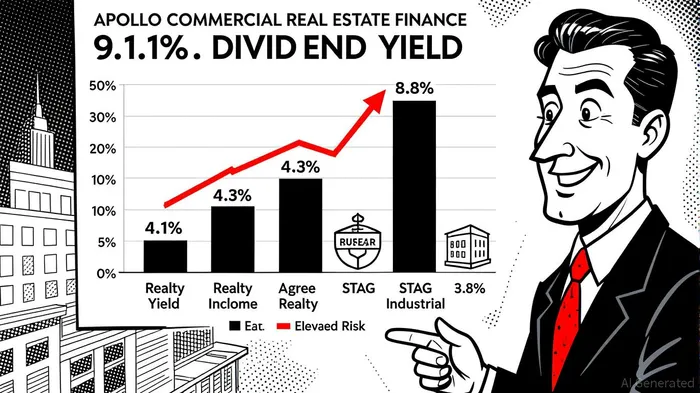
For income-focused investors, Apollo Commercial Real Estate Finance (ARI) presents a paradox: a tantalizing 9.1% dividend yield[1] juxtaposed with a payout ratio of 181.82% based on trailing earnings[3]. This stark contrast underscores the tension between high yield and sustainability, a critical consideration in a market where rising interest rates and credit risks are reshaping the landscape for real estate investment trusts (REITs).
Financial Performance and Dividend Coverage
ARI's Q2 2025 results revealed distributable earnings of $0.26 per share, narrowly covering its $0.25 quarterly dividend[1]. However, net income available to common stockholders was a mere $0.12 per share, signaling a reliance on non-GAAP metrics to fund payouts[1]. The company's loan portfolio expanded to $8.6 billion, driven by $1.4 billion in new originations during the quarter[1], while refinancing efforts extended corporate debt maturity to 2029[1]. These actions suggest a strategy to stabilize capital structure, yet the 426.44% debt-to-equity ratio[1] remains a red flag, indicating extreme leverage that could amplify losses during economic downturns.
Leverage and Risk Profile
High leverage is a double-edged sword for ARI. While it enables aggressive growth in loan origination—$2.0 billion in new commitments for H1 2025[2]—it also exposes the company to refinancing risks and interest rate volatility. For context, high-yield peers like Realty IncomeO-- (O) and Agree RealtyADC-- (ADC) maintain conservative leverage ratios and BBB+ or higher credit ratings[1], underpinning their ability to sustain dividends even in challenging markets. ARI's lack of a publicly disclosed credit rating, combined with its declining dividend trend (-8.2% compound annual decline over five years[3]), raises concerns about its capacity to weather prolonged stress.
Analyst Outlook and Peer Comparisons
Analysts remain divided on ARI's prospects, with a “hold” consensus rating and a median price target of $9.95[2]. This reflects uncertainty about whether the company can balance growth with sustainability. In contrast, peers like STAG IndustrialSTAG-- (STAG) and Main Street CapitalMAIN-- (MAIN) boast safer payout ratios (<90%) and consistent dividend growth streaks (13+ years[1]). ARI's “C” grade for dividend valuation and strength[3] further highlights its inferiority to these benchmarks, particularly for investors prioritizing long-term income reliability over short-term yield.
Conclusion: High Yield, High Stakes
ARI's 9.1% yield[1] is undeniably attractive in a low-interest-rate environment, but its structural vulnerabilities—excessive leverage, a payout ratio exceeding 180%, and a five-year dividend decline—make it a speculative bet for income investors. For those willing to tolerate elevated risk, ARI could offer outsized returns if its refinancing and portfolio diversification strategies succeed. However, conservative investors seeking stable, growing dividends would be better served by peers with stronger balance sheets and proven track records. As the market navigates macroeconomic headwinds, the adage “higher yield, higher risk” holds true for ARI.





Comentarios
Aún no hay comentarios