
The EV Market's Supply-Side Bottleneck: Why Rivian's R2 Could Be the Key to Breaking Tesla's 50% Dominance
The electric vehicle (EV) market is at a pivotal inflection point. For years, TeslaTSLA-- has dominated the mid-price segment-a category defined by vehicles priced between $35,000 and $60,000-with a near-untouchable 50% market share. But cracks are forming in that dominance. In November 2025, Tesla's grip on the mid-price segment stood at 56.7%, with 39,800 units sold, yet its overall U.S. EV market share had slipped to 41% by Q3 2025, down from 49% in the same period the prior year. This decline isn't just a blip; it reflects a broader shift as automakers like RivianRIVN--, Ford, and Hyundai gain traction. The question now is whether Rivian's upcoming R2-a $45,000 electric SUV-can exploit supply-side bottlenecks in the EV industry to disrupt Tesla's reign.
Tesla's Mid-Price Dominance: A House of Cards?
Tesla's success in the mid-price segment has been built on two pillars: product innovation and cost efficiency. The Model Y and Model 3 remain the top-selling EVs in the U.S., with 114,000 and 53,000 units sold in Q3 2025, respectively. However, Tesla's average transaction price (ATP) of $54,310 in November 2025 suggests it is increasingly leaning on premium features and software to maintain margins, even as the mid-price segment becomes more price-sensitive.
The expiration of federal tax credits in 2025 has further strained demand, with the overall EV market share dropping to 5.4% in November. Tesla's used EV sales, while still dominant 10,785 units sold, highlight a growing problem: depreciation rates for EVs are outpacing those of internal combustion vehicles, eroding residual value and deterring price-sensitive buyers. This creates an opening for competitors who can offer comparable performance at lower costs.
Rivian's R2: A Supply-Side Revolution
Rivian's R2 is not just another EV-it's a calculated response to the structural challenges plaguing the mid-price segment. The company's production strategy is centered on three pillars: cost reduction, battery innovation, and supply chain resilience.
Cost Efficiency Through Design and Scale
Rivian aims to slash production costs by over 50% compared to its R1 models according to industry analysis. This is achieved through simplified body architecture, modular components, and long-term supplier contracts negotiated before the imposition of tariffs which could add $10,000 per vehicle. By streamlining manufacturing, Rivian can price the R2 at $45,000-a 20% discount relative to Tesla's mid-range offerings-without sacrificing profitability.Battery Breakthroughs
The R2's battery pack, built with LG's 4695 cylindrical cells, offers a 300-mile range and 94 kWh capacity. Unlike Tesla's 2170 cells, these 4695 cells are designed for higher energy density and structural integration, where the battery pack doubles as part of the vehicle's floor. This design reduces weight and optimizes space, addressing a key pain point for EV buyers who prioritize utility.Strategic Partnerships and Scalability
Rivian's collaboration with Volkswagen Group provides access to broader financial resources and shared platforms, enabling faster global scalability. Meanwhile, its Normal, Illinois plant is projected to produce 175,000 R2 units annually by 2026, a scale that could rival Tesla's Fremont factory.
The Long-Term Play: Beyond the R2
Rivian's strategy extends beyond the R2. The vehicle is designed with V2H (vehicle-to-home) capabilities, allowing it to power homes during outages. This positions the R2 as a dual-purpose asset-transportation and energy storage-creating a sticky ecosystem that could rival Tesla's software-driven value proposition.
Moreover, Rivian's Georgia plant, set to support R2 and R3 production, is a nod to international markets where Tesla's supply chain bottlenecks (e.g., China-based production) could become liabilities. By localizing production in the U.S., Rivian avoids the geopolitical risks that have plagued Tesla's global expansion.
Why This Matters for Investors
Tesla's dominance in the mid-price segment is not invincible. The company's reliance on premium pricing and software monetization leaves it vulnerable to competitors who can offer comparable hardware at lower costs. 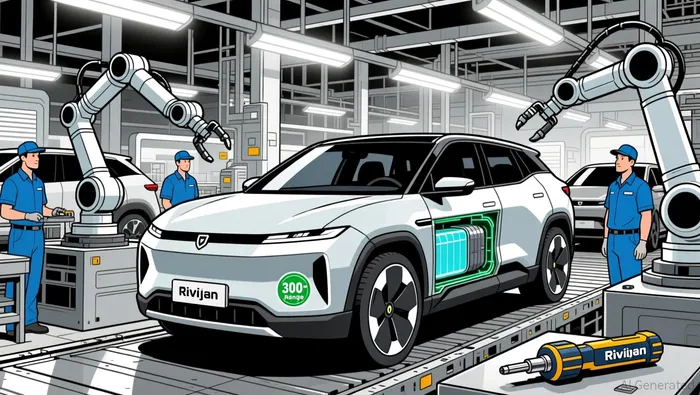 Rivian's R2, with its cost-efficient design, next-gen battery tech, and V2H capabilities, is poised to capture a significant share of the price-sensitive EV market.
For investors, the key takeaway is clear: the EV sector is transitioning from a product-driven race to a supply-side arms race. Companies that can innovate on cost, battery efficiency, and scalability-like Rivian-will outpace those clinging to legacy strategies. Tesla's 50% dominance may hold for now, but the R2's launch in 2026 could be the catalyst that cracks the mid-price segment wide open.





Comentarios
Aún no hay comentarios