
Eurozone Equity Market Divergence and Emerging Opportunities: Assessing Regional Resilience Amid Global Volatility
The Eurozone equity market in 2025 has become a study in contrasts. While the region's economy navigates trade tensions and uneven growth, pockets of resilience are emerging, driven by structural reforms, fiscal stimulus, and corporate strategies focused on shareholder value. For investors, the challenge lies in identifying which markets and sectors are best positioned to thrive amid global volatility.
Regional Divergence: Trade Exposure and Structural Reforms
The Eurozone's GDP growth is projected to reach 0.9% in 2025, but this masks stark regional disparities. Germany, the bloc's largest economy, faces headwinds from its high trade exposure. U.S. and Chinese retaliatory tariffs on industrial goods and green technologies have dampened its manufacturing sector, with growth expected at a modest 0.1%, according to J.P. Morgan's eurozone outlook. In contrast, Spain's economy is forecast to expand by 2.5%, buoyed by tourism recovery and infrastructure investments, per DelMorgan & Co.'s analysis. This divergence underscores the importance of structural reforms and fiscal policy. Germany's €500 billion infrastructure plan, for instance, aims to offset trade-related losses by boosting domestic demand and modernizing energy networks.
Meanwhile, the European Central Bank (ECB) has signaled a shift in monetary policy. With core inflation stabilizing at 2.7% in April 2025, the OECD economic outlook shows cooling price pressures, and CIJ Europe's Q3 analysis indicates the ECB paused its rate-cutting cycle, maintaining a deposit rate of 2.0% (CIJ Europe's Q3 2025 outlook). This pause has provided temporary relief to borrowers but has also highlighted the uneven impact of monetary easing. Southern economies like Spain and Italy, which rely heavily on construction and services, have benefited more from lower borrowing costs than export-dependent northern economies, as J.P. Morgan notes.
Q3 2025: A Tale of Two Markets
The third quarter of 2025 revealed further fragmentation. The MSCI Europe index surged 16% from April lows, driven by a rebound in consumer confidence and real wage growth, a trend DelMorgan & Co. identified. However, this outperformance was uneven. Allianz Global noted that defense and infrastructure stocks-fueled by public investment-outperformed, while sectors like automotive and machinery lagged due to trade uncertainties. SeabrookClark's analysis echoed this, noting that France's equity market struggled amid weak industrial output, while Germany's defense sector gained traction from Readiness 2030 spending commitments.
Emerging markets and Japan also saw gains, partly due to U.S. dollar weakness and trade tariff relief. Yet, India's equity market lagged, hit by U.S. visa restrictions and tariffs on IT services. For the Eurozone, this highlights a critical trend: domestic demand and labor market strength are increasingly outpacing external trade risks. Unemployment remains at a record low of 6.2%, driven by job creation in ICT, healthcare, and education, providing a buffer against global shocks.
Opportunities in Resilience
Investors seeking opportunities in the Eurozone must focus on three areas:
1. Infrastructure and Defense Sectors: Germany's €500 billion plan, coupled with France and Italy's Readiness 2030 commitments, is creating a pipeline of public-private partnerships. These projects are not only inflation-resistant but also aligned with long-term decarbonization goals, as J.P. Morgan highlights.
2. Structural Reform Leaders: Countries like Spain and the Netherlands, which have implemented labor market and regulatory reforms, are attracting capital. Their economies are better positioned to absorb external shocks while maintaining growth, a pattern DelMorgan & Co. documents.
3. Green Technology and Services: Despite trade tensions, the ECB's accommodative stance and corporate focus on shareholder value are driving investment in green energy and digital services. These sectors are expected to outperform as the Eurozone pivots toward self-sufficiency, according to DelMorgan & Co. observations.
Navigating the Risks
While the Eurozone's internal momentum is robust, external risks persist. U.S. tariffs on steel and aluminum, coupled with geopolitical tensions in Eastern Europe, could disrupt supply chains and inflation trajectories. Investors must also contend with divergent national policies. For example, France's focus on labor protections contrasts with Germany's infrastructure-driven approach, creating regulatory uncertainty for cross-border firms.
Conclusion
The Eurozone's equity market in 2025 is a mosaic of resilience and vulnerability. For investors, the key lies in balancing exposure to growth-oriented sectors-such as infrastructure and green technology-with hedging against trade-related risks. As Deloitte notes, the region's strong labor market and domestic demand provide a solid foundation, but structural reforms and fiscal coordination will determine whether this resilience translates into sustained growth. In a world of global volatility, the Eurozone's regional divergence is not a weakness but an opportunity for those who can navigate its complexities.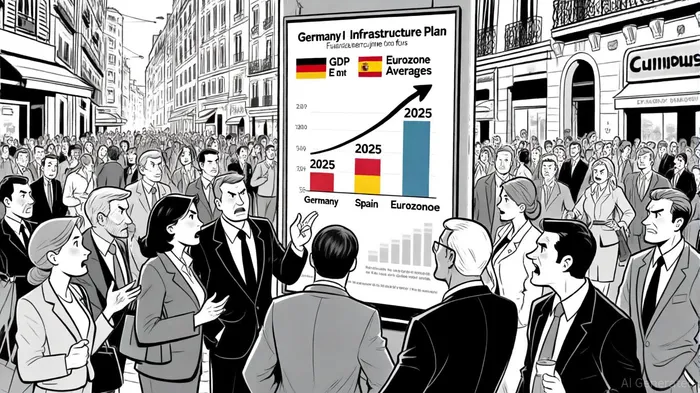







Comentarios
Aún no hay comentarios