
Eurozone Bond Market Dynamics Amid Fed Easing Expectations: Strategic Reallocation Opportunities in Sovereign Debt
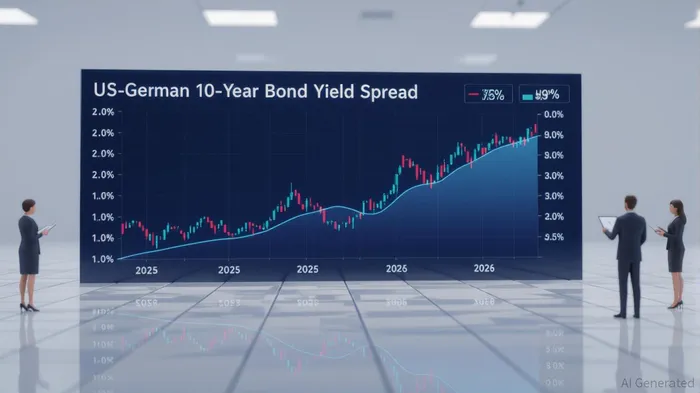
The Eurozone bond market is undergoing a period of recalibration as investors grapple with divergent central bank policies and shifting global capital flows. With the U.S. Federal Reserve signaling a phased easing cycle and the European Central Bank (ECB) navigating a fragile economic outlook, the interplay between these forces is creating both risks and opportunities for sovereign debt investors. Strategic reallocation across asset classes and geographies is becoming increasingly critical, particularly as yield differentials widen and policy uncertainty persists.
Diverging Policy Paths and Yield Spreads
The U.S.-German 10-year bond yield gapGAP-- has expanded to 183 basis points, its widest since July 2025, as the Fed's rate cuts contrast with the ECB's cautious approach [1]. This divergence reflects fundamentally different economic trajectories: the U.S. labor market remains resilient, while the Eurozone faces weak business activity and fiscal constraints in key economies like Germany and France [1]. The ECB's forward guidance—projecting a deposit rate cut to 2.0% in June 2025—has failed to offset the upward pressure on yields, with Germany's 10-year bond yield reaching 2.286% in late December 2024, its highest since November 2022 [4].
Meanwhile, markets are pricing in nearly 70 basis points of Fed easing by the end of 2026, creating a “policy gap” that is amplifying capital flows into U.S. Treasuries at the expense of Eurozone debt [1]. This dynamic is particularly acute for investors seeking yield, as the ECB's gradualist stance—rooted in concerns over inflation persistence and fiscal sustainability—limits its ability to close the gap [2].
Investor Behavior and Market Structure Shifts
Central banks are playing a diminished role in Eurozone bond markets, with their holdings of domestic sovereign bonds in OECD economies declining from 29% in 2021 to 19% in 2024 [4]. This withdrawal has created a void that private investors, including foreign institutional buyers and domestic households, are increasingly filling. However, the influx of price-sensitive capital has heightened volatility, particularly in peripheral Eurozone markets where spreads are more susceptible to liquidity shocks [4].
The U.S. dollar's dominance as a safe-haven asset remains intact, despite rising fiscal deficits and shifting tariff policies [2]. U.S. Treasury markets continue to offer unmatched liquidity, making them a magnet for capital fleeing higher-risk assets. Yet, the eurozone's structural challenges—fragmented bond markets and weak service-sector growth—limit its ability to compete as an alternative safe-haven destination [1]. This asymmetry is likely to persist unless the ECB adopts a more aggressive easing cycle or Eurozone governments implement coordinated fiscal stimulus.
Strategic Reallocation Opportunities
For investors, the current environment presents three key opportunities:
Hedging Against ECB Easing: With analysts projecting ECB rates could fall as low as 1% by 2026 if growth remains weak [1], investors may consider extending duration in Eurozone bonds with embedded caps or using interest rate swaps to hedge against further yield declines.
Diversifying Into Higher-Yielding Eurozone Debt: While German bonds remain under pressure, peripheral Eurozone markets (e.g., Spain, Italy) offer more attractive risk-adjusted returns. Investors with a higher risk tolerance could selectively allocate to these markets, provided they hedge currency and credit risks.
Currency-Linked Sovereign Debt Plays: The euro's relative weakness against the dollar—driven by divergent monetary policies—creates opportunities for carry trades involving Eurozone bonds. Investors could pair long positions in high-yielding Eurozone debt with short positions in the euro to capitalize on both yield differentials and currency trends.
Risks and Considerations
The primary risk lies in the ECB's inability to meet market expectations for aggressive easing, which could trigger a sharp repricing of Eurozone bonds. Additionally, rising global bond yields—driven by broader fiscal challenges in OECD countries—threaten to compress margins across sovereign debt markets [3]. Investors must also contend with the potential for geopolitical shocks, which have increasingly overshadowed economic concerns in central bank decision-making [1].
Conclusion
The Eurozone bond market is at a crossroads, shaped by the interplay of Fed easing expectations, ECB policy constraints, and shifting investor behavior. While the widening U.S.-Eurozone yield gap creates headwinds for Eurozone sovereigns, it also opens avenues for strategic reallocation. Investors who can navigate the delicate balance between yield capture, duration risk, and currency exposure may find fertile ground in this evolving landscape.







Comentarios
Aún no hay comentarios