
European Regulatory Responses to U.S. Stablecoins: Strategic Opportunities in Cross-Border Digital Currency Infrastructure
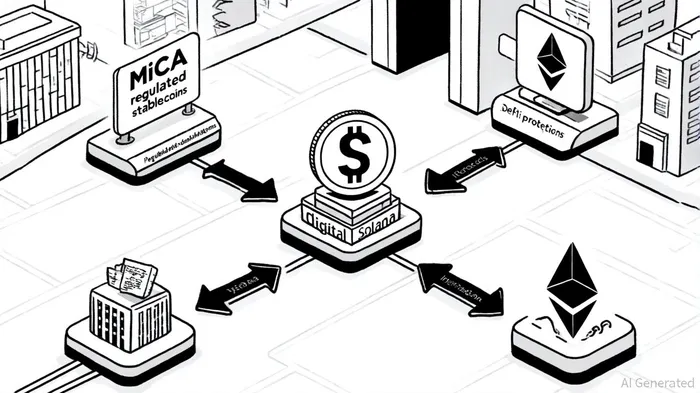
The European Union's regulatory response to U.S. stablecoins has evolved into a strategic counterbalance to global digital currency dynamics. With the Markets in Crypto-Assets (MiCA) framework fully operational since December 2024, the EU has established a robust legal infrastructure for cross-border digital currency transactions while accelerating its digital euro initiative. This shift not only addresses the dominance of U.S. dollar-backed stablecoins but also creates fertile ground for investment opportunities in cross-border payment systems, blockchain partnerships, and institutional-grade stablecoin adoption.
MiCA: A Regulatory Framework for Global Competitiveness
MiCA has redefined the EU's approach to stablecoins, mandating that all fiat-backed stablecoins be fully reserved and transparently audited[1]. This has led to a 60% surge in cross-border crypto transaction volumes, projected to reach €1.2 trillion by 2025[2]. The framework's harmonization of crypto regulations across the EU has reduced compliance costs for businesses, with 75% of European crypto firms aligning operations with MiCA by 2025[3]. For investors, this signals a maturing market where regulated stablecoins—such as EUROe (Membrane Finance), EURC (Circle), and Anchored Euro (Anchored Coins)—are becoming foundational infrastructure for B2B payments, payroll systems, and real-time settlements[4].
The EU's strict reserve requirements have also spurred innovation in compliance tools. For instance, platforms like Vaultody now offer real-time audit trails for MiCA-compliant stablecoins, enabling institutions to verify liquidity at scale[5]. This infrastructure is critical for cross-border transactions, where 40% of European crypto payments now rely on regulated stablecoins[6].
The Digital Euro: A Strategic Counter to U.S. Stablecoin Dominance
The European Central Bank's (ECB) pivot toward public blockchains like EthereumETH-- and SolanaSOL-- for the digital euro represents a pivotal strategic move. Initially designed as a private CBDC, the digital euro's potential deployment on public chains aims to enhance interoperability with global payment systems and DeFi protocols[7]. Ethereum's smart contract ecosystem and Solana's high-throughput capabilities are being evaluated for use cases such as programmable money and automated cross-border settlements[8].
This shift is driven by the U.S. GENIUS Act, which has intensified European concerns about the dollar's dominance in digital finance. By leveraging public blockchains, the ECBXEC-- seeks to reduce reliance on U.S.-controlled systems while maintaining compliance with MiCA's privacy and AML/KYC standards[9]. However, challenges remain: public blockchains must reconcile transparency with the EU's strict data protection laws, and cybersecurity risks—such as smart contract vulnerabilities—require rigorous testing[10].
Investment Opportunities in Cross-Border Infrastructure
The convergence of MiCA, the digital euro, and blockchain partnerships is unlocking three key investment opportunities:
MiCA-Compliant Stablecoin Issuers:
Companies like CircleCRCL-- and Anchored Coins are expanding their euro-pegged stablecoins to meet EU demand. These tokens, backed by liquid reserves in European banks, offer institutional investors a low-risk on-ramp to cross-border payments. With 78% growth in MiCA-licensed crypto service providers, competition is driving down transaction fees by 30%[11].Blockchain Infrastructure Providers:
Ethereum and Solana are positioning themselves as critical partners for the digital euro. Ethereum's robust developer ecosystem and Solana's low-cost, high-speed transactions make them attractive for real-time settlements. Investors should monitor pilot programs, as early adopters could capture significant market share in cross-border DeFi integration[12].Regulatory Compliance Platforms:
The demand for AML/KYC solutions under MiCA is surging. Firms like Chainalysis and Elliptic are expanding their EU operations to help institutions meet real-time monitoring requirements. With 90% of EU financial institutions citing MiCA as a stability booster, compliance tech is a high-growth sector[13].
Risks and Considerations
While the EU's strategy is promising, risks persist. The digital euro's public blockchain model could face pushback from privacy advocates, and geopolitical tensions may delay implementation. Additionally, U.S. stablecoin issuers are adapting to the GENIUS Act, potentially re-entering the EU market with compliant products. Investors must also weigh the ECB's final decision on blockchain selection, expected by late 2025[14].
Conclusion
The EU's regulatory and technological response to U.S. stablecoins is reshaping the global cross-border payment landscape. By combining MiCA's compliance rigor with the digital euro's potential on public blockchains, Europe is positioning itself as a leader in digital finance. For investors, the opportunities lie in stablecoin infrastructure, blockchain partnerships, and compliance innovation—sectors poised to benefit from the EU's strategic autonomy agenda.







Comentarios
Aún no hay comentarios