
European Market Volatility: A Buying Opportunity Amid CAC 40 and IBEX 35 Downturns?
European Market Volatility: A Buying Opportunity Amid CAC 40 and IBEX 35 Downturns?
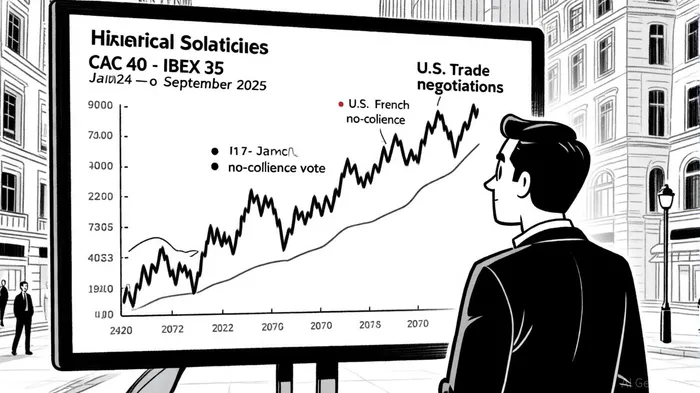
The Eurozone's equity markets have long been a barometer of global economic sentiment, and 2025 has proven no exception. With the CAC 40 and IBEX 35 indices navigating a landscape of macroeconomic uncertainty, investors are increasingly asking whether these downturns represent strategic entry points into undervalued Eurozone equities.
Volatility as a Double-Edged Sword
The CAC 40, France's benchmark index, has exhibited a 10-day historical volatility of 10.24 as of September 29, 2025 - a decline of 55.8% year-over-year, according to Wall Street Numbers. While this suggests a temporary easing of short-term turbulence, the index's 0.9% drop in August 2025 underscores structural vulnerabilities. Political instability, including a no-confidence vote in the French government, has eroded investor confidence, according to a J.P. Morgan review.
Meanwhile, the IBEX 35, Spain's flagship index, has bucked the trend, surging over 10% in late Q3 2025, driven by robust banking and retail sector performance, per J.P. Morgan. However, its volatility forecast of 15.06% on September 9, 2025, signals lingering risks, according to a V-Lab volatility analysis.
Macro Drivers and Sectoral Opportunities
The volatility in both indices is inextricably linked to global macroeconomic forces. U.S. dollar weakness has bolstered international equity markets, V-Lab's analysis shows, while trade negotiations and potential tariff impositions have created a volatile backdrop, according to a Morningstar outlook. For the CAC 40, political uncertainty in France remains a drag, but this has pushed certain sectors-particularly undervalued value stocks-to attractive valuations. Morningstar finds that value equities in Europe trade at a 12% discount to fair value, offering higher dividend yields and long-term appreciation potential.
The IBEX 35's outperformance, meanwhile, highlights the resilience of Spain's economy. Banking giants like Santander and BBVA surged by over 20% in Q3 2025, driven by strong earnings and expansion into markets like India, as reported by J.P. Morgan. Retailers such as Inditex have also benefited from improved consumer confidence. For investors, this suggests that defensive sectors within the IBEX 35-particularly financials and consumer staples-could serve as hedges against broader Eurozone volatility.
Strategic Entry Points and Risk Mitigation
As the BlackRock spring outlook emphasizes, the importance of low-volatility strategies in high-uncertainty environments cannot be overstated. For the CAC 40, this could mean targeting undervalued sectors like utilities or industrials, which have historically demonstrated resilience during market corrections. In the IBEX 35, the banking sector's 20%+ gains in Q3 2025 present a compelling case for selective entry, particularly for investors seeking exposure to Spain's economic rebound.
However, caution is warranted. The CAC 40's underperformance relative to the MSCI Europe ex-UK index in August 2025, noted by J.P. Morgan, highlights the risks of overexposure to politically fragile markets. Diversification remains key: pairing Eurozone equities with inflation-linked bonds, gold, or infrastructure investments could mitigate correlation risks, as BlackRock suggests.
Conclusion: Balancing Caution and Opportunity
While the CAC 40 and IBEX 35 face distinct challenges, their volatility creates asymmetric opportunities for disciplined investors. The CAC 40's political headwinds have depressed valuations in certain sectors, offering long-term value. The IBEX 35's momentum, driven by banking and retail growth, suggests a more immediate upside. As BlackRock notes, a diversified, defensive approach is critical in 2025's high-volatility environment. For those willing to navigate the noise, these indices may yet reveal their true worth.







Comentarios
Aún no hay comentarios