
European Market Resilience: The Case for Defensive Investing in Stable Sectors
European Market Resilience: The Case for Defensive Investing in Stable Sectors
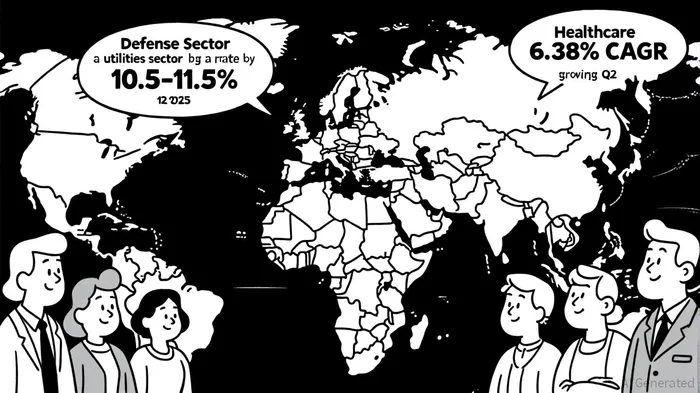
Defensive investing has long been a cornerstone of risk mitigation in volatile markets, and Europe's current economic landscape offers compelling opportunities in stable sectors. With geopolitical tensions, energy transitions, and demographic shifts reshaping the continent, investors are increasingly turning to utilities, healthcare, and defense industries-sectors that combine resilience with growth potential. This analysis examines how these sectors are positioned to outperform in the coming years, supported by robust policy frameworks and structural tailwinds.
Defense: A Geopolitical Tailwind Fuels Growth
Europe's defense sector is experiencing a renaissance driven by NATO's 2035 spending targets and heightened regional security concerns. According to a Defense News report, European defense companies are projected to grow revenue by 10.5% to 11.5% annually over the next decade, fueled by a record €343 billion in 2024 spending and a projected €381 billion in 2025. The industry's order backlog is expanding faster than it is being fulfilled, with firms historically converting 34% of their backlog annually, though this dipped to 30% in 2024 due to surging demand.
Notably, European defense spending is expected to outpace U.S. growth, with Europe targeting 1.2% to 1.4% of GDP for procurement by 2035, compared to the U.S. maintaining 1%. Subsectors like air defense and land armament are leading the charge, with German and Eastern European firms outperforming peers due to their strategic alignment with regional security priorities. For investors, this represents a rare combination of geopolitical necessity and long-term capital deployment.
Utilities: Energy Transition and Stable Yields Converge
The European utilities sector has demonstrated remarkable resilience in 2025, rising 12% in Q2 and outperforming the broader market by 10%, according to a Morningstar report. This momentum is underpinned by declining interest rates, improved generation spreads, and a 4% increase in forward power prices. Despite a 5% drop in gas prices, favorable dynamics such as a weaker U.S. dollar and the Iran-Israel ceasefire have bolstered sector performance.
However, the sector faces headwinds. Renewable capacity additions declined by 11% in 2025, exemplified by the cancellation of the Hornsea 4 offshore wind project in May. Conversely, network investments rose 6% in Q1 2025, signaling long-term growth in grid infrastructure. With a forward dividend yield of 4.4%, utilities remain attractive, particularly for income-focused investors. Key names like RWE, Veolia Environnement, and SSE are well-positioned to benefit from regulatory support and renewable project pipelines.
Healthcare: Digital Transformation and Aging Populations Drive Demand
The European healthcare sector is undergoing a quiet revolution, driven by digital adoption and an aging population. Data from MarketdataForecast reveals that the consumer healthcare market was valued at USD 74.12 billion in 2024 and is projected to grow at a 6.38% CAGR, reaching USD 129.32 billion by 2033. This expansion is fueled by rising chronic conditions like diabetes and hypertension, which are pushing consumers toward self-care solutions such as over-the-counter medications and wellness supplements.
Digital health platforms and e-pharmacies are accelerating access, with Germany, France, and the Netherlands leading in adoption. Telehealth and AI-powered diagnostics are further reshaping the landscape, enabling cost-effective, at-home care. According to a GlobeNewswire report, these innovations are not only improving patient outcomes but also reducing the burden on strained public healthcare systems. For investors, the sector offers a blend of defensive characteristics and innovation-driven growth.
Strategic Implications for Investors
The convergence of policy support, structural demand, and technological innovation positions European defensive sectors as a bulwark against macroeconomic uncertainty. Defense companies benefit from geopolitical tailwinds, utilities offer stable yields amid energy transitions, and healthcare is being transformed by digital tools. While challenges like renewable project delays and regulatory shifts exist, the long-term fundamentals remain robust.







Comentarios
Aún no hay comentarios