
European Industrial Sector at Crossroads: Labor Cost Restructuring and Manufacturing Competitiveness
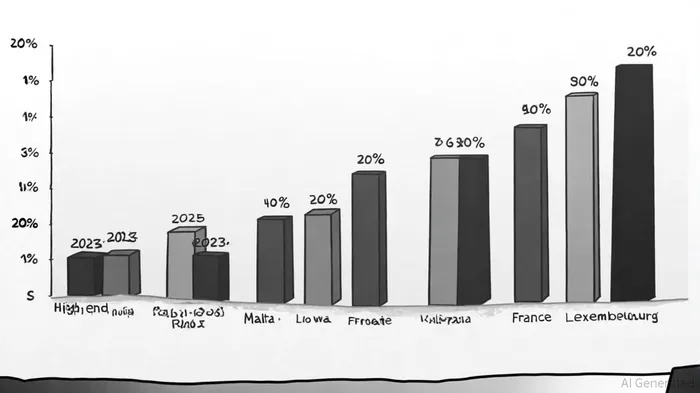
The European industrial sector stands at a pivotal juncture, with labor cost restructuring reshaping its competitive landscape. As data from Eurostat reveals, nominal hourly labor costs in the EU rose by 4.1% annually in Q1 2025, driven by wage growth (4.2%) and non-wage components (3.8%) [1]. This trend, however, masks stark regional disparities. Romania, for instance, saw a 16.1% surge in hourly wage costs—the highest in the bloc—while France and Malta recorded minimal increases of 1.9% and 1.6%, respectively [1]. Such divergences underscore the fragility of a unified industrial strategy in a region where labor costs vary by over 400% between the highest (Luxembourg, €55.2/hour) and lowest (Bulgaria, €10.6/hour) [3].
Sector-Specific Pressures and Productivity Gaps
The manufacturing and construction industries, cornerstones of European industrial output, face acute pressure. In Q1 2025, EU manufacturing labor costs climbed 4.4% year-on-year, with construction rising 5.2% [1]. These increases outpace productivity gains, which the Eurosystem forecasts at a modest 0.4% for 2024 [3]. For context, countries like Germany and France—where non-wage costs account for 32.2% and 31.6% of total labor costs, respectively [3]—risk eroding competitiveness against lower-cost rivals. Meanwhile, nations such as Hungary and Poland, with hourly labor costs below €15, face a different challenge: sustaining growth without triggering inflationary pressures or labor shortages.
Competitiveness in a Global Context
Europe's industrial sector must now contend with a dual threat. On one hand, high-cost economies like Denmark and Belgium—where hourly labor costs exceed €48—struggle to match the cost efficiency of Asian and North American competitors. On the other, lower-cost Eastern European nations risk becoming trapped in a low-wage, low-productivity cycle. This duality is evident in the OECD's analysis of strategic sectors such as semiconductors and steel, where market distortions and policy interventions are increasingly necessary to maintain global relevance [2]. The Global Industry Classification Standard (GICS®) further highlights the need for granular sector analysis, as investors seek to navigate these fragmented dynamics [3].
Future Outlook: Slowdown or Structural Shift?
While the Eurosystem projects a moderation in unit labor cost growth—from 6.1% in 2023 to 4.1% in 2024 [3], this does not signal a resolution of underlying vulnerabilities. Structural reforms, such as modernizing labor markets and boosting automation, will be critical to align wage growth with productivity. For investors, the path forward lies in hedging against regional volatility: capitalizing on innovation-driven sectors in high-cost economies while supporting productivity-enhancing investments in lower-cost regions.
Conclusion
The European industrial sector's vulnerability is not a monolithic crisis but a mosaic of challenges shaped by labor cost restructuring. As policymakers and investors grapple with these realities, the ability to differentiate between regions and sectors will determine long-term competitiveness. For now, the data suggests a continent at a crossroads—where the path forward demands both strategic patience and bold innovation.







Comentarios
Aún no hay comentarios