
European Equity Market Stagnation and the DAX Paradox: Strategic Reallocation in a Fragmented Landscape
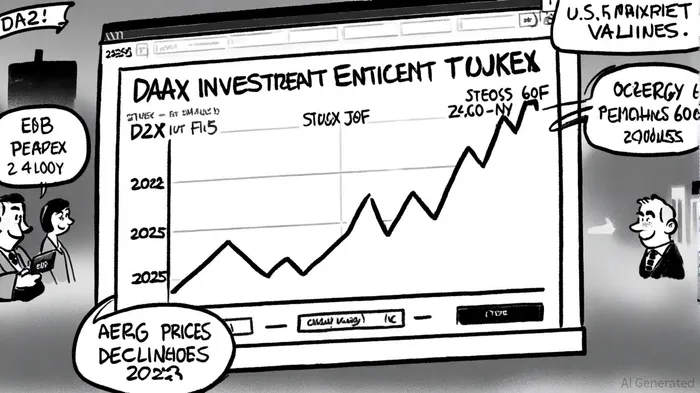
The European equity market has long been a puzzle for investors. In 2024–2025, the broader region has stagnated, weighed down by political instability, weak corporate earnings, and structural underperformance. Yet, the DAX index—a barometer of Germany's largest firms—has defied the trend, surging over 30% in U.S. dollar terms since 2023 and nearing 24,500 points in July 2025 [1]. This divergence raises a critical question: How can investors navigate a fragmented landscape where one index thrives while the rest of Europe lags?
The DAX's Decoupling: Globalization and Policy Tailwinds
The DAX's resilience stems from two pillars: the global revenue diversification of its constituents and accommodative monetary policy. Companies like SAPSAP--, Siemens, and Deutsche Telekom derive 80% of their revenue outside Germany [2], insulating them from domestic challenges such as weak GDP growth and labor shortages. For instance, SAP's 35% U.S. revenue exposure has allowed it to capitalize on global demand for AI-driven enterprise solutions [3]. Meanwhile, the European Central Bank's rate cuts and falling energy prices have eased borrowing costs and reduced pressure on energy-intensive industries [4].
This dynamic has created a valuation gap. The DAX trades at a forward P/E of 15.09x, significantly below the S&P 500's 21x [5], offering an attractive entry point for investors seeking value. However, the broader European market remains unattractive, with the STOXX 600 trading near historical averages (13.2x) amid persistent inflation, geopolitical risks, and sluggish productivity [6].
Strategic Reallocation: Balancing Opportunity and Risk
For investors, the challenge lies in reconciling the DAX's strength with Europe's broader stagnation. Some experts advocate increasing exposure to German equities. A EUR 500 billion infrastructure investment package and a EUR 46 billion tax relief plan have spurred expectations of double-digit earnings growth by 2026 [7]. Sectors like defense and infrastructure are particularly compelling, with defense budgets projected to rise 50% by 2030 [8]. Passive tools like the iShares Core DAX UCITS ETF or active strategies targeting undervalued stocks could capitalize on this momentum.
Yet, caution is warranted. The SSGA Investment Solutions Group has advised reducing European equity allocations, citing deteriorating macroeconomic conditions and a shift in capital toward U.S. markets [9]. Political risks—such as France's upheaval and Germany's looming election—add to the uncertainty. Moreover, while the DAX's global reach mitigates domestic headwinds, it remains exposed to global trade tensions, particularly under the Trump administration's aggressive tariff policies [10].
The Path Forward: A Nuanced Approach
The key to strategic reallocation lies in granularity. Investors should differentiate between the DAX's global champions and the broader European market's structural weaknesses. For those with a long-term horizon, the DAX offers a compelling case: a diversified index insulated from domestic stagnation, supported by fiscal stimulus and favorable valuations. However, short-term volatility is inevitable. Analysts project the DAX could reach 30,000 points by 2025 and 40,000 by 2030, but periodic corrections are likely amid macroeconomic uncertainties [11].
In contrast, the broader European market requires a more defensive stance. Until structural reforms address productivity gaps and capital market integration, Europe will struggle to close the performance gap with the U.S. Investors should prioritize sectors with clear tailwinds—such as renewable energy and AI adoption—while hedging against geopolitical shocks.
Conclusion
The DAX's outperformance underscores a broader truth: in a fragmented global economy, success is no longer bound by geography. Germany's largest firms have leveraged globalization and policy support to thrive, even as the broader European economy falters. For investors, the lesson is clear: strategic reallocation must be rooted in sector-specific fundamentals and a nuanced understanding of macroeconomic divergences. The DAX may not be a panacea for Europe's woes, but it offers a rare glimpse of optimism in an otherwise stagnant landscape.





Comentarios
Aún no hay comentarios