
European Equities at a Crossroads: Euro Stoxx 50's Bullish Trajectory vs. Blue-Chip Underperformance in a Fragile Recovery
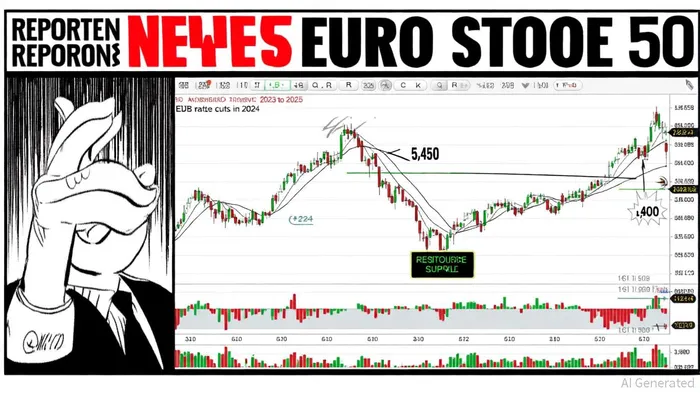
The Euro Stoxx 50 index has emerged as a standout performer in 2025, breaking above critical resistance levels to reach 5,500 points—a level unseen since the early 2000s [1]. Technical analysts describe the index as forming an ascending triangle pattern, with a bullish breakout anticipated if it sustains above 5,600 [1]. However, this optimism contrasts sharply with the underperformance of individual blue-chip stocks within the index, which have lagged behind the broader market's gains. This divergence underscores the fragility of Europe's post-recovery phase, where macroeconomic vulnerabilities—ranging from U.S. tariff threats to structural productivity gaps—continue to weigh on corporate earnings and investor sentiment.
A Technical Bull Case for the Euro Stoxx 50
The index's recent surge is supported by favorable technical indicators and dovish monetary policy. The European Central Bank's (ECB) four rate cuts in 2024 have bolstered risk assets, with inflation easing to 2.1% in Q2 2025 [1]. This dovish stance has fueled speculative momentum, pushing the Euro Stoxx 50 into overbought territory on the Relative Strength Index (RSI) [1]. Analysts at Kagels Trading note that while short-term consolidation is likely, the index remains on a 60% probability path to reach 6,000+ within 12 months [1]. Long-term forecasts, such as those from TradersUnion, project a potential ascent to 6,890 by 2029, driven by anticipated technological advancements and economic recovery [4].
Blue-Chip Underperformance: A Macroeconomic Conundrum
Despite the index's strength, blue-chip stocks—such as Siemens, TotalEnergies, and LVMH—have underperformed, reflecting deeper structural challenges. European markets have underperformed U.S. equities by the most in 25 years, with the euro's slide below $1 exacerbating cross-border valuation pressures [4]. A report by Marketscreener attributes this to U.S. tariff threats, political instability in France and Germany, and weak productivity growth in the eurozone [4]. For instance, Germany's industrial sector remains mired in stagnation, with unemployment at 6.8% and manufacturing PMI hovering near contractionary levels [1].
The ECB's recent growth downgrade to 0.9% for 2025 further highlights these vulnerabilities. While domestic fiscal stimulus in Germany and improved financing conditions offer some support, the index remains exposed to global headwinds. Analysts at Kappa Signal caution that U.S. President Donald Trump's proposed tariffs on EU goods could disrupt the fragile recovery, particularly for export-heavy sectors like automotive and machinery [1].
Geopolitical and Energy Risks: A Double-Edged Sword
Geopolitical tensions, notably the Russia-Ukraine war, continue to strain energy markets and supply chains. Although Europe has diversified its gas imports, energy prices remain 20% above pre-2022 levels, squeezing corporate margins [1]. Meanwhile, China's uneven recovery and U.S. economic volatility add layers of uncertainty. The Euro Stoxx 50's exposure to global growth means it benefits from U.S. equity strength but is equally vulnerable to a slowdown in either region [2].
Investment Implications and Strategic Outlook
For investors, the Euro Stoxx 50 presents a paradox: a technically robust index in a macroeconomic environment riddled with risks. While the ECB's rate cuts and global equity strength offer tailwinds, structural weaknesses in Germany and energy costs pose significant headwinds. Analysts at BIS argue that European stocks are now undervalued, with bearish positioning reaching extremes, making them potential recovery trades [4]. However, this requires a careful balance—leveraging the index's upward momentum while hedging against geopolitical and inflationary shocks.
Conclusion
The Euro Stoxx 50's technical optimism contrasts with the macroeconomic fragility of its constituents, reflecting Europe's uneven recovery. While the index's trajectory suggests a path toward 6,000, investors must remain cautious about the risks of overbought conditions and external shocks. For now, the index appears to be a barometer of global risk appetite, but its long-term success will depend on Europe's ability to address productivity gaps and geopolitical vulnerabilities.







Comentarios
Aún no hay comentarios