
European Equities via ADRs: Navigating Mixed Signals in a Volatile Market
Assessing Short-Term Stability and Long-Term Opportunity in U.S.-Listed European ADRs
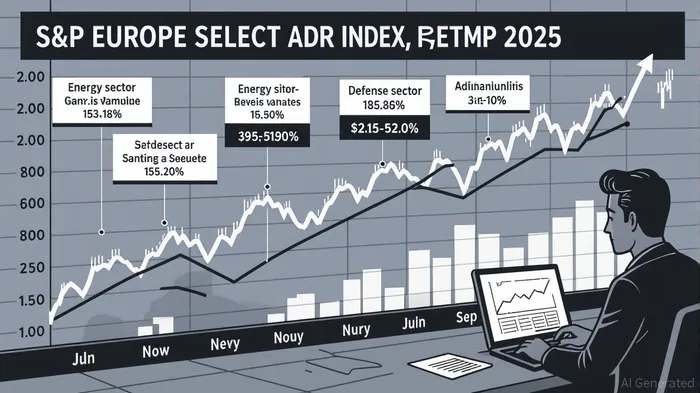
The U.S.-listed European American Depositary Receipt (ADR) market in 2025 has been a study in contrasts. While the S&P Europe Select ADR Index posted a modest 0.5% gain in June 2025, driven by pharmaceuticals and energy firms like EniE-- and TotalEnergies, it slipped 0.4% in May amid declines in biotech and consumer stocks. By August, the index had stabilized near 1,529.86, with energy firms like BPBP-- offsetting broader market caution. These fluctuations underscore the sector-specific dynamics shaping European ADRs, where energy stocks have acted as a safe haven while biotech and consumer sectors remain volatile.
Short-Term Volatility: Sectoral Shifts and Geopolitical Drivers
The defense sector has emerged as a standout performer in 2025, with European defense ADRs surging on the back of rising geopolitical tensions and strategic autonomy initiatives. The Select STOXX Europe Aerospace & Defense ETF (EUAD), which includes ADRs of Airbus and Safran, has gained 39% year-to-date, outpacing the 5.4% rise in the U.S. Aerospace & Defense ETF (ITA). This divergence reflects Europe's aggressive defense spending, particularly in Germany, where fears of U.S. disengagement from NATO have spurred a 39% surge in defense stocks. Individual companies like Rheinmetall and Rolls-Royce have mirrored this trend, with the latter delivering an 89.72% return by year-end 2024.
However, such gains are not universal. Biotech and consumer sectors remain fragile, with companies like EvaxionEVAX-- and AbivaxABVX-- experiencing declines despite broader ADR market growth. This sectoral bifurcation highlights the risks of overconcentration in defense or energy stocks, even as these sectors benefit from macroeconomic tailwinds.
Long-Term Opportunities: Valuation Metrics and Macroeconomic Tailwinds
While short-term volatility persists, European ADRs present compelling long-term opportunities, particularly in sectors with strong fundamentals and undervalued metrics. European banks, for instance, trade at a 34% two-year forward P/E discount relative to other sectors, with J.P. Morgan projecting 15% price appreciation over the next year and 25% over the long term. These banks, supported by robust capital ratios (14.2% common equity Tier 1 in 2025) and disciplined cost management, are poised to outperform as interest rates stabilize.
Similarly, the broader European ADR market offers attractive valuations. The Developed Markets ADR 30 Index trades at a trailing P/E of 13.5 and a forward P/E of 13.6, with a price/book ratio of 1.7. Individual stocks like ING Group NV ADR (P/E of 10.54) further underscore the value proposition. These metrics, combined with Europe's projected 1.3% GDP growth and 2.1% inflation in 2025, suggest a stabilizing macroeconomic environment that could bolster ADRs' long-term appeal.
Navigating the Mixed Signals: A Strategic Approach
Investors must balance the short-term risks of sectoral volatility with the long-term potential of undervalued European equities. For short-term stability, energy and defense ADRs offer defensive positioning amid geopolitical and macroeconomic uncertainties. However, overreliance on these sectors could expose portfolios to sector-specific shocks, as seen in the biotech and consumer downturns.
For long-term growth, sectors like banking and industrials present compelling opportunities. European banks' improving profitability (15–15.5% ROE in 2026–2027) and disciplined capital management align with a broader trend of fiscal expansion in Europe, particularly in Germany's infrastructure and defense investments. Meanwhile, industrials benefit from EU efforts to remove internal trade barriers, enhancing intra-European trade and investment.
Conclusion
The U.S.-listed European ADR market in 2025 is a mosaic of volatility and value. While short-term stability hinges on sectoral shifts and geopolitical dynamics, long-term opportunities are anchored in undervalued fundamentals and macroeconomic resilience. Investors who adopt a balanced approach—leveraging defensive sectors for stability while allocating to undervalued industries for growth—can navigate the mixed signals and position themselves to capitalize on Europe's evolving equity landscape.





Comentarios
Aún no hay comentarios