
European Energy Market Volatility and Investment Opportunities: Navigating Geopolitical and Supply-Demand Dynamics
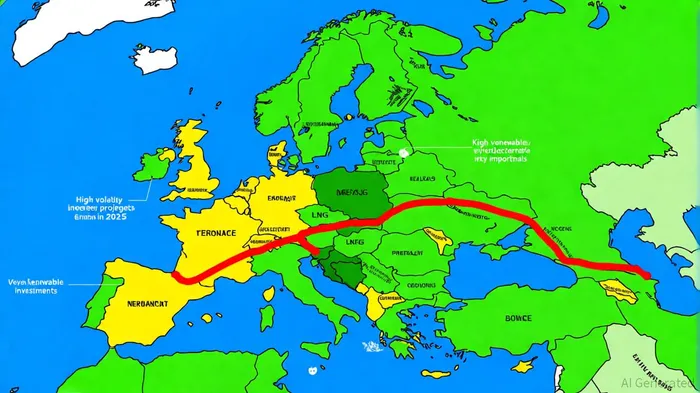
The European energy market in 2025 is a battleground of contradictions. On one hand, the continent is accelerating its transition to renewables, with 47% of electricity now generated from low-emission sources[1]. On the other, geopolitical tensions, supply chain bottlenecks, and industrial shifts are creating a perfect storm of volatility. For investors, this duality presents both risks and opportunities—particularly in sectors poised to address the continent's evolving energy needs.
Geopolitical Tensions Amplify Market Fragility
The Russia-Ukraine war remains a shadow over European energy security, even as the EU has largely weaned itself off Russian gas. However, new flashpoints—such as Houthi attacks in the Red Sea and escalating tensions between Israel and Iran—have disrupted shipping lanes and spiked oil prices, with Brent crude fluctuating between $70–$78 per barrel[2]. These disruptions are compounded by the EU's reliance on LNG imports from North America and the Middle East, which, while diversifying supply, have introduced price asymmetries compared to the U.S. market[3].
Meanwhile, the EU's push for energy independence has exposed vulnerabilities in its infrastructure. For instance, France's nuclear output, a critical pillar of its energy mix, has been curtailed by worker strikes, forcing greater reliance on wind power and imported gas[4]. Such fragility underscores the need for resilient, diversified systems—a theme central to the EU's recent collaborations, including the U.S.-Japan-Australia Green Hydrogen Initiative and the Middle East-Europe Energy Corridor[5].
Supply-Demand Imbalances: A Looming Crisis?
The interplay of rising electricity demand and lagging infrastructure upgrades is creating acute imbalances. Goldman Sachs projects that power demand will grow by 1.5–2% annually, pushing reserve margins—critical buffers during peak demand—toward zero by 2029[6]. This trajectory raises the specter of blackouts, particularly during periods of low renewable generation, such as "Dunkelflaute" conditions where solar and wind output plummets[7].
Industrial demand, once a reliable growth driver, is also uncertain. High energy costs have prompted energy-intensive sectors like steel and chemicals to scale back production, relocating to lower-cost regions[8]. McKinsey warns that much of the anticipated electricity demand growth may not materialize due to efficiency gains and structural economic shifts, including deindustrialization[9]. This dual challenge—balancing variable renewable supply with unpredictable demand—has become a focal point for policymakers and investors alike.
Investment Opportunities: Building a Resilient Energy Future
Despite these headwinds, the European energy market offers compelling opportunities for those who can navigate its complexities. Three areas stand out:
1. Renewable Infrastructure and Grid Modernization
The EU added 89 gigawatts (GW) of renewable capacity in 2025, including 70 GW of solar and 19 GW of wind—a 36% increase from 2024[10]. However, grid infrastructure has struggled to keep pace. Delays in permitting and interconnector rollouts have led to curtailed renewable output, particularly in Southern Europe[11]. Investors with exposure to grid operators or companies specializing in smart grid technologies—such as Siemens Energy or Iberdrola—stand to benefit from the €3 trillion investment pipeline needed by 2035 to modernize the grid[12].
2. Energy Storage and Flexibility Solutions
The intermittency of renewables has made energy storage a priority. The EU's Battery 2030+ program and Horizon Europe initiatives are accelerating advancements in lithium-ion and hydrogen storage[13]. Meanwhile, battery storage firms like Northvolt and Enel Green Power are securing contracts to deploy gigawatt-scale projects. For investors, the growing demand for flexibility—whether through batteries, demand-side management, or hydrogen—represents a $200 billion market opportunity by 2030[14].
3. Cross-Border Interconnectors
Interconnectors—high-voltage transmission lines linking EU countries—are critical for balancing supply and demand. The EU aims to double its interconnection capacity by 2035, but current projects remain insufficient to meet needs[15]. Recent developments, such as the North Sea Wind Power Hub and the Mediterranean Solar Plan, highlight the potential for cross-border collaboration[16]. Investors in interconnector developers like Iberdrola or TenneT could capitalize on this infrastructure boom.
Conclusion: A Market at a Crossroads
The European energy market is at a pivotal moment. While geopolitical risks and supply-demand imbalances threaten stability, they also create openings for investors who can align with the EU's decarbonization goals. The key lies in supporting technologies and infrastructure that address both short-term volatility and long-term sustainability. As the EU races to meet its 2030 climate targets, the winners will be those who invest in resilience—not just in energy, but in the systems that underpin it.







Comentarios
Aún no hay comentarios