
European Defense Sector Booms: Hensoldt's $1.2 Billion Expansion Positions for Long-Term Growth
The European defense sector is undergoing a seismic shift in 2025, driven by geopolitical volatility and a historic surge in defense spending. According to a report by Goldman Sachs, real defense spending in Europe has grown by 3.9% annually in real terms since 2014, with European defense stocks hitting record highs in 2025[1]. This momentum is underpinned by NATO's 2025 Summit commitment to allocate 5% of GDP to defense and security by 2035—a strategic pivot in response to Russia's invasion of Ukraine and regional instability[1]. For investors, this environment presents a compelling opportunity, particularly in companies like Hensoldt AG, which is leveraging surging demand through a $1.2 billion expansion plan[3].
Hensoldt's Financial Momentum: A Barometer of Sector Strength
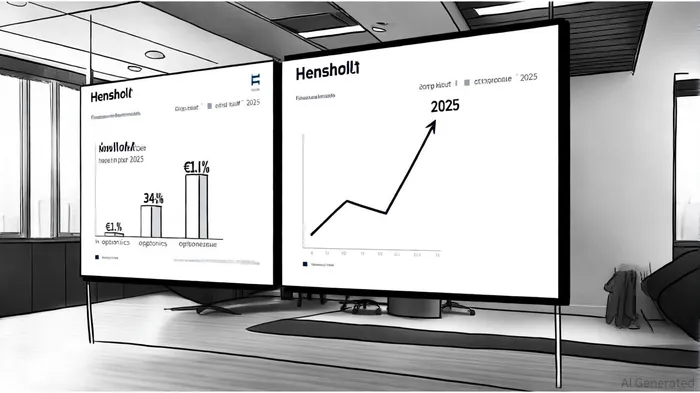
Hensoldt's performance in 2025 underscores the sector's transformation. The German defense electronics firm reported a record order intake of €701 million in Q1 2025, driven by contract extensions for Eurofighter Mk1 radars and new orders under the Eurofighter Halcon program[1]. By mid-2025, its order backlog had surged to €6,929 million—a 4.3% increase from year-end 2024—while H1 revenue reached €944 million, up 11% year-on-year[2]. The optronics segment, in particular, outperformed expectations with a 34% revenue increase, offsetting slower growth in the sensor segment[4].
This growth is not accidental but a direct response to structural shifts. As Reuters notes, Germany's removal of defense budget constraints has catalyzed demand for Hensoldt's advanced radar and sensor systems[4]. The company's CEO, Oliver Dörre, has emphasized that “political will is translating into concrete orders,” positioning Hensoldt as a key player in future German and EU defense programs[2].
Strategic Expansion: Fueling Long-Term Growth
Hensoldt's $1.2 billion (€1 billion) investment plan, announced in May 2025, is a calculated move to address capacity constraints and meet the surge in defense orders[3]. This expansion, spread over two years, targets industrial capacity upgrades, R&D in software-defined defense (SDD), and geographic diversification. The investment aligns with the company's 2030 revenue target of €6 billion—a 20% increase from its previous goal—reflecting confidence in the European defense market's structural growth[4].
The rationale for this expansion is clear. Hensoldt's order backlog now stands at €7,070 million, with a book-to-bill ratio of 1.2x in 2025[4]. This backlog, combined with a 50% revenue contribution from Germany, 30% from Europe, and 20% from global markets by 2030[2], signals a diversified and resilient business model. Strategic acquisitions, such as ESG GmbH, and partnerships like the one with Quantum Systems—a defense tech startup—further bolster Hensoldt's SDD capabilities, ensuring it remains competitive in a tech-driven sector[4].
Risks and Opportunities in a Fragmented Market
While Hensoldt's trajectory is promising, challenges persist. Goldman Sachs highlights structural issues in Europe's defense industrial base, including underinvestment, deindustrialization, and political fragmentation[1]. However, Hensoldt's flexible financing structure—restructured in April 2025—provides a buffer against these risks[1]. The company's focus on high-margin optronics and SDD also positions it to capitalize on next-generation defense technologies, which are expected to dominate spending in the 2030s[4].
For investors, the key question is whether Hensoldt can sustain its growth amid macroeconomic headwinds. Its 2025 revenue guidance of €2,500–2,600 million and 11% H1 sales growth suggest strong near-term momentum[2]. However, long-term success will depend on its ability to execute the $1.2 billion expansion efficiently and maintain its technological edge in a rapidly evolving sector.
Conclusion: A Strategic Bet on European Defense
Hensoldt's expansion reflects a broader trend: European defense firms are repositioning to meet unprecedented demand. With NATO's 5% GDP target and Germany's fiscal flexibility, the sector is primed for sustained growth. Hensoldt's combination of strong order intake, strategic investments, and geographic diversification makes it a compelling play for investors seeking exposure to this transformation. As the company's CEO notes, the “era of underinvestment is over”—a sentiment that encapsulates both the opportunity and urgency defining the European defense landscape[4].







Comentarios
Aún no hay comentarios