
European ADRs: Navigating Volatility and Unlocking Long-Term Value
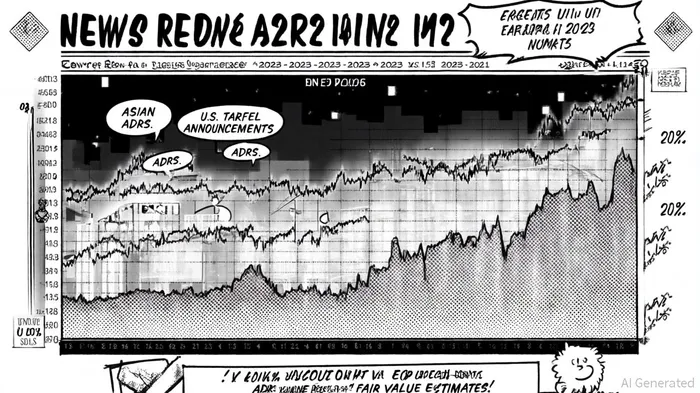
The recent volatility in European American Depositary Receipts (ADRs) has sparked renewed interest in their long-term investment potential. Amid trade uncertainties, macroeconomic shifts, and geopolitical tensions, European equities traded in U.S. markets have exhibited a complex interplay of risks and opportunities. This analysis evaluates their prospects by dissecting valuation metrics, cross-border performance dynamics, and structural catalysts shaping the landscape.
Valuation Attractiveness Amid Structural Tailwinds
European ADRs currently trade at a 5% discount to fair value estimates, a compelling entry point for investors seeking undervalued assets[1]. This discount is underpinned by macroeconomic fundamentals showing improvement, including a projected 1.1% EU GDP growth in 2025 and aggressive ECB rate cuts (deposit rate now at 2.15%)[5]. While U.S. markets remain in the 90th percentile of historical valuations (S&P 500 at ~22x forward P/E), European equities trade at ~14x, offering a more favorable risk-reward profile[3].
Structural tailwinds further bolster the case for European ADRs. The EU's strategic focus on sovereignty—evidenced by a €1.065 billion European Defence Fund and €3 billion in defense loans—has catalyzed growth in aerospace, technology, and healthcare sectors[5]. Companies like Rheinmetall, securing major contracts, exemplify this trend. Meanwhile, the absence of direct U.S. tariffs on European exports (unlike steel/aluminum sectors) has insulated broader indices from the worst of trade-related sell-offs[3].
Cross-Border Liquidity and Investor Sentiment Shifts
European ADRs face liquidity challenges compared to their home-market counterparts, with wider bid-ask spreads and lower trading volumes[7]. However, this gap is less pronounced for large-cap stocks, where Average Daily Value Traded (ADVT) in the U.S. is only 1.3x that of Europe[2]. This suggests European equities are more liquid relative to their size than commonly perceived.
Investor sentiment has shifted dramatically in 2025. European large-cap blend ETFs attracted EUR 14.4 billion in Q1 inflows, reversing a multi-quarter outflow trend[1]. This reflects waning confidence in U.S. policy direction and a search for diversification. By contrast, Asian and emerging market ADRs, while trading at lower valuations (MSCI Emerging Markets at 11.87 forward P/E), face higher geopolitical and inflation risks[4]. European ADRs strike a balance between defensive valuations and macroeconomic stability.
Navigating Volatility: Risks and Resilience
Recent volatility has been driven by U.S. tariff threats and geopolitical tensions. For instance, the April 2025 announcement of potential 50% tariffs on EU steel and aluminum triggered a sharp sell-off in Autos and Industrials sectors[6]. However, European markets have shown resilience, with the STOXX Europe 600 Index returning 24.4% in H1 2025 despite August's historical underperformance[8].
The ECB's empirical analysis highlights a strong correlation between economic policy uncertainty (EPU) and market volatility, particularly in Germany[6]. Yet, fiscal stimulus and defense spending have mitigated these risks, with earnings growth expected to outpace U.S. markets in 2026[1].
Long-Term Outlook: A Case for Strategic Allocation
While short-term risks persist—such as unresolved U.S.-EU trade disputes and political uncertainties in France—European ADRs present a compelling long-term case. Their valuation discount, coupled with structural reforms and sector-specific growth drivers, positions them to outperform in a diversified portfolio.
Conclusion
European ADRs offer a unique confluence of undervaluation, macroeconomic support, and sectoral resilience. While volatility remains a near-term challenge, the interplay of ECB easing, fiscal stimulus, and strategic EU investments creates a fertile ground for long-term gains. Investors willing to navigate short-term turbulence may find European ADRs an attractive counterbalance to overvalued U.S. markets.







Comentarios
Aún no hay comentarios