
Europe's Defense Renaissance: Why the Rheinmetall-Indra Alliance Signals a Strategic Pivot
The strategic partnership between Rheinmetall and Indra, formalized through a May 2025 Memorandum of Understanding (MoU), marks a watershed moment in Europe’s push for self-reliant defense capabilities. This allianceAENT-- is not merely a corporate merger but a blueprint for how intra-EU collaboration can modernize militaries, secure supply chains, and unlock value in defense technology stocks. For investors, the timing could not be better: with geopolitical tensions heightening demand for advanced systems and European governments racing to meet NATO’s 2% defense spending target, the Rheinmetall-Indra model is a harbinger of growth—and a compelling investment thesis.
The Strategic Imperative: Modernizing Spain’s Armed Forces
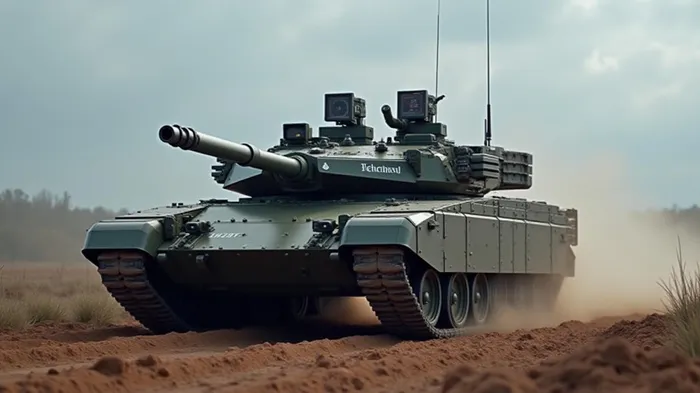
The alliance’s immediate focus—upgrading Spain’s Leopard 2E combat systems and armored vehicle fleets—underscores a broader European challenge: modernizing legacy equipment while ensuring interoperability. Rheinmetall, a pioneer in armored vehicle design (including the Keiler NG breaching system), brings cutting-edge engineering, while Indra, Spain’s defense tech backbone, provides local integration expertise. Together, they are redefining Spain’s military readiness: retrofitting Leopard 2E tanks with advanced C4I systems, enhancing the Lince Battle Management System (BMS), and expanding the MAESTRE Mission System for wheeled vehicles.
This collaboration is no accident. Spain’s defense budget has surged by 17% since 2020, driven by commitments to NATO’s 2% target and a need to replace outdated equipment. The MoU ensures that critical upgrades—like the Leopard 2E’s fire-control systems and digital battle management—are executed by trusted EU partners, reducing reliance on non-European suppliers.
Supply Chain Resilience: A Model for EU Autonomy
The alliance’s success hinges on its dual strength: Rheinmetall’s global engineering leadership and Indra’s deep local integration into Spain’s defense ecosystem. By co-producing systems like the Leopard 2E combat suite and BMS, they are creating a vertically integrated supply chain that insulates Europe from geopolitical disruptions. Consider the Keiler NG, Rheinmetall’s mine-clearing vehicle: its production in Spain via subsidiary REM S.A.U. ensures that critical capabilities are both designed and manufactured within the EU.
This model is replicable across the continent. As France, Germany, and Poland push for shared defense procurement frameworks, Rheinmetall-Indra’s partnership demonstrates how cross-border collaboration can balance innovation with local job creation. For investors, this bodes well for firms with strong intra-EU production footprints and dual-use technologies.
The C4I Boom: A Growth Catalyst for Defense Tech
The alliance’s focus on C4I systems—critical for modernizing command and control—positions it at the heart of a booming market. Hybrid warfare, cyber threats, and the need for real-time intelligence sharing have fueled global C4I spending, projected to hit $75 billion by 2028. Rheinmetall and Indra are already ahead of the curve: their work on the Leopard 2E’s upgraded C4I suite exemplifies how AI-driven analytics and networked systems are becoming standard in European arsenals.
Investment Implications: Why Defense Tech Stocks Are a Buy Now
The Rheinmetall-Indra partnership is a microcosm of a macro trend: Europe’s shift from fragmented defense spending to coordinated, technology-driven modernization. Investors should take note of three key drivers:
- Rising Demand for Local Integration: As EU countries prioritize domestic suppliers, firms like Indra (BME:INDR) and Rheinmetall (BO:RHG) stand to benefit from exclusive contracts and recurring maintenance revenue.
- C4I System Penetration: Companies with advanced digital capabilities—Indra’s thermal cameras and BMS, Rheinmetall’s vehicle systems—are poised to capture a larger share of defense budgets.
- Geopolitical Tailwinds: With Russia’s aggression and China’s military expansion fueling urgency, NATO members are accelerating modernization.
Conclusion: A Strategic Pivot for the Decade
The Rheinmetall-Indra alliance is more than a business deal—it’s a template for European defense autonomy. By combining German engineering with Spanish integration expertise, they are delivering systems that make NATO members stronger, supply chains more resilient, and defense tech firms more profitable. For investors, this is a call to action: allocate capital to companies at the vanguard of intra-EU collaboration and modernization. The next decade will belong to those who bet early on Europe’s defense renaissance.
Act now—before others catch up.







Comentarios
Aún no hay comentarios