
Euro Stoxx Index Momentum: A Strategic Buy-Point Amid Eurozone Economic Recovery?
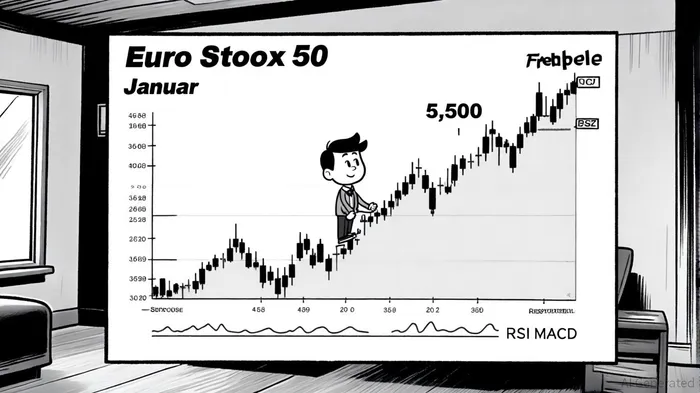
The Euro Stoxx 50, a bellwether for European equities, has emerged as a focal point for investors navigating the Eurozone's uneven recovery. With technical indicators and macroeconomic fundamentals aligning in a nuanced dance, the question of whether the index presents a strategic buy-point demands a granular analysis of both price action and broader economic forces.
Technical Analysis: Momentum and Structural Buy-Points
The Euro Stoxx 50's technical profile reveals a complex interplay of bullish and neutral signals. The Relative Strength Index (RSI) currently stands at 59.88, comfortably above the 50 midpoint, signaling a bullish bias[1]. Meanwhile, the Moving Average Convergence Divergence (MACD) at 20.28 underscores strengthening upward momentum[1]. The index's position above the middle Bollinger Band and within Keltner Channels further reinforces mid-term support, suggesting a healthy trend[1].
A critical development has been the breakout above the 5,100 resistance level, a long-term barrier that now acts as a dynamic support. This breakout has triggered Fibonacci extension targets of 5,800 (1.618) and 6,400 (2.0), assuming sustained momentum[4]. The 50-day and 200-day moving averages, at 5,373.20 and 5,233.93 respectively, also provide a structural foundation for further gains[2]. However, caution is warranted: the Average Directional Index (ADX) at 16.60 indicates a weak trend and a sideways market, with no clear dominance from buyers or sellers[1]. Traders must monitor overbought RSI levels and volume patterns to anticipate potential pullbacks[4].
Macroeconomic Catalysts: Growth, Inflation, and ECB Policy
The Eurozone's macroeconomic backdrop offers a mixed but cautiously optimistic outlook. GDP growth is projected at 0.9% for 2025, with a gradual acceleration to 1.1% in 2026 and 1.3% in 2027[3]. This recovery is underpinned by a resilient labor market, with unemployment steady at 6.2%, and robust employment growth in services, ICT, and healthcare sectors[3]. However, external headwinds—particularly U.S. tariffs on steel and aluminum—have dampened exports, especially in Germany and Italy[3]. Domestic demand, including consumer spending and infrastructure investment, is expected to mitigate these export-related declines[3].
Inflation, a perennial concern, is stabilizing around the European Central Bank's (ECB) 2% target. Headline inflation is projected to dip to 1.4% in early 2026 before returning to 2.0% by 2027, driven by lower energy prices and a stronger euro[3]. The ECB's June 2025 rate cut—reducing the deposit facility rate to 2.0%—was a pivotal moment[2]. While the immediate market reaction saw the Stoxx 600 rise 0.9%, subsequent volatility, including a 0.99% drop in the DAX on July 1, 2025, highlights the fragility of investor sentiment[4]. Analysts now price in a 45% chance of another rate cut by year-end, contingent on trade policy developments and inflation trajectories[4].
Correlation Between ECB Policy and Technical Signals
The ECB's dovish pivot has created a favorable environment for equities. Lower borrowing costs enhance corporate profitability and investor appetite for risk assets, which aligns with the Euro Stoxx 50's technical bullishness[3]. The index's post-rate-cut performance—initially surging 0.9%—reflects this dynamic[2]. However, the ECB's “meeting-by-meeting” approach to future policy, as emphasized by President Christine Lagarde, introduces uncertainty[2]. This ambiguity is evident in the index's mixed short-term performance, with the DAX's July 1 plunge underscoring vulnerability to trade tensions and geopolitical risks[4].
From a technical perspective, the ECB's easing cycle supports the index's long-term trajectory. A sustained close above 5,600 could validate the bullish case, with Fibonacci targets of 5,800 and 6,400 in sight[4]. Conversely, a breakdown below the 5,141 support level would signal renewed bearish pressure, necessitating a reassessment of risk-reward dynamics[1].
Risk Considerations and Strategic Outlook
While the technical and macroeconomic outlooks are broadly constructive, risks persist. Geopolitical tensions, energy price volatility, and U.S.-EU trade disputes could disrupt the Eurozone's recovery[3]. Additionally, the ECB's policy path remains data-dependent, with inflation and growth outcomes pivotal to future rate decisions[2].
For investors, a strategic buy-point emerges at the confluence of technical support levels (e.g., 5,141) and favorable macroeconomic conditions. Positioning should prioritize liquidity and risk management, with stop-loss orders below key support levels. The ECB's dovish bias and the Euro Stoxx 50's technical resilience suggest a medium-term bullish case, but patience is essential to navigate short-term volatility[4].
Conclusion
The Euro Stoxx 50 occupies a pivotal juncture, where technical momentum and macroeconomic catalysts converge to present a compelling, albeit cautious, investment opportunity. While the index's breakout above 5,500 and alignment with Fibonacci targets signal potential for further gains, the ECB's policy uncertainty and external risks necessitate a measured approach. For disciplined investors, the current environment offers a strategic entry point—provided they remain vigilant to evolving macroeconomic and geopolitical dynamics.







Comentarios
Aún no hay comentarios