
The Euro Stablecoin Gap: Why Europe's Digital Currency Ambitions Are Losing Ground to U.S. Dollar Dominance
The Regulatory Tightrope: MiCA vs. U.S. Flexibility
The EU's Markets in Crypto-Assets (MiCA) regulation, implemented in December 2024, was hailed as a landmark effort to create a harmonized crypto framework. However, its stringent requirements-such as mandating 1:1 reserve ratios for stablecoin issuers and imposing capital buffers of at least 2% of average reserves-have created a high barrier to entry according to analysis. These rules, while designed to protect consumers and ensure financial stability, have inadvertently stifled innovation. For instance, TetherUSDT-- Ltd. recently discontinued support for its euro-pegged stablecoin EURT in the EU, citing regulatory complexity as reported.
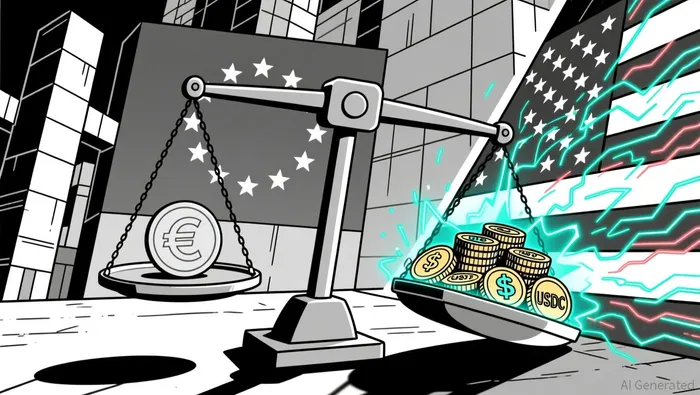
In contrast, the U.S. regulatory landscape, though historically fragmented, has shown signs of clarity. The passage of the GENIUS Act in 2025, which provides a federal framework for stablecoin oversight, has given U.S. issuers a competitive edge according to experts. This regulatory clarity has enabled U.S. stablecoins to consolidate their dominance, with USDT and USDC capturing $45 billion in net inflows during Q3 2025. The U.S. approach prioritizes market growth over preemptive restrictions, allowing innovators to scale rapidly while regulators adapt-a stark contrast to Europe's precautionary stance.
Market Dynamics: Network Effects and Institutional Resistance
The euro's underrepresentation in stablecoins is not just a regulatory issue-it's a market one. U.S. dollar-backed stablecoins benefit from entrenched network effects. USDT and USDC are deeply integrated into global DeFi protocols, cross-border payment systems, and institutional portfolios. For example, USDC's partnership with Coinbase and its adoption by major banks like JPMorgan have cemented its role as a digital dollar equivalent.
Europe's attempts to counter this dominance are hampered by institutional resistance. The European Central Bank (ECB) has long been skeptical of privately issued stablecoins, with President Christine Lagarde advocating for a state-controlled digital euro instead. This tension between private innovation and public control has left the EU in a regulatory limbo. While a consortium of nine European banks plans to launch a euro-backed stablecoin by mid-2026, the project faces an uphill battle against the entrenched dominance of U.S. alternatives.
The Road Ahead: Can Europe Catch Up?
The euro's stablecoin gap is unlikely to close soon. The EU's regulatory framework, while robust, lacks the agility to compete with the U.S.'s more flexible approach. Moreover, the ECB's Digital Euro project-expected to launch by 2028–2029-may further divert resources and attention from private-sector initiatives. This creates a paradox: Europe's desire to maintain financial sovereignty through a CBDC could undermine its ability to foster a competitive stablecoin ecosystem.
For investors, the implications are clear. U.S. dollar-backed stablecoins will remain the dominant force in global digital finance, supported by both regulatory clarity and market infrastructure. Euro-backed alternatives, meanwhile, are constrained by regulatory overreach and institutional hesitancy. While the EU's MiCA framework may eventually evolve to accommodate innovation, the window for Europe to close the gap is narrowing.
Conclusion
The euro stablecoin gap is a cautionary tale of regulatory overreach and missed opportunities. While the EU's MiCA regulation has set a global standard for crypto oversight, its rigidity has stifled the very innovation it aimed to protect. In contrast, the U.S. has leveraged regulatory clarity and market dynamics to solidify the dollar's dominance in the digital age. For Europe to reclaim its financial influence, it must reconcile its regulatory ambitions with the realities of a rapidly evolving market-one that rewards speed, flexibility, and scale.





Comentarios
Aún no hay comentarios