
EURAU Stablecoin and Chainlink CCIP: A New Paradigm in Institutional-Backed Cross-Chain Liquidity
The EURAU-CCIP Synergy: Building a Euro-Denominated Interoperability Layer
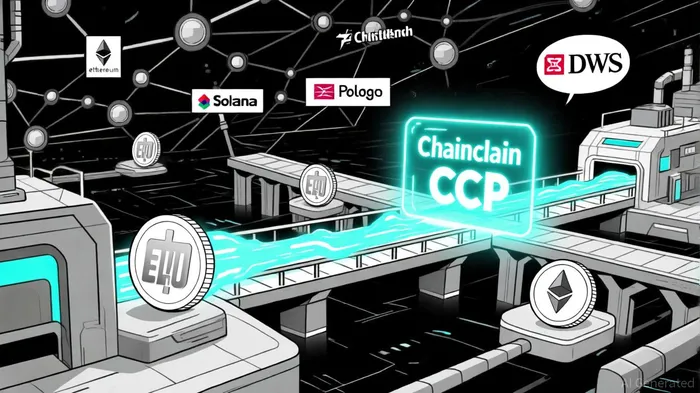
EURAU, fully backed by euro reserves and compliant with the EU's Markets in Crypto-Assets (MiCA) regulation, is expanding its footprint across EthereumETH--, ArbitrumARB--, Base, Optimism, Polygon, and SolanaSOL-- via ChainlinkLINK-- CCIP, according to Coinotag. This partnership eliminates the need for wrapped tokens or centralized bridges, which have historically introduced security risks and slippage. Instead, CCIP enables EURAU to maintain 1:1 parity with the euro while facilitating seamless cross-chain transfers, a critical feature for institutional use cases like B2B settlements and treasury management, as reported by Cryptotimes.
Chainlink's CCIP acts as a trustless middleware, ensuring that EURAU's value remains consistent across disparate networks. For example, a European multinational corporation can settle payments on Ethereum while its counterpart accesses liquidity on Solana, all without intermediaries or conversion losses. This capability aligns with the growing demand for interoperable financial infrastructure, particularly in regions like Europe, where regulatory frameworks are maturing to support tokenized assets, according to Markets.com.
Market Dynamics: From Niche to Mainstream
The institutional-grade stablecoin market is poised for explosive growth. By Q3 2025, tokenized real-world assets (RWAs) had surpassed $30 billion in value, with private credit and U.S. Treasuries dominating the landscape, according to an Investax report. However, euro-backed stablecoins remain underrepresented, accounting for just $500 million of the $307 billion total stablecoin market, as noted by Brave New Coin. This gap highlights a significant opportunity for EURAU, which is uniquely positioned to capitalize on Europe's push for monetary sovereignty and digital euro adoption.
Wirex, a UK-based fintech, forecasts that Europe's stablecoin market could reach €1 trillion by the end of the decade, driven by MiCA's regulatory tailwinds, according to the Wirex whitepaper. The EU's MiCA framework, effective since December 2024, mandates transparency and reserve audits for stablecoins, creating a fertile ground for EURAU's growth. Deutsche Bank and DWS's involvement further bolsters credibility, as these institutions bring decades of treasury management expertise to the table, per Cointelegraph.
Competitive Landscape: EURAU vs. Global Peers
While EURAU focuses on Europe, other projects are targeting regional markets. Western Union's USDPT stablecoin, launching on Solana in 2026, aims to leverage the platform's high-speed infrastructure for cross-border payments, according to Coinotag on Western Union. Similarly, South Korea's KRWQ stablecoin, built on Coinbase's Base network, addresses the dominance of USD-pegged assets in Asia, as reported in Coinotag on KRWQ. These initiatives underscore a global trend: institutions are prioritizing localized stablecoins to meet regulatory and market-specific demands.
However, EURAU's edge lies in its institutional-grade security and MiCA compliance. Unlike many stablecoins that rely on opaque reserve structures, EURAU's 1:1 euro backing is auditable and transparent, a critical factor for risk-averse investors. Additionally, its adoption of the Cross-Chain TokenAUCTION-- (CCT) standard ensures compatibility with future blockchain innovations, including the Canton Network, as Coinotag reported.
Investment Thesis: A $1 Trillion Opportunity
The institutional-grade cross-chain stablecoin market is projected to grow at a 10-15x multiple over the next decade, with EURAU and similar projects leading the charge. By 2030, the European stablecoin market alone could surpass €1 trillion, driven by tokenized treasuries, corporate settlements, and RWA integration, according to the Wirex whitepaper. For investors, this represents a dual opportunity:
1. Direct Exposure: Early adoption of EURAU or CCIP-based infrastructure projects.
2. Indirect Exposure: Investing in institutional-grade blockchain platforms (e.g., Chainlink, Solana) that enable cross-chain liquidity.
The key risks include regulatory shifts and competition from USD-pegged stablecoins. However, EURAU's alignment with MiCA and its institutional backing mitigate these concerns, making it a resilient play in a rapidly evolving sector.
Conclusion
EURAU and Chainlink CCIP are not just solving a technical problem-they are building the rails for a new era of institutional-grade, cross-chain finance. As Europe's tokenized asset market matures, EURAU's role as a secure, interoperable euro-pegged stablecoin will become increasingly indispensable. For investors, this represents a rare confluence of regulatory tailwinds, institutional credibility, and technological innovation-a recipe for long-term value creation in the digital asset space.





Comentarios
Aún no hay comentarios