
EU-US Trade Policy Uncertainty and Its Impact on Transatlantic Market Volatility and Risk Premiums
The EU-US trade relationship has long been a cornerstone of global economic stability, yet recent policy shifts and escalating tariffs have introduced unprecedented uncertainty. As of September 2025, this uncertainty is reshaping risk premiums and volatility dynamics in transatlantic equities and commodities. Investors must now navigate a landscape where trade policy acts as both a catalyst for market instability and a determinant of asset pricing.
Policy Uncertainty and Its Macroeconomic Consequences
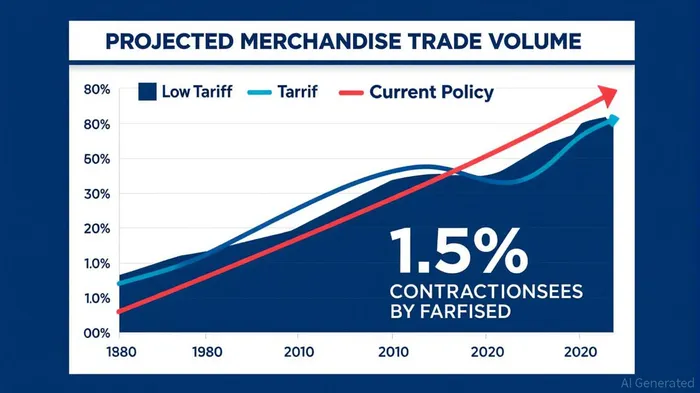
The European Central Bank (ECB) has explicitly linked trade policy uncertainty to weaker euro area growth. In its March 2025 projections, the ECB noted that unresolved disputes with the US—particularly over potential reciprocal tariffs—have depressed exports and investment, contributing to a projected 0.9% GDP growth for the year[1]. This aligns with broader global trends: the World Trade Organization (WTO) reported in April 2025 that world merchandise trade is expected to contract by 0.2% in 2025 under current conditions, nearly three percentage points below a "low tariff" baseline[3]. A temporary pause on US reciprocal tariffs has mitigated some of this contraction, but the underlying uncertainty remains a drag on global trade flows[3].
Volatility in Equities and Commodities
The ripple effects of trade policy uncertainty are evident in financial markets. For equities, the ECB's March 2025 Economic Bulletin highlighted that transatlantic investors are demanding higher risk premiums to compensate for the volatility generated by tariff-related disruptions[4]. This aligns with a 2023 study in Journal of Risk Financial Management, which found that volatility anomalies in stock markets are most pronounced over medium to long-term horizons—suggesting that structural policy shifts, such as those in EU-US trade relations, amplify market instability[1].
Commodities, particularly in agriculture and textiles, face similar pressures. The United Nations Conference on Trade and Development (UNCTAD) noted in March 2025 that high import duties in these sectors—often exceeding 30%—have exacerbated price swings and supply chain fragility[2]. For example, EU-US disputes over agricultural tariffs have led to divergent pricing signals for soybeans and wheat, creating arbitrage opportunities but also increasing hedging costs for producers[2].
Strategic Implications for Investors
The interplay between trade policy and market volatility demands a recalibration of investment strategies. Diversification across sectors less exposed to transatlantic tariffs—such as technology or services—may offer a buffer against equity market swings. For commodities, the use of futures contracts and options to hedge against price volatility is becoming increasingly critical.
Conclusion
EU-US trade policy shifts are no longer abstract geopolitical concerns—they are concrete drivers of market behavior. As the ECB and WTO underscore, the path of least resistance for investors lies in acknowledging policy uncertainty as a persistent headwind and structuring portfolios to withstand its effects. The coming months will test whether diplomatic efforts to stabilize transatlantic relations can outpace the market's demand for risk-adjusted returns.







Comentarios
Aún no hay comentarios