
EU Regulatory Shifts and Small EVs: Navigating the Path to Compliance for Renault and Stellantis
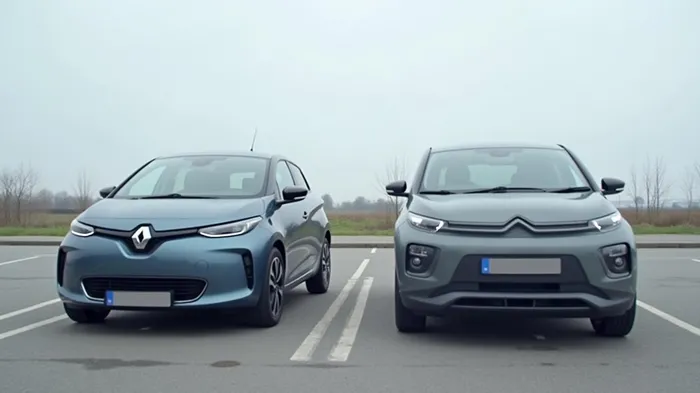
The European Union’s recent relaxation of 2025 emissions targets has reignited debates about the balance between climate goals and automotive industry realities. At the heart of this tension are Renault and StellantisSTLA--, two automakers aggressively advocating for regulatory flexibility while racing to dominate the small electric vehicle (EV) market. Their strategies—centered on affordable models like the Renault 5 and Citroën e-C3—highlight both the opportunities and risks of Europe’s evolving regulatory landscape.
Regulatory Flexibility and Industry Strategy
In March 2025, the EU allowed automakers to “pool” 2025 emissions targets with those of 2027, easing immediate compliance pressure. Renault and Stellantis executives seized this as a win, arguing that stringent rules risked stifling innovation for small, budget-friendly EVs critical to mass adoption. Yet both companies have already invested heavily in such models. The Renault 5, for instance, became France’s top-selling BEV in March 2025, with 3,340 units sold—a testament to demand for compact, low-cost alternatives. Stellantis, meanwhile, has rolled out the Citroën e-C3 and Fiat Grande Panda, priced as low as €19,990, to target similar markets.
This strategy aligns with a broader industry shift: small EVs now account for over 30% of BEV sales in Europe, driven by consumers seeking practicality and affordability. However, the regulatory relaxation may slow the pace of BEV adoption. While the EU’s original 2025 target for BEV market share was 20–22%, current adoption rates hover at 19%—a narrow margin that could shrink without stricter rules.
Investors have yet to fully price in these dynamics. Renault’s (RNO) stock has risen 12% year-to-date, buoyed by strong Renault 5 sales and its alliance with Nissan and Mitsubishi. Stellantis (STLA), however, has seen a 5% decline amid concerns about its reliance on hybrids—33% of its CO₂ reductions in 2025 come from mild and full hybrids, which critics argue are transitional technologies at best.
The Compliance Playbook
Both companies are leveraging regulatory flexibilities to meet targets. Renault aims for a 17% BEV market share in 2025 through its alliance with Nissan and Mitsubishi, while Stellantis plans to pool emissions data with partners like Tesla. Mild hybrids (MHEVs) also play a role: Stellantis’s Opel Corsa and Citroën C3 MHEVs contribute to compliance while maintaining ICE-derived profits.
Yet Transport & Environment (T&E) warns that without stricter rules, the EU risks falling behind Chinese competitors like BYD and Leapmotor, which dominate the global small-EV market. Stellantis’s joint venture with Leapmotor—producing the T03 in Europe—suggests it recognizes this threat. Still, T&E estimates that even with relaxed rules, all automakers can meet 2025 targets through a mix of BEVs (60% of reductions), hybrids (20%), and regulatory tools (12%).
Market Dynamics and Risks
The EU’s “ReArm Europe” plan, which prioritizes defense spending over climate initiatives, complicates the picture. Diverting €800 billion from climate to military goals could delay EV infrastructure and subsidies, undermining automakers’ efforts. National policies will be critical: France’s BEV market share rose to 19% in March 2025, but without stable incentives, consumers may delay purchases.
Meanwhile, the decline of ICE vehicles continues. Petrol-only cars fell to 21.4% of France’s market in March, while diesel dropped to 4.2%. This shift favors EV-focused companies but also exposes automakers like Stellantis, which still derives profits from ICE vehicles, to long-term structural risks.
Conclusion: A Delicate Balancing Act
Renault and Stellantis are navigating a complex landscape where regulatory flexibility offers short-term relief but long-term uncertainty. Their focus on affordable small EVs—backed by strong sales data (Renault 5’s top-three BEV ranking for over a year) and strategic partnerships—positions them to capitalize on consumer demand. However, the EU’s delayed climate ambitions and rising competition from Asia introduce risks.
Investors should monitor two key metrics: the EU’s 2027 emissions target (now decoupled from 2025 rules) and national subsidy policies. If BEV adoption accelerates beyond 22% by 2027, as T&E projects, Stellantis and Renault could outperform—especially if their small EV pipelines (e.g., Renault’s R4 and Dacia Spring updates) meet demand. Conversely, if subsidies dwindle or Chinese rivals undercut pricing, their stocks could lag. For now, the data suggests cautious optimism: Renault’s BEV strategy is paying off, while Stellantis’s hybrid reliance highlights its dual dependence on regulatory leniency and market innovation. The path forward remains narrow, but for investors willing to bet on Europe’s transition, these automakers offer a front-row seat.





Comentarios
Aún no hay comentarios