
EU Regulatory Expansion and Ethereum: Navigating Risks and Opportunities in a Fragmented Crypto Landscape
The European Union's Markets in Crypto-Assets Regulation (MiCA), which became fully enforceable on December 30, 2024, has reshaped the regulatory landscape for EthereumETH-- and other cryptoassets. By categorizing Ethereum as a utility token under the “other crypto-assets” framework, MiCA imposes stringent compliance requirements on service providers, including licensing, transparency, and anti-money laundering (AML) protocols[1]. This regulatory shift has created both structural risks and strategic opportunities for Ethereum-related firms, particularly as the EU's approach contrasts sharply with the U.S. regulatory environment under the GENIUS Act[2].
Regulatory Divergence: MiCA vs. the GENIUS Act
The EU's MiCA framework mandates a unified, prescriptive approach across 27 member states, requiring Ethereum firms to submit detailed whitepapers, segregate client assets, and maintain 100% reserve backing for stablecoins[3]. In contrast, the U.S. GENIUS Act, enacted in July 2025, prioritizes innovation and regulatory clarity, with a focus on stablecoin oversight and consumer protection[4]. This divergence has led to a bifurcated market: while MiCA's passporting rights allow compliant firms to operate seamlessly across the EU, the U.S. model's flexibility may attract Ethereum startups seeking less restrictive environments[5].
For example, CoinbaseCOIN-- and Kraken have delisted TetherUSDT-- (USDT) in the EU due to MiCA non-compliance, while USD Coin (USDC) secured an e-money license, highlighting the regulatory hurdles for stablecoins under the new regime[6]. Meanwhile, U.S. firms benefit from the GENIUS Act's emphasis on fostering innovation, potentially accelerating Ethereum's adoption in decentralized finance (DeFi) and institutional-grade applications[7].
Financial Performance and Institutional Adoption
Post-MiCA compliance, Ethereum's financial metrics reflect a mix of resilience and vulnerability. Institutional adoption has surged, with Ethereum-linked ETFs and stocks outperforming BitcoinBTC-- in 2025, driven by inflows from firms like BlackRockBLK-- and Fidelity[8]. Ethereum's price rose 75% in 90 days by Q3 2025, supported by a 39% increase in staking participation and $90 billion in staked ETH[9]. However, revenue from transaction fees has declined by 95% compared to 2021 highs, attributed to Layer 2 scaling solutions and reduced NFT activity[10].
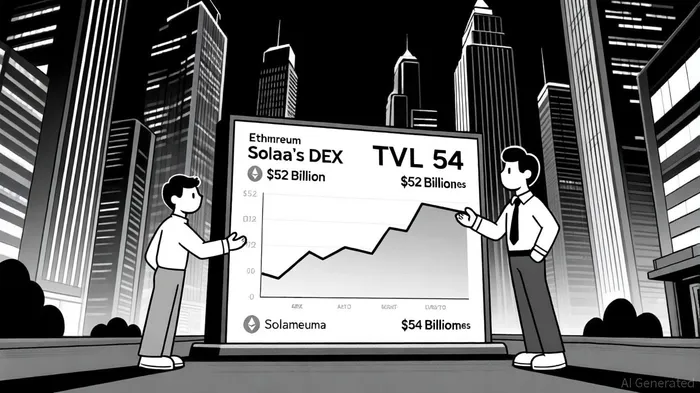
Staking yields remain a key draw, averaging 5.2% APY in 2025, though analysts caution against over-reliance on this income stream[11]. Meanwhile, Ethereum's dominance in DeFi is under threat: Solana's decentralized exchanges (DEXs) outperformed Ethereum's in Q3 2025, with Solana's DEX volume reaching $54 billion versus Ethereum's $52 billion[12]. Solana's TVL surged to $12.2 billion in September 2025, a 165% year-over-year increase, while Ethereum's TVL stabilized at $47 billion[13].
Investment Risks: Regulatory Uncertainty and Competitive Pressures
Ethereum faces significant risks from regulatory arbitrage and technological competition. The EU's MiCA framework has increased compliance costs for smaller firms, with operational complexity and cybersecurity requirements raising barriers to entry[14]. In the U.S., the legal status of staking remains unresolved, creating uncertainty for Ethereum validators and institutional investors[15].
Security vulnerabilities further compound risks. The Bybit bridge hack in 2025, which exploited cross-chain infrastructure, underscored the fragility of Ethereum's ecosystem[16]. Additionally, macroeconomic factors like U.S. Treasury yields have historically correlated with Ethereum's price, with a 1% yield increase linked to a 28% drop in ETH value[17].
Opportunities: Innovation and Institutional Infrastructure
Despite these challenges, Ethereum's ecosystem offers long-term opportunities. The Pectra hard fork and Layer 2 solutions like Base are enhancing scalability, potentially driving daily active addresses and justifying higher valuations[18]. Institutional infrastructure, including Coinbase's Bitcoin-backed USDCUSDC-- loans and Kraken's security-focused compliance, is positioning Ethereum as a cornerstone of tokenized finance[19].
Moreover, MiCA's harmonized standards have reduced cross-border friction, enabling Ethereum firms to access a unified EU market. For instance, the 44% rise in institutional staking participation in 2025 demonstrates growing trust in regulated environments[20].
Conclusion: A Calculated Approach to Ethereum Investment
The post-MiCA landscape demands a nuanced investment strategy. While Ethereum's institutional adoption and technological upgrades present compelling opportunities, investors must weigh risks from regulatory fragmentation, Solana's competitive gains, and macroeconomic volatility. For Ethereum to retain its leadership in smart contract platforms, continued innovation in Layer 2 and DeFi, alongside proactive compliance with evolving regulations, will be critical.





Comentarios
Aún no hay comentarios