
EU's Green Classification of Nuclear and Gas as a Catalyst for Energy Transition Investing
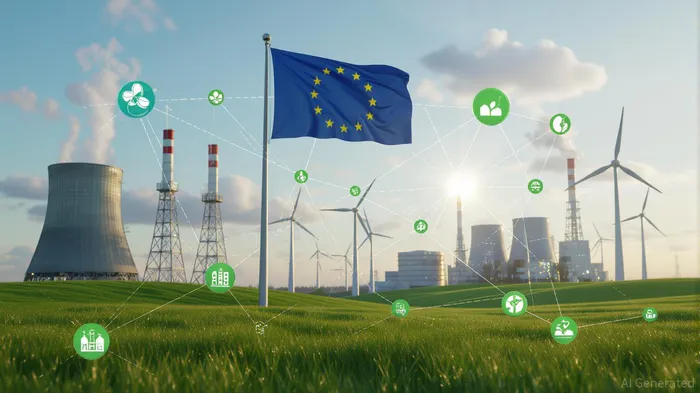
The European Union's recent regulatory updates classifying nuclear and gas energy as environmentally sustainable under the EU Taxonomy for Sustainable Activities have sparked significant debate and investment activity. These changes, formalized through the Climate Delegated Act, position nuclear and gas as transitional tools for achieving climate neutrality while addressing energy security concerns[1]. This classification not only reshapes the EU's energy landscape but also redefines capital allocation dynamics in clean energy infrastructure.
Regulatory Framework: Balancing Climate Goals and Energy Security
The EU Taxonomy now allows nuclear and gas projects to qualify as “green” if they meet stringent criteria. For gas, eligibility hinges on avoiding “significant environmental harm” and contributing to climate objectives, such as replacing coal-fired plants[2]. Nuclear energy must similarly avoid harm to water resources and ecosystems, with a focus on extending the lifespans of existing reactors and advancing small modular reactors (SMRs)[3]. These rules align with the EU's six environmental objectives, particularly climate change mitigation and adaptation, while acknowledging the absence of scalable low-carbon alternatives in the short term[1].
The 10% materiality exemption and simplified reporting templates further ease compliance burdens for companies, encouraging broader participation in green finance[4]. However, critics argue that the inclusion of gas risks diverting capital from renewables, while nuclear's long lead times and waste management861140-- challenges remain unresolved.
Financial Mechanisms: Green Bonds, Subsidies, and Private Capital
The regulatory shift has unlocked new avenues for financing. Green bonds, a cornerstone of EU green finance, are now explicitly channeling funds toward nuclear and gas projects. The European Central Bank (ECB) emphasizes that structural reforms and streamlined regulations are critical to attracting private investment, which currently accounts for a significant share of the €1.2 trillion annual green investment needed by 2030[5].
Subsidies and public-private partnerships are also de-risking investments in low-carbon technologies. For instance, the EU's REPowerEU Plan has redirected funding toward extending nuclear plant lifetimes and developing SMRs, which promise lower costs and faster deployment[6]. Meanwhile, private equity and venture capital are surging in climate-tech, with global energy transition investments hitting $2.1 trillion in 2024, per BloombergNEF[7].
Investment Trends and Capital Flows
The International Energy Agency (IEA) reports a 50% increase in global nuclear investment over the past five years, driven by SMR innovation and regulatory clarity[8]. In the EU, nuclear's 24% share of electricity generation underscores its strategic role, particularly as Russia's gas exports decline[9]. The ECB estimates that transport and energy sectors will require €754 billion annually for decarbonization, with green bonds offering both emission reductions and economic spillovers like GDP growth[10].
However, the 52 billion cubic meters of Russian gas still imported in 2024 highlight lingering dependencies[9]. This reality has spurred hybrid strategies: gas is seen as a bridge to renewables, while nuclear provides baseload power during the transition.
Implications for Investors and Policymakers
For investors, the EU's taxonomy creates a dual opportunity: leveraging green-labeled gas and nuclear projects for returns while aligning with climate mandates. Yet, risks persist, including regulatory reversals and public opposition to nuclear energy. Policymakers must balance short-term energy security with long-term decarbonization, ensuring that transitional investments do not lock in high-emission infrastructure.
The ECB's call for removing administrative barriers[5] and the EU's focus on SMRs[6] signal a commitment to innovation. However, the success of this transition hinges on maintaining transparency in green finance and avoiding greenwashing.
Conclusion
The EU's green classification of nuclear and gas represents a pragmatic, if contentious, step toward a climate-neutral future. By integrating these energy sources into its taxonomy, the bloc is not only addressing immediate energy security needs but also redirecting capital flows toward technologies that can bridge the gap to renewables. For investors, the challenge lies in navigating regulatory nuances and aligning portfolios with both environmental and financial objectives. As the EU's energy transition unfolds, the interplay between policy, capital, and innovation will determine whether this classification catalyzes a sustainable transformation—or merely delays it.







Comentarios
Aún no hay comentarios