
EU Crypto Sanctions and Their Impact on Digital Asset Markets
The European Union's 2025 regulatory and sanctions framework has become a defining force in shaping the future of digital assetDAAQ-- markets. As the EU tightens its grip on crypto compliance and cross-border transactions, investors must navigate a landscape where regulatory risk and innovation collide. From the Markets in Crypto-Assets (MiCA) regulation to targeted sanctions against Russia, the EU's approach is not just reshaping DeFi and stablecoin ecosystems but also setting a global precedent for how governments balance financial stability with technological disruption.
MiCA: A Double-Edged Sword for DeFi
The EU's MiCA regulation, which came into full effect on December 30, 2024, has redefined the compliance landscape for crypto-asset service providers (CASPs). By requiring EU-wide licenses and stringent AML/KYC protocols, MiCA has forced over 80% of European crypto exchanges to overhaul their compliance frameworks[3]. For DeFi platforms, the regulation creates a critical distinction: fully decentralized platforms without identifiable control structures remain outside MiCA's scope, while those with centralized governance, admin keys, or front-end interfaces now face licensing obligations[5].
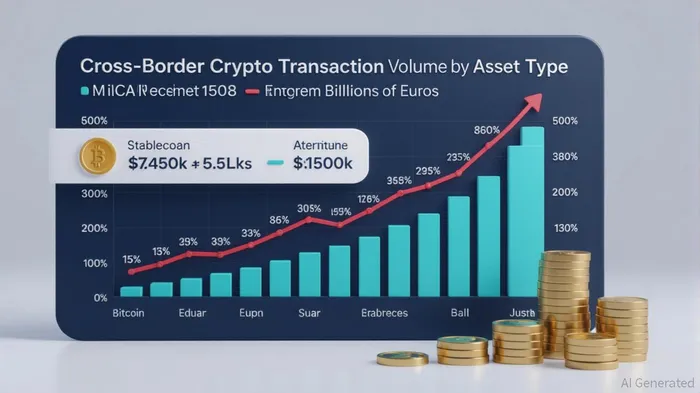
This dichotomy presents both risks and opportunities. On one hand, DeFi platforms with centralized elements must now allocate significant resources to compliance, potentially stifling innovation. On the other, the regulation has inadvertently accelerated the adoption of stablecoins—now accounting for 40% of cross-border crypto payments in Europe—by mandating their use in large-scale transactions under MiCA's reserve and transparency rules[3]. For investors, this signals a shift toward regulated stablecoins as a bridge between DeFi's flexibility and traditional finance's compliance demands.
Sanctions and the Shadow War on Crypto
Parallel to MiCA, the EU's sanctions packages have directly targeted crypto's role in circumventing financial controls. The 16th sanctions package, announced on February 24, 2025, expanded oversight of digital asset services and cracked down on entities supporting Russia's “shadow fleet” of crypto intermediaries[1]. This was followed by the 18th package in July 2025, which designated two Chinese banks for facilitating sanctions evasion and expanded transaction bans to include Russian and Belarusian crypto-asset providers[2].
The upcoming 19th package, expected to target Russian crypto assets, banks, and energy sectors, underscores the EU's intent to disrupt Russia's war economy[3]. These measures are not just geopolitical tools but also test cases for enforcing compliance in decentralized systems. For instance, the EU's “anti-circumvention tool” aims to block the diversion of machinery to Russia, even from non-EU countries like Kazakhstan[6]. However, challenges persist: privacy-centric cryptocurrencies and fully decentralized platforms remain difficult to monitor, creating regulatory blind spots[1].
Regulatory Risk vs. Global Opportunity
The EU's approach is already influencing global regulatory trends. Singapore and Hong Kong, for example, are aligning their policies with MiCA to ensure cross-border interoperability[4]. This creates a paradox: while MiCA's strict requirements may deter smaller DeFi projects, they also incentivize innovation in compliant, institutional-grade DeFi solutions.
Investors should also consider the long-term implications of MiCA's harmonization. By standardizing AML/KYC protocols across the EU, the regulation reduces fragmentation, making cross-border transactions more predictable. For stablecoin issuers, this means access to a unified market of 450 million users—a significant tailwind for projects like the EU's own digital euro.
The Road Ahead: Innovation Under Scrutiny
The EU's regulatory and sanctions strategies highlight a broader tension: how to harness crypto's potential without enabling illicit activity. For DeFi, the path forward will likely involve hybrid models that blend decentralization with selective compliance. Projects that can demonstrate transparency—such as on-chain governance with auditable smart contracts—may thrive, while those relying on anonymity could face existential risks.
Investors must also weigh the geopolitical dimension. As the EU's 19th sanctions package targets Russian crypto assets, the global market may see increased volatility in assets linked to sanctioned jurisdictions. Conversely, regions like Southeast Asia, which are adapting MiCA-like frameworks, could become safe havens for compliant DeFi innovation.
Conclusion
The EU's 2025 regulatory and sanctions landscape is a microcosm of the broader crypto-asset market's evolution. While MiCA and sanctions packages introduce friction for DeFi and cross-border transactions, they also create opportunities for regulated, institutional-grade solutions. For investors, the key is to differentiate between short-term compliance costs and long-term structural shifts. In a world where crypto is increasingly entangled with global politics, the ability to navigate regulatory complexity may be the ultimate competitive advantage.







Comentarios
Aún no hay comentarios