
EU's Crypto Regulation Overhaul: Implications for Global Fintech and Blockchain Investments
Key Provisions of MiCA: Compliance as a Competitive Barrier
MiCA mandates that CASPs and token issuers register with a National Competent Authority (NCA), maintain minimum capital reserves, and implement robust governance systems, as described in the Innreg guide. Notably, the framework enforces mandatory white paper disclosures for token issuers, ensuring transparency for investors, and extends anti-money laundering (AML) obligations to include the Crypto Travel Rule, which requires CASPs to collect and transmit sender and recipient identities for every transaction, according to Sumsub analysis. Stablecoin issuers face additional scrutiny, with reserve and liquidity requirements ensuring full backing by high-quality assets, a point the Innreg guide highlights.
These provisions, while increasing operational costs, also create a barrier to entry for unregulated players. For instance, Circle's compliance with MiCA-achieved through its registration as an Electronic Money Institution (EMI) in France-has enabled USD Coin (USDC) to capture significant market share in Europe, outpacing non-compliant alternatives like TetherUSDT-- (USDT), as detailed in the Innreg guide. This underscores how regulatory alignment can become a differentiator in a fragmented market.
Strategic Positioning: Passporting and Cross-Border Scalability
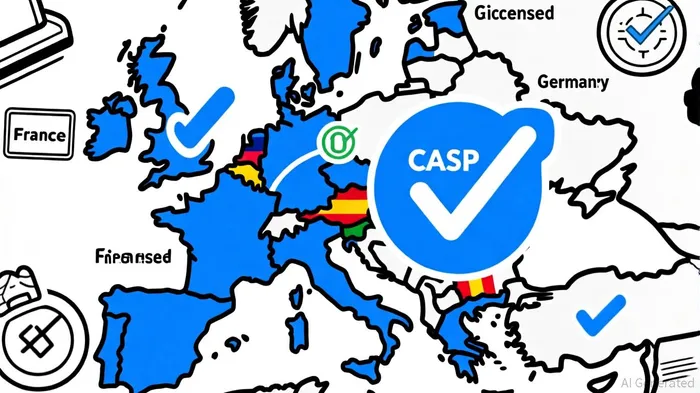
One of MiCA's most transformative features is the "passporting" system, which allows licensed entities to operate across all EU member states without redundant licensing, as the Innreg guide explains. This mechanism reduces compliance costs and accelerates market access, enabling fintech and blockchain firms to scale rapidly. For example, regulated exchanges like Bitpanda and OKX have leveraged passporting to expand their services across the EU single market, while startups in custody solutions and euro-backed stablecoins have attracted institutional investors by demonstrating adherence to MiCA's transparency and security standards, a trend noted in Sumsub analysis.
The strategic value of passporting is evident in Germany's FinmadiG law, which streamlined MiCA implementation for local firms, and Malta's proactive enforcement approach, which has positioned the country as a hub for compliant crypto innovation, according to the FintechArbor overview. Investors should prioritize firms that have secured early regulatory approvals in these jurisdictions, as they are likely to dominate cross-border operations in the coming years.
Innovation Within Compliance: Case Studies in Early-Mover Advantage
MiCA's emphasis on investor protection and operational resilience has spurred innovation in compliant solutions. Startups issuing Asset-Referenced Tokens (ARTs) or E-Money Tokens (EMTs) are now required to maintain transparent reserve ratios, a requirement that has driven the rise of regulated stablecoin providers like CircleCRCL--, as the Innreg guide observes. Similarly, custody startups are offering institutional-grade storage solutions that align with MiCA's AML and market abuse controls, addressing a critical pain point for institutional investors, as illustrated in a ScienceDirect study.
A compelling example is the growth of MiCA-compliant wallets, with over 30 million units created and €500 billion in assets under custody as of 2025, a surge documented in Sumsub analysis. This surge reflects how firms are embedding compliance into product design, creating a flywheel effect where regulatory adherence attracts both retail and institutional demand.
Challenges and Opportunities: Navigating the New Normal
While MiCA fosters innovation, it also poses challenges for smaller firms and decentralized platforms, which may struggle with compliance costs, a dynamic explored in the FintechArbor overview. However, these challenges create opportunities for larger players to consolidate market share. For instance, decentralized finance (DeFi) and non-fungible token (NFT) platforms-currently excluded from MiCA's scope-face an uncertain regulatory future, but early adopters of hybrid models (e.g., DeFi platforms with centralized compliance layers) could bridge this gap, according to an O2K analysis.
Investors should also monitor the EU's enforcement of the Crypto Travel Rule, as compliance with this provision could redefine transactional transparency in the crypto space. Firms that integrate identity verification and transaction tracking tools early-such as Sumsub's AML solutions-are likely to gain a first-mover advantage, per observations in Sumsub analysis.
Future Outlook: A Regulated Ecosystem for Sustainable Growth
By 2025, MiCA's full implementation is expected to enhance investor confidence, reduce market instability, and foster long-term innovation, a conclusion supported by the ScienceDirect study. For global fintech and blockchain firms, the EU's regulatory framework serves as a blueprint for compliance-driven growth. Startups that align with MiCA's principles-transparency, security, and cross-border scalability-are poised to lead the next phase of crypto adoption.





Comentarios
Aún no hay comentarios