
The EU Combustion Engine Ban and Its Implications for the Future of European Automotive and Energy Sectors
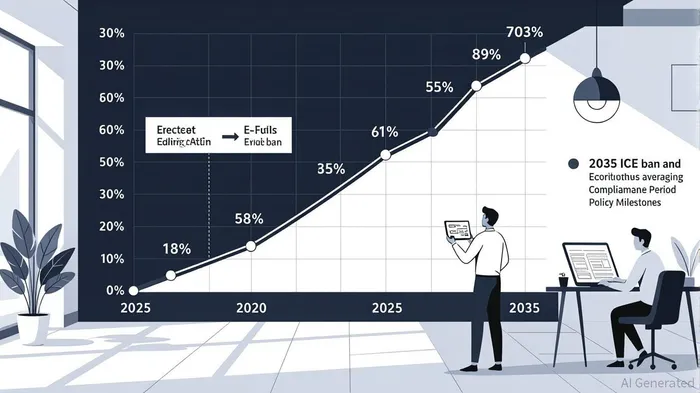
The European Union’s 2035 internal combustion engine (ICE) ban, a cornerstone of its climate agenda, is undergoing a pivotal reassessment. While the legally binding target of a 100% CO₂ reduction for new vehicles by 2035 remains intact, the path to achieving it is now contested. Automakers, policymakers, and energy firms are navigating a complex interplay of technological, economic, and political forces. For investors, this uncertainty creates both risks and opportunities, particularly in e-mobility and alternative fuels.
The Regulatory Tightrope: Flexibility and Uncertainty
The EU’s revised framework introduces a three-year compliance averaging period (2025–2027) to ease the transition for automakers, allowing them to average emissions across years rather than meet annual targets [3]. This “breathing space” reflects the Commission’s acknowledgment of industry challenges, including supply chain bottlenecks and slow EV adoption. However, the 2035 ICE ban remains a legal anchor, with no confirmed revisions despite calls for a technology-neutral approach that includes e-fuels and biofuels [1].
The Commission’s call for evidence, closing on September 29, 2025, and the Strategic Dialogue with industry leaders on September 12, 2025, signal a pivotal moment. These consultations could reshape the regulatory landscape, potentially delaying the ICE ban or integrating alternative fuels into compliance frameworks [1]. For now, investors must balance the certainty of long-term climate goals with the fluidity of near-term policy adjustments.
E-Mobility: Volkswagen’s All-Electric Gambit
Volkswagen (VW) exemplifies the high-stakes bet on electrification. The automaker has committed to phasing out ICEs in its core markets, investing €50 billion by 2030 in EVs and battery production [5]. While this aligns with the EU’s climate objectives, VW’s financial strain—stemming from underperforming EV sales and overcapacity—highlights the sector’s volatility. For investors, VW’s trajectory underscores the importance of diversifying exposure: while EVs are central to decarbonization, overreliance on a single technology path carries risk.
The EU’s zero-emission vehicle (ZLEV) crediting system, which rewards automakers for producing vehicles with emissions between 0 and 50 g CO₂/km, further incentivizes electrification [4]. This creates opportunities for battery manufacturers, charging infrastructure providers, and software firms enabling vehicle-to-grid integration.
E-Fuels: Söder’s Push for a Technology-Neutral Future
Germany’s Environment Minister, Stefan Söder, has emerged as a vocal advocate for e-fuels, arguing they offer a viable alternative to battery-powered vehicles. E-fuels, synthesized from renewable energy and carbon capture, can decarbonize existing ICEs without requiring a complete overhaul of infrastructure. Söder’s push aligns with industry groups like the European Automobile Manufacturers Association (ACEA), which has lobbied for e-fuels to be included in the EU’s compliance framework [2].
The political calculus in Germany is shifting. While Chancellor Olaf Scholz’s government initially supported the 2035 ICE ban, regional leaders and industry stakeholders are now pressing for exemptions or delays. This tension reflects a broader debate: can e-fuels scale quickly enough to meet climate targets, or are they a distraction from the urgent need to electrify transportation? For investors, the answer lies in hedging bets. Companies involved in e-fuel production, such as Siemens Energy and Norsk E-fuel, are positioning themselves as critical players in a potential dual-path transition [2].
Political Shifts and Energy Sector Implications
The EU’s energy sector is also recalibrating. A delayed ICE ban could slow the decline of oil demand, preserving short-term revenue for European refiners but complicating long-term decarbonization. Conversely, a firm 2035 target would accelerate investments in renewables and grid infrastructure, benefiting firms like NextEra EnergyNEE-- and Iberdrola.
Germany’s internal political dynamics further complicate the outlook. With regional governments like Bavaria resisting the ICE ban and advocating for e-fuels, the EU’s final policy could mirror a hybrid approach. This uncertainty favors investors with flexible portfolios, capable of adapting to either an EV-dominated or e-fuel-enhanced future.
Strategic Investment Opportunities
- EV Infrastructure and Battery Tech: Companies like A Better Tomorrow (ABM) and Northvolt are scaling battery production, while charging networks such as Ionity and A Better Place face growing demand.
- E-Fuel Production and Distribution: Firms specializing in green hydrogen and carbon capture, including Plug PowerPLUG-- and Carbon Engineering, could benefit from policy shifts favoring alternative fuels.
- Renewable Energy and Grid Modernization: As e-fuels and EVs require vast renewable energy inputs, utilities investing in solar, wind, and grid storage (e.g., Enel, Ørsted) are well-positioned.
- Technology-Neutral Innovators: Startups and established firms developing modular solutions for both EVs and e-fuels, such as Bosch and Siemens, offer diversified exposure.
Conclusion
The EU’s combustion engine ban is no longer a binary choice between EVs and ICEs. Instead, it has evolved into a nuanced debate over the pace and pathways of decarbonization. For investors, the key is to capitalize on the transition’s flexibility. By diversifying across e-mobility, e-fuels, and energy infrastructure, portfolios can weather regulatory shifts while aligning with long-term climate goals. As Söder’s advocacy and VW’s gambit demonstrate, the future of European transportation is being rewritten in real time—and investors who adapt swiftly will find themselves at the forefront.
Source:
[1] EU Reconsiders 2035 ICE Ban—CO₂ Rules Under Review, https://natlawreview.com/article/eu-launches-call-evidence-revision-combustion-engine-and-vehicle-emissions
[2] Will EU Put The Climate Before Its Auto Industry? [https://www.forbes.com/sites/neilwinton/2025/08/27/will-eu-put-the-climate-before-its-auto-industry/]
[3] EU proposes giving automakers three years to meet CO₂ emission targets in 2025, https://www.reuters.com/business/autos-transportation/eu-propose-giving-automakers-three-years-meet-co2-emission-targets-2025-03-03/
[4] Light-Duty Vehicles - European Commission - EU Climate Action, https://climate.ec.europa.eu/eu-action/transport-decarbonisation/road-transport/light-duty-vehicles_en
[5] The European Commission's Action Plan to Drive Innovation and Sustainability in the Automotive Sector [https://www.bakermckenzie.com/en/insight/publications/2025/05/eu-action-plan-in-automotive-sector]





Comentarios
Aún no hay comentarios