
The EU's 2035 EV Policy Shift: Strategic Opportunities in a Prolonged Transition
The European Union's revised 2035 emissions policy has rewritten the rules of the automotive transition, creating a more flexible framework that accommodates hybrid technologies and small electric vehicles (EVs) while delaying a full ban on internal combustion engines (ICEs). This shift, driven by lobbying from German and Italian automakers and their allies, introduces a nuanced landscape of investment opportunities. By analyzing the policy's key components-super credits for small EVs, hybrid-friendly emissions offsets, and battery manufacturing incentives-we can identify actionable targets for investors navigating this prolonged electrification timeline.
1. Super Credits for Small EVs: A Tailwind for Local Manufacturers
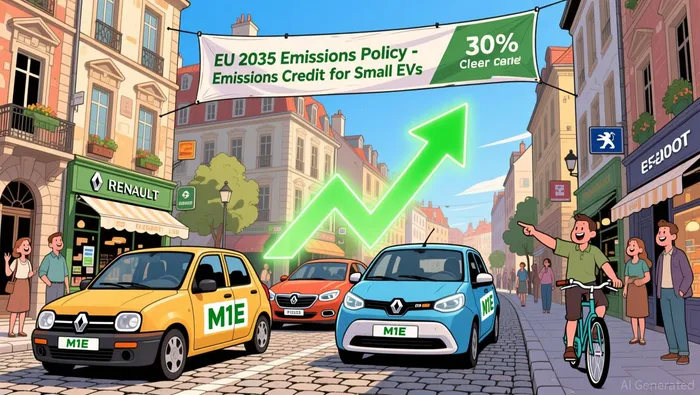 The EU's introduction of the "M1E" category-a class of small, fully electric vehicles under 4.2 meters in length-has created a unique advantage for European automakers. Each M1E-certified vehicle sold counts as 1.3 toward CO₂ compliance targets, effectively granting a 30% emissions credit compared to standard EVs. This "super credit" mechanism, valid until 2035, incentivizes the production of affordable, locally assembled EVs, which are critical for meeting intermediate emissions goals.
Key beneficiaries include Renault (Twingo, Renault 5), Volkswagen (ID. Polo), and StellantisSTLA-- (Peugeot E-208, Citroën e-C3), all of which have models that align with the M1E criteria. These manufacturers are now positioned to leverage the super credit system to offset emissions from their broader fleets, reducing the pressure to fully electrify by 2035. For investors, this represents a strategic opportunity to back companies that can scale small EV production while maintaining flexibility in their ICE offerings.
2. Hybrid and Range-Extended Vehicles: A Transitional Lifeline
The revised policy allows automakers to meet a 90% reduction in tailpipe emissions by 2035, with the remaining 10% offset through e-fuels. This opens the door for plug-in hybrids (PHEVs) and extended-range electric vehicles (EREVs) to remain in the market beyond 2035, provided they use low-carbon offsets. While Chinese automakers currently dominate PHEV and EREV technology, European manufacturers like Volkswagen and Stellantis are adapting their hybrid portfolios to align with the new framework.
For example, Volkswagen's ID. Buzz and Stellantis' Maserati Grecale Hybrid are being repositioned to incorporate e-fuel compatibility, a move that could extend their market relevance. Investors should monitor how these automakers integrate hybrid technologies with offset strategies, as this could determine their competitiveness against Asian rivals.
3. Battery Manufacturing Incentives: A €1.8 Billion Boost
The EU's "Battery Booster" strategy, including €1.8 billion in funding (€1.5 billion in interest-free loans), is accelerating the development of a local battery supply chain. Six major battery projects-spanning France, Germany, Poland, and Sweden-are set to receive €852 million in grants, with production expected to begin by 2027–2030. These projects, such as LG Energy Solution's 46inEU cylindrical cell plant in Poland and Verkor's AGATHE project in France, are critical for reducing reliance on imported materials and ensuring cost-competitive battery production.
Startups like Verkor and established players with EU-based battery facilities are prime candidates for investment. The focus on recycling and sustainable production methods further enhances the long-term viability of these projects, aligning with the EU's climate goals while supporting automakers' compliance efforts.
4. Risks and Counterarguments: A Balancing Act
Critics argue that the policy shift risks slowing the EV transition by diverting investment from full electrification. Environmental groups warn that the 10% ICE allowance and hybrid incentives could undermine climate targets. Additionally, Chinese automakers may gain a competitive edge in the EU's hybrid-friendly environment.
However, the policy's emphasis on super credits and battery localization provides a buffer for European manufacturers to adapt. For investors, the key is to focus on companies that can balance compliance flexibility with long-term electrification strategies, such as Renault's dual-track approach to small EVs and e-fuel partnerships.
Conclusion: Strategic Entry Points in a Shifting Landscape
The EU's 2035 policy shift creates a hybrid of opportunities and challenges. Investors should prioritize:
- Small EV manufacturers with M1E-certified models (e.g., Renault, Volkswagen, Stellantis).
- Battery producers securing EU grants (e.g., Verkor, LG Energy Solution).
- Hybrid automakers integrating e-fuel or green steel offsets.
While the policy's long-term climate impact remains debated, its immediate effect is to extend the window for European automakers to compete in a transitional market. By aligning with the super credit system and battery incentives, investors can capitalize on a prolonged but strategically navigable electrification path.





Comentarios
Aún no hay comentarios