
The EU's 2035 Combustion Engine Ban and Its Implications for European Auto Stocks
The European Union's 2035 combustion engine ban represents one of the most transformative regulatory shifts in the automotive sector, with profound implications for European automakers and their stock valuations. While the policy aims to accelerate decarbonization, its implementation has sparked intense debate over regulatory flexibility, technological feasibility, and market readiness. For investors, the interplay between strategic regulatory risk and sectoral resilience will define the trajectory of European auto stocks in the coming years.
Regulatory Risk: A Tectonic Shift with Uncertain Fault Lines
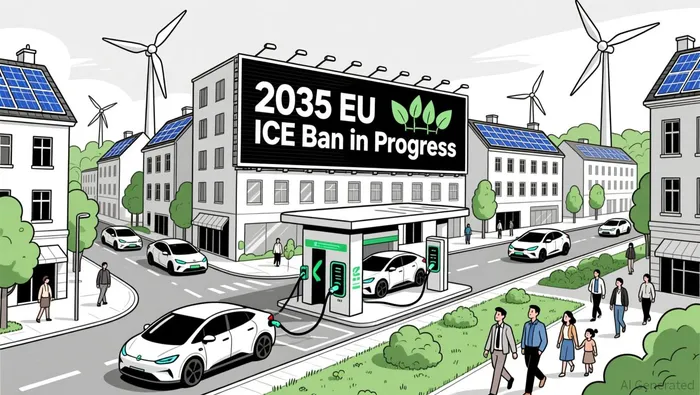
The EU's binding 2035 zero-emission vehicle (ZEV) mandate, adopted in 2023, requires all new passenger cars and vans to achieve 100% CO₂ emission reductions by that year, effectively phasing out internal combustion engines (ICEs) according to the EU climate action plan. However, the transition has proven more challenging than anticipated. As of mid-2025, battery electric vehicle (BEV) sales in Europe account for just 16% of new car registrations, up from 13% in 2024 according to EVXL data. This lag has prompted automakers like Volkswagen and StellantisSTLA-- to lobby for regulatory adjustments, including the inclusion of CO₂-neutral fuels (e.g., e-fuels and biofuels) and plug-in hybrids in the compliance framework as reported by Reuters.
The European Commission's recent call for evidence on revising the 2035 ban-part of its Automotive Sector Industrial Action Plan-signals a potential pivot toward greater flexibility as outlined in a sustainability blog. This process, however, is mired in political tensions, particularly between Germany (which favors ICE reprieves) and France (which advocates strict adherence to the original timeline) according to Bloomberg. For investors, the uncertainty surrounding final regulations introduces a critical risk: abrupt policy shifts could either accelerate or delay the phaseout of ICEs, directly impacting automakers' capital allocation and profitability.
Compliance Mechanisms and Exemptions: A Double-Edged Sword
To ease the transition, the EU introduced a three-year averaging window for 2025–2027 compliance, allowing manufacturers to meet CO₂ targets over an extended period according to the EU climate action plan. Additionally, the zero- and low-emission vehicle (ZLEV) incentive mechanism offers relief to automakers exceeding ZLEV benchmarks (25% for cars, 17% for vans) by reducing their CO₂ emission targets proportionally according to Two Birds analysis. Small-volume manufacturers (fewer than 10,000 annual car registrations) may also propose custom targets, while those with fewer than 1,000 registrations are fully exempt as per the EU climate action plan.
These mechanisms provide temporary breathing room but are not a panacea. For instance, the ZLEV incentive's 5% cap on emissions relaxation limits its effectiveness for automakers struggling to meet benchmarks. Meanwhile, pooling arrangements-where manufacturers combine fleets to meet targets-are restricted to same-vehicle-type groupings, limiting collaboration as outlined in the EU climate action plan. As a result, automakers with slower EV adoption (e.g., those reliant on ICEs for niche markets) face disproportionate penalties, including a €95/gram CO₂/km excess emissions fee as per the EU climate action plan.
Sectoral Resilience: Strategic Adaptations and Financial Projections
European automakers are responding to regulatory pressures with a mix of strategic pivots and financial restructuring. Volkswagen and Porsche, for example, have revised their 2035 ICE ban strategies to include hybrid and e-fuel technologies, while Stellantis has emphasized market-driven timelines over rigid legislative mandates according to EVXL reporting. These shifts reflect a broader industry trend: balancing regulatory compliance with consumer demand. Challenges such as charging infrastructure gaps, high electricity costs, and consumer resistance to BEVs remain significant hurdles as reported by EVXL.
Financial analysts project a sectoral recovery by 2026, driven by cost-cutting measures and turnaround strategies according to Auto News analysis. However, McKinsey warns that one-third of the industry's GDP could be at risk by 2035 due to decarbonization, software-defined vehicles, and global competition as per McKinsey Center insights. The rise of Chinese automakers like BYD-offering affordable, rapidly developed EVs-further complicates the landscape, squeezing European competitors on both price and innovation according to EVXL analysis.
Investment Outlook: Navigating the Crossroads of Risk and Resilience
For investors, the EU's 2035 ICE ban presents a paradox: a policy-driven tailwind for decarbonization coexists with regulatory and operational headwinds. Automakers with diversified portfolios (e.g., those integrating e-fuels or hybrids) may outperform peers reliant solely on BEVs. Conversely, those unable to adapt to shifting regulations or global competition face heightened volatility.
The December 2025 policy review will be a pivotal moment. If the EU softens the 2035 mandate, automakers could see near-term relief but long-term uncertainty. A strict adherence to the original timeline, meanwhile, would accelerate EV adoption but risk overburdening the industry. Investors must weigh these scenarios against automakers' strategic agility, financial health, and geopolitical dynamics-particularly the EU's ability to compete with China's EV surge.
In the end, the EU's 2035 ICE ban is not merely a regulatory event but a test of the European automotive sector's resilience. Those that navigate the crossroads of compliance, innovation, and market realities will emerge stronger; others may falter under the weight of their own inertia.







Comentarios
Aún no hay comentarios