
Etsy's Strategic Shift to NYSE Listing: A Catalyst for Institutional Credibility and Capital Access
The NYSE as a Symbol of Institutional Trust
A 2023 academic study revealed that 63% of firms listed on the NYSE experienced an increase in institutional ownership post-listing, underscoring the exchange's role in attracting large-cap investors and pension funds. This trend is rooted in the NYSE's reputation for transparency, liquidity, and regulatory rigor, which align with the risk-averse preferences of institutional investors. For Etsy, a company that has faced volatility in its stock price—peaking at $294.38 in 2021 before retreating to $58.20 by September 2025, according to Etsy's stock history—the transition to the NYSE may signal a commitment to long-term stability and governance.
Etsy's CEO, Josh Silverman, emphasized this alignment during Etsy's NYSE announcement, stating that the move reflects the company's “20-year legacy of connecting creative entrepreneurs with shoppers” and its desire to partner with the NYSE's “community of industry leaders.” Such rhetoric resonates with institutional investors who prioritize companies with clear strategic visions and governance frameworks.
Strategic Shifts and Market Reactions
Etsy's 2025 strategic pivot—centered on personalization, sustainability, and AI-driven innovation—has already begun to shape investor sentiment. The company's Q2 2025 deep dive showed revenue growth but triggered mixed reactions due to concerns over declining active buyers and margin pressures from increased marketing investments. However, the subsequent unveiling of AI-enhanced search algorithms, visual discovery tools, and a greener logistics strategy spurred an 11.03% stock surge on September 29, 2025, according to MarketReport Analytics. This rebound suggests that investors are beginning to reward Etsy's focus on long-term differentiation, even as short-term challenges persist.
The strategic shift also coincided with leadership changes, including Rafe Colburn's expanded role as Chief Product and Technology Officer. Analysts have noted that such organizational clarity could streamline innovation efforts, further bolstering institutional confidence.
Institutional Ownership: A Mixed Picture
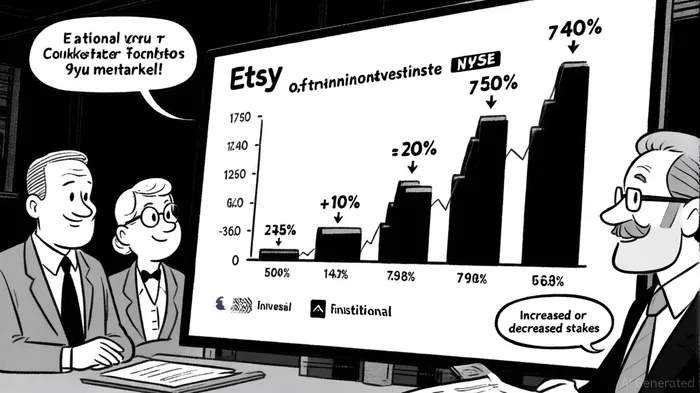
MarketBeat shows Etsy's institutional ownership remains robust at 99.53%, but recent quarters have seen divergent trends. On one hand, firms like Pallas Capital Advisors increased their holdings by over 211%, signaling optimism in an InvestingSnacks report. On the other, InvestingSnacks coverage showed DAVENPORT & Co LLC reduced their stakes by 38%, reflecting caution amid macroeconomic uncertainties and tariff-related risks (InvestingSnacks). This duality highlights the delicate balance Etsy must strike between attracting new capital and retaining existing institutional support.
Analyst ratings have also shifted toward neutrality or bearishness, with price targets averaging around $49 and a “Hold” consensus, according to InvestingSnacks' coverage. However, Etsy's NYSE transition could mitigate these concerns by aligning the company with a broader investor base that values institutional-grade transparency.
Unlocking Capital Access for High-Growth Platforms
For high-growth platforms, access to capital is often contingent on perceived credibility. Etsy's NYSE move aligns with historical precedents where listings on the exchange have catalyzed institutional investment; for instance, that 2023 study also notes the NYSE's fixed-commission structure and liquidity advantages, which reduce transaction costs for large institutional portfolios.
Moreover, Etsy's strategic emphasis on sustainability and AI innovation—key themes in ESG (Environmental, Social, Governance) investing—positions the company to tap into the $35 trillion global ESG asset management market, according to a global ESG report. By aligning with the NYSE's institutional ecosystem, Etsy may attract ESG-focused funds and pension managers seeking high-impact, long-term investments.
Conclusion: A Strategic Bet on Long-Term Value
Etsy's transition to the NYSE is more than a symbolic gesture—it is a strategic recalibration aimed at fortifying institutional trust and broadening capital access. While short-term challenges persist, the company's focus on personalization, sustainability, and AI-driven innovation aligns with the priorities of institutional investors and ESG funds. For high-growth platforms, Etsy's journey offers a blueprint: credibility and capital access are not merely financial metrics but outcomes of deliberate, values-driven strategies.
As Etsy navigates this new chapter, the market will watch closely to see whether the NYSE listing catalyzes a sustained resurgence—or if the company's long-term vision will require further recalibration.





Comentarios
Aún no hay comentarios