
ETHZilla's Strategic Move into On-Chain Housing Finance: A Game-Changer in Tokenized Real-World Assets
The convergence of institutional-grade lending and blockchain-based securitization is reshaping the financial landscape, and ETHZilla's aggressive foray into on-chain housing finance positions it at the forefront of this transformation. By leveraging blockchain's inherent advantages-transparency, programmability, and global accessibility-ETHZilla is not merely digitizing traditional asset classes but redefining how real-world assets (RWAs) are structured, traded, and governed. This analysis evaluates the long-term value creation potential of ETHZilla's strategy, contextualized within broader industry trends and supported by concrete case studies.
Strategic Partnerships and Tokenization Infrastructure
ETHZilla's recent acquisitions and partnerships underscore its commitment to building a robust on-chain infrastructure for institutional lending. The company's 20% stake in Karus, an AI-driven automotive-finance startup, enables the integration of predictive credit analytics into its blockchain platform, allowing for the tokenization of auto-loan portfolios according to reports. This move aligns with the broader tokenized debt market's growth, where institutions increasingly rely on blockchain rails to issue and trade fixed-income products as data shows. By early 2026, ETHZilla plans to launch tokenized auto-loan portfolios, leveraging Karus's historical data and dealer networks to create liquid, institutional-grade assets according to plans.
Complementing this, ETHZilla's partnership with Liquidity.io-a regulated platform for trading private assets-has unlocked new avenues for RWA securitization. The collaboration includes a $15 million investment in Satschel, Inc., granting ETHZilla exclusive rights to list EthereumETH-- Layer 2 (L2) tokens on the exchange. This partnership not only enhances liquidity for on-chain assets but also ensures compliance with evolving regulatory frameworks, a critical factor for institutional adoption.
Industry Trends: Blockchain's Role in Institutional Lending
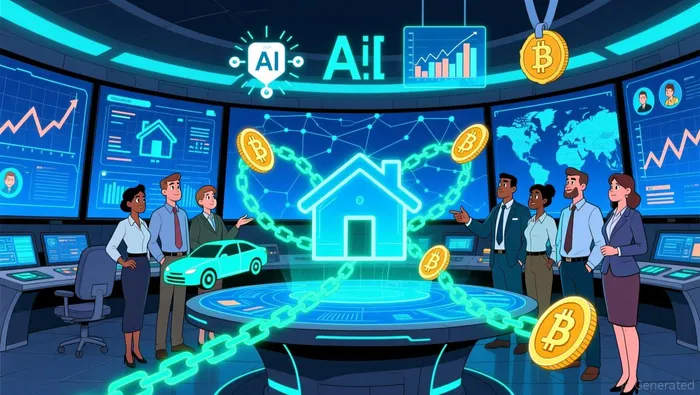 The tokenization of RWAs has transitioned from theoretical innovation to large-scale adoption in 2025. By October 2025, the total value of tokenized RWAs reached $33 billion, with tokenized government debt and stablecoins forming a significant portion. In real estate, blockchain is enabling fractional ownership and global access to previously illiquid assets. For instance, a New York luxury hotel was tokenized, allowing investors to purchase fractional stakes for as little as $1,000. Deloitte predicts that $4 trillion in real estate will be tokenized by 2035, with securitized loans and tokenized ownership representing the largest share of this growth.
Institutional adoption has been further accelerated by regulatory clarity, particularly around stablecoins. The U.S. GENIUS Act and similar frameworks in the EU and Asia have provided the legal infrastructure for financial institutions to enter the tokenization space with confidence. For example, Santander issued a $20 million blockchain bond in 2025, reducing the issuance process to days, while Hamilton Lane pioneered tokenized middle-market corporate loans, enhancing transparency and liquidity.
Case Studies: Tokenizing Housing Finance
ETHZilla's focus on housing finance is particularly noteworthy. The company's 15% stake in Zippy targets the $14 billion manufactured housing market, aiming to tokenize chattel loans through platforms like Liquidity.io. This approach mirrors broader industry trends, such as MQube's tokenization of £1.3 billion in mortgage debt on a blockchain platform, which streamlined transfers and reduced transaction costs. Similarly, Kin Capital's $100 million real estate debt fund on the Chintai blockchain demonstrates how tokenization can optimize capital formation and portfolio management.
Blockchain's impact on mortgage-backed securities (MBS) is equally transformative. Platforms like LiquidFi and Figure Technologies have reduced reporting times for MBS from 55 days to 30 minutes and achieved cost savings of $850 per $100,000 mortgage, respectively. These efficiencies highlight the potential for tokenized securitizations to outperform traditional models in terms of speed, cost, and flexibility.
Long-Term Value Creation and Challenges
The long-term value of ETHZilla's strategy lies in its ability to bridge traditional finance and blockchain ecosystems. By tokenizing housing loans and securitizing RWAs, ETHZilla is creating assets that are inherently more liquid, transparent, and globally accessible. For example, tokenized real estate allows investors to diversify portfolios with minimal capital, as seen in platforms offering $50 minimums for U.S. rental properties. This democratization of access expands the investor base and fosters cross-border capital flows.
However, challenges remain. Secondary market liquidity for tokenized assets is still maturing, and interoperability between blockchain networks and legacy systems poses technical hurdles. Regulatory frameworks, while improving, must continue to evolve to address issues like cross-border compliance and investor protection. ETHZilla's partnerships with regulated platforms like Liquidity.io suggest a proactive approach to these challenges, but sustained growth will depend on resolving these issues.
Conclusion
ETHZilla's strategic moves into on-chain housing finance and institutional-grade securitization position it as a key player in the tokenization revolution. By integrating AI-driven analytics, regulated trading platforms, and scalable blockchain infrastructure, the company is addressing the core inefficiencies of traditional lending and asset management. As the tokenized RWA market grows toward $4 trillion in real estate and beyond, ETHZilla's ability to tokenize diverse assets-from auto loans to manufactured housing-will likely drive significant long-term value creation. While regulatory and technical challenges persist, the trajectory of blockchain-based securitization suggests that ETHZilla's vision is not just innovative but increasingly inevitable.






Comentarios
Aún no hay comentarios