
ETHM as a Strategic Play on Institutional Ethereum Exposure
The institutionalization of EthereumETH-- has reached a pivotal inflection point in 2025, driven by a confluence of regulatory clarity, technological advancements, and capital inflows. As corporate treasuries, ETFs, and traditional financial institutions increasingly allocate capital to Ethereum, the market is witnessing a structural shift toward digital asset integration. At the forefront of this movement is The EtherETH-- Machine (ETHM), a publicly traded Ethereum treasury company poised to capitalize on this trend through its merger with SPAC DynamixETHM-- Corporation. This article evaluates ETHM's investment case ahead of the merger's finalization, analyzing its strategic alignment with institutional Ethereum adoption and the broader macroeconomic forces reshaping the crypto landscape.
The Merger and ETHM's Strategic Positioning
The Ether Machine's merger with Dynamix Corporation is set to close by the fourth quarter of 2025, subject to shareholder approval. This business combination, approved unanimously by both parties, positions ETHMETHM-- as a publicly traded vehicle focused on generating long-term, risk-adjusted yields through staking, restaking, and decentralized finance (DeFi). The company's mandate to steadily increase its ether (ETH) concentration per share aligns directly with the growing demand for institutional-grade Ethereum exposure.
A critical catalyst for ETHM's value proposition is its recent investment of $654 million in ETH from Jeffrey Berns, founder of Blockchains, which has elevated its total ETH holdings to 495,362 ETH, valued at approximately $2.16 billion. This capital infusion not only strengthens ETHM's balance sheet but also reinforces its ability to scale operations in a competitive market. 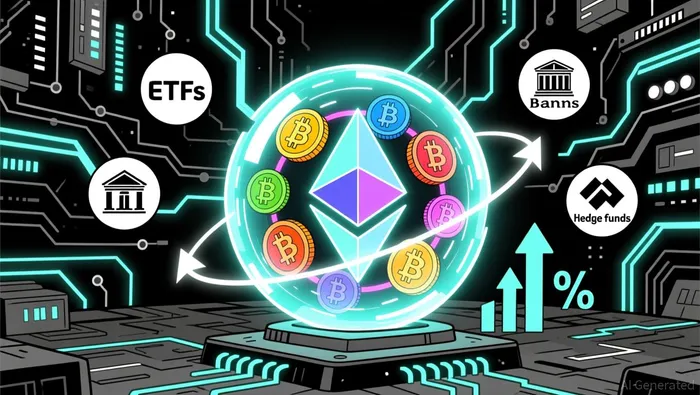 By aggregating and staking large ETH reserves, ETHM contributes to Ethereum's network security while generating yield for stakeholders-a dual benefit that resonates with institutional investors seeking both capital preservation and returns.
Institutional Ethereum Adoption: A Macro-Driven Tailwind
Ethereum's institutional adoption in 2025 has been fueled by its role as the backbone of smart contracts, DeFi, and tokenized assets. Corporate treasuries and ETFs have accumulated over 10 million ETH, representing a significant portion of the circulating supply. This trend is underpinned by the approval of regulated Ethereum ETFs, which have attracted inflows exceeding those of BitcoinBTC-- ETFs. The transition to Ethereum's proof-of-stake (PoS) consensus mechanism has further enhanced its appeal, offering institutional investors low-risk yield opportunities of 3-4% annually through staking.
Scalability improvements via Layer-2 solutions have also positioned Ethereum as a viable infrastructure for high-volume institutional applications. These solutions now process millions of transactions daily at costs far below traditional payment networks, enabling Ethereum to compete with legacy systems in efficiency and cost-effectiveness. Additionally, Ethereum's role in tokenizing traditional assets-such as real estate, equities, and commodities-has expanded its utility beyond speculative trading, creating a more diversified demand base.
ETHM's Strategic Value in a Maturing Market
The Ether Machine's SPAC merger with Dynamix, led by Andrew Keys (formerly of ConsenSys), underscores the growing institutional interest in Ethereum as an investment asset. This move reflects a broader trend of traditional finance entities embracing digital assets as part of their strategic portfolios. As Ethereum treasury companies like ETHM continue to accumulate and stake ETH, they not only generate yield but also bolster the network's security and liquidity, creating a virtuous cycle of value creation.
Looking ahead, Ethereum's upcoming Fusaka upgrade is expected to enhance its throughput, blob capacity, and node efficiency, positioning it for a modular, high-throughput future. This upgrade will likely solidify Ethereum's dominance in the DeFi space and attract further institutional capital. For ETHM, the Fusaka upgrade represents a strategic tailwind, as increased network activity could drive higher staking rewards and expand the company's revenue streams through DeFi participation.
Conclusion: A Compelling Investment Thesis
ETHM's merger with Dynamix and its strategic focus on Ethereum treasury management present a compelling case for investors seeking exposure to the institutionalization of crypto. The company's ability to scale ETH holdings, generate yield through staking, and leverage Ethereum's technological advancements positions it as a key player in a rapidly evolving market. With regulatory tailwinds, growing institutional adoption, and a clear roadmap for value creation, ETHM offers a unique opportunity to participate in Ethereum's next phase of growth. As the merger nears completion, investors should closely monitor its progress and the broader Ethereum ecosystem for signs of sustained momentum.





Comentarios
Aún no hay comentarios