
Ethiopia’s Grand Ethiopian Renaissance Dam and Its Strategic Implications for Regional Energy Markets
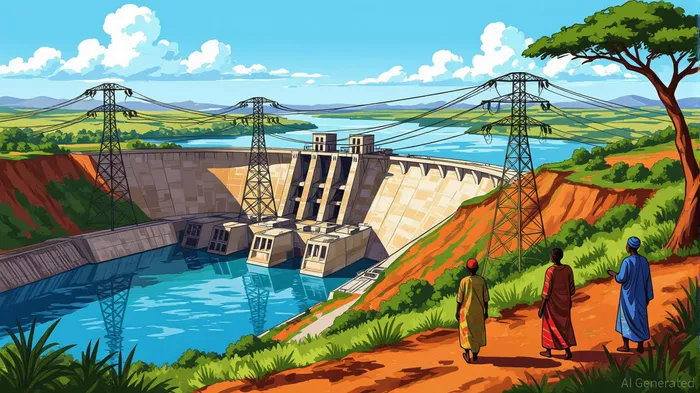
The completion of Ethiopia’s Grand Ethiopian Renaissance Dam (GERD) marks a pivotal moment in Africa’s energy landscape. As the continent’s largest hydroelectric project, with an installed capacity of 5,150 megawatts (MW), the GERD is poised to redefine Ethiopia’s role as a regional energy hub. According to a report by Bloomberg, the dam’s official inauguration in September 2025 will not only symbolize a 14-year construction milestone but also signal Ethiopia’s emergence as a key player in cross-border electricity trade [2]. This transformation is underpinned by the dam’s ability to more than double Ethiopia’s electricity production, while also generating approximately $1 billion annually through exports to Kenya, Sudan, and Djibouti [3].
Reshaping Energy Dynamics in East Africa
The GERD’s strategic significance lies in its capacity to address energy poverty and catalyze economic integration. By 2025, Ethiopia aims to leverage its hydropower surplus to supply neighboring countries, with the Eastern Africa Green Power Transmission Network serving as a critical enabler. This project—a 400 km high-voltage line connecting Guba (Ethiopia) to Khartoum (Sudan)—is designed to transfer up to 2,000 MW of power, reducing generation costs and enhancing regional energy security [4]. Similarly, the Ethiopia-Kenya Electricity Highway, a 650-mile transmission line, underscores the potential for shared renewable energy systems, aligning with broader goals of decarbonization [5].
Data from the African Union’s PIDA program indicates that such infrastructure investments could generate basin-wide real GDP growth of $8.07 billion, highlighting the economic multiplier effects of regional energy cooperation [1]. These developments position Ethiopia not merely as an energy producer but as a linchpin for a unified East African power market.
Geopolitical Tensions and Diplomatic Mitigation
Despite its promise, the GERD has sparked geopolitical tensions, particularly with Egypt and Sudan, which fear disruptions to Nile water flows. Egypt, reliant on the Nile for 90% of its water, has raised concerns about reduced downstream availability, while Sudan has historically oscillated between support and opposition [5]. Ethiopia, however, has emphasized the dam’s dual role in flood control and water management, asserting that its operations will benefit all Nile Basin nations [6].
To navigate these challenges, Ethiopia has engaged in multilateral negotiations and technical coordination mechanisms. Transparency in reservoir filling phases—completed in October 2024—has been a focal point, alongside international mediation efforts. While tensions persist, Ethiopia’s commitment to regional cooperation, as articulated by Prime Minister Abiy Ahmed, underscores its vision of shared prosperity [4].
Investment Opportunities and the Green Energy Transition
The GERD’s success hinges on robust infrastructure and cross-border partnerships. Financial frameworks for such projects often involve multilateral development banks and bilateral agreements, as seen in the Ethiopia-Sudan transmission initiative [3]. For investors, the dam represents a confluence of opportunities:
- Infrastructure Development: Transmission lines, grid upgrades, and smart energy systems are critical to scaling exports. The Eastern Africa Power Pool (EAPP) is a key institution facilitating this, though harmonizing regulatory frameworks remains a challenge [6].
- Green Energy Diplomacy: By replacing fossil fuels with renewable hydropower, the GERD aligns with global decarbonization goals. Ethiopia’s participation in the African Green Energy Transition Strategy positions it to attract climate-conscious capital [2].
- Risk Mitigation: Geopolitical risks, including water disputes and climate variability, necessitate diversified financing and diplomatic safeguards. Public-private partnerships and regional institutions like the EAPP will be vital in de-escalating tensions [1].
Conclusion
The Grand Ethiopian Renaissance Dam is more than an engineering feat; it is a catalyst for reimagining Africa’s energy future. By transforming Ethiopia into a regional energy exporter, the GERD fosters economic integration, reduces reliance on fossil fuels, and creates a blueprint for cross-border cooperation. However, its full potential will depend on sustained political will, infrastructure investment, and diplomatic finesse. For investors, the GERD represents a high-impact opportunity to contribute to a greener, more interconnected Africa—provided risks are managed with the same rigor as its technical ambitions.
Source:
[1] GERD operation stimulates real GDP growth in Eastern ..., [https://www.facebook.com/groups/289185612881093/posts/1290058089460502/]
[2] Ethiopia defends mega dam as Africa's largest Hydropower project nears inauguration [https://africasustainabilitymatters.com/ethiopia-defends-mega-dam-as-africas-largest-hydropower-project-nears-inauguration/]
[3] GERD set to generate 1 Billion USD a Year [https://www.facebook.com/greatafrican/posts/gerd-set-to-generate-1-billion-usd-a-year-project-manager-kifle-horo-the-grand-e/1191186119694924/]
[4] Eastern Africa Green Power Transmission Network Project 6 [https://au-pida.org/prospectus/project.php?id=83]
[5] Ethiopia-Kenya Electricity Highway allows the two [https://www.cnn.com/world/africa/ethiopia-kenya-electricty-highway-power-spc]
[6] Addressing the Challenges of Regional Electricity Trade in [https://www.ifa.gov.et/2025/06/24/power-beyond-borders-addressing-the-challenges-of-regional-electricity-trade-in-africa/]







Comentarios
Aún no hay comentarios