
Ethereum's Yield Renaissance: Capital Efficiency and Institutional Adoption in 2025
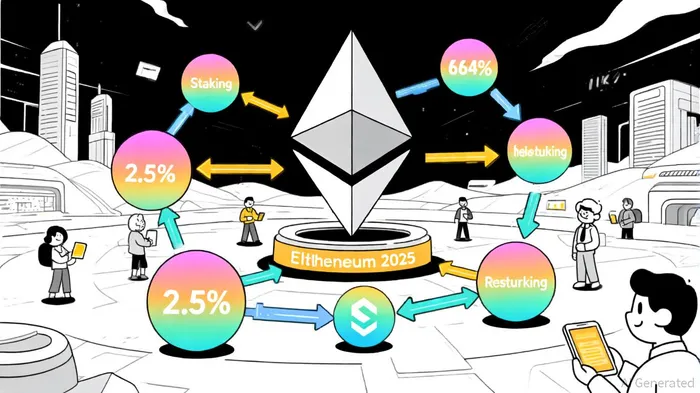
The EthereumETH-- ecosystem in 2025 has become a battleground for capital efficiency, with institutional and retail investors alike deploying increasingly sophisticated strategies to maximize returns. From staking and restaking to synthetic yield generation and funding rate farming, the landscape reflects a maturing market where innovation and institutional adoption are inextricably linked.
Staking and Restaking: The New Capital Efficiency Paradigm
Ethereum's staking mechanics have evolved dramatically since the Pectra upgrade in May 2025, which raised the validator effective balance cap from 32 ETHETH-- to 2,048 ETH[4]. This change enabled larger operators to consolidate stakes, reducing overhead costs and improving capital efficiency. By Q3 2025, total staked ETH had surged to 36.1 million, representing over 29% of the total supply[5].
Restaking has further amplified these gains. Platforms like EigenLayerEIGEN-- allow investors to deploy liquid staking tokens (e.g., stETH, eETH) into additional security layers, generating secondary yields. EigenLayer's TVL grew by 120% in Q3 2025, reaching $18.34 billion[5], as investors layered returns through protocols like Lido and Rocket PoolRPL--. This "stacked" approach—combining staking with restaking—can boost effective APYs by 1.5%–2%[5], making Ethereum staking a compelling alternative to traditional DeFi yield farming.
DeFi's Role in Capital Efficiency
While staking dominates headlines, DeFi protocols continue to innovate. AaveAAVE--, for instance, leads the lending space with a 25.6% market share and $12.8 billion in TVL[1], driven by Aave V3's Efficiency Mode and cross-chain liquidity features. Meanwhile, f(x) Protocol's dual-token model addresses the "Stablecoin Trilemma," offering leveraged exposure to decentralized stablecoins (fxUSD) while maintaining capital efficiency[3].
Layer 2 solutions have also transformed DeFi's accessibility. ArbitrumARB-- and OptimismOP--, with combined TVL exceeding $37 billion[1], reduce gas costs and increase throughput, enabling retail investors to participate in high-yield pools. Uniswap's liquidity pools, for example, offer base APYs up to 64%[2], though these are typically volatile and require active management. Automated strategies via Yearn Finance mitigate this complexity, optimizing returns across multiple protocols[2].
Institutional Adoption and Stablecoin Strategies
Institutional capital has poured into Ethereum's yield ecosystem, particularly in stablecoin strategies. By Q3 2025, $47.3 billion in stablecoins was deployed into yield-generating mechanisms, with Aave capturing 41.2% of the multi-chain lending market[2]. Protocols like Ethena's USDeUSDe-- have attracted attention by minting synthetic dollars backed by ETH, offering staking yields of 8.47% APY[5]. This model appeals to institutions seeking predictable returns without exposure to volatile crypto assets.
Funding rate farming has also emerged as a novel institutional strategy. On platforms like Bitget, investors exploit perpetual futures markets by shorting ETH-USDT pairs during price rallies, collecting payments from overleveraged long positions[5]. This approach generates steady yields without requiring directional price predictions, aligning with institutional risk management frameworks.
Emerging Trends and Risks
Synthetic yield platforms and restaking derivatives are pushing the boundaries of capital efficiency. However, these innovations introduce new risks, including smart contract vulnerabilities and liquidity constraints. For example, EigenLayer's rapid TVL growth has raised concerns about overconcentration in a single protocol[5]. Similarly, synthetic assets like USDe depend on stable ETH prices; a sharp correction could trigger cascading liquidations[5].
Regulatory scrutiny also looms. While Ethereum's institutional adoption is accelerating, frameworks for restaking and synthetic yield remain untested in many jurisdictions. Protocols must balance innovation with compliance to sustain long-term growth.
Conclusion
Ethereum's yield strategies in 2025 represent a tectonic shift in capital efficiency, driven by institutional adoption and protocol innovation. From restaking's layered returns to DeFi's automated optimizations, the ecosystem is redefining how capital is deployed. However, participants must navigate a complex risk landscape, balancing high yields with security and regulatory compliance. As the market matures, Ethereum's ability to harmonize these forces will determine its dominance in the next era of decentralized finance.






Comentarios
Aún no hay comentarios