
Ethereum Whale Behavior and Market Implications in 2025
In 2025, Ethereum's market dynamics were shaped by a stark divergence between institutional and retail investor behavior, with whale activity and leveraged positioning shifts emerging as pivotal forces. As the crypto market navigated macroeconomic headwinds and a historic October crash, Ethereum's price action and on-chain metrics revealed a complex interplay of bullish conviction and systemic risk. This analysis explores how whale accumulation, leveraged positioning adjustments, and sentiment shifts defined Ethereum's trajectory in 2025, offering insights into its potential for 2026.
Whale Accumulation and Institutional Confidence
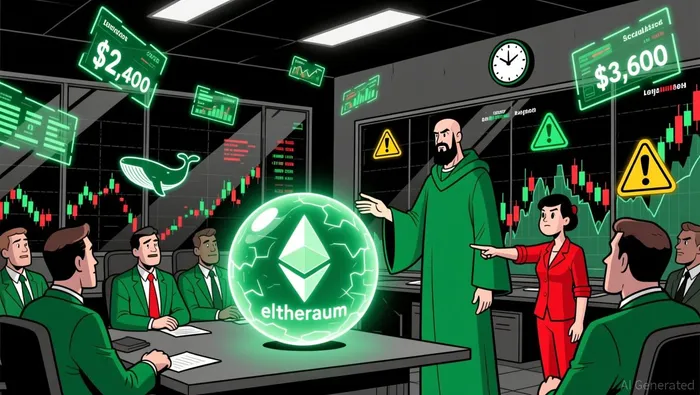
Ethereum's whale activity in 2025 reached unprecedented levels, with large investors amassing over 22 million ETHETH-- by year-end-a 63% increase from early 2025 levels. This accumulation occurred amid a prolonged price consolidation phase, as EthereumETH-- traded between $2,400 and $3,600. Notably, institutional players like BitMine ImmersionBMNR-- Technologies (BMNR) and Trend Research deployed leveraged DeFi strategies to build ETH exposure, with the latter committing $130 million to a 6,379 ETH purchase despite a $141 million unrealized loss on existing holdings. These moves underscored institutional confidence in Ethereum's long-term value, even as retail investors offloaded holdings, pushing retail exposure to multi-year lows.
The surge in whale activity was further amplified by leveraged positioning. A single whale opened a $392 million long position covering 120,000 ETH, signaling strong conviction in Ethereum's upside potential. However, such leveraged bets introduced tail risk, as demonstrated during the October 2025 crash, when a $19 billion in crypto liquidations-including $130 million in ETH longs-triggered a 28% price drop for the quarter.
Leveraged Positioning and Systemic Risk
The October 2025 crash exposed the fragility of leveraged positioning in Ethereum's ecosystem. As funding rates for perpetual futures surged to 30% annualized and open interest collapsed, traders faced cascading liquidations. A notable whale closed its 7x leveraged long position during this period, incurring significant losses. Post-crash, the market entered a deleveraging phase, with Ethereum's funding rates normalizing and open interest stabilizing at lower levels. This shift reflected a broader recalibration of risk, as traders reduced exposure amid profit-taking and holiday liquidity drawdowns.
Despite these adjustments, leveraged positioning remained a double-edged sword. While large longs reinforced bullish sentiment, they also heightened volatility. For instance, Ethereum's backwardation-evidenced by a 7D APR of -32.38%-highlighted intense short-term hedging demand. This dynamic created a tug-of-war between bears, who sought to exploit overleveraged longs, and bulls, who viewed the $3,100 support level as a critical inflection point.
Retail vs. Institutional Sentiment: A Tale of Two Markets
Retail and institutional sentiment diverged sharply in 2025. Retail investors, characterized by panic selling during drawdowns, contributed to Ethereum's price volatility. In contrast, institutions employed dollar-cost averaging and leveraged strategies to accumulate ETH during corrections. This divergence was epitomized by Trend Research's $130 million purchase, which defied a $141 million unrealized loss on its existing holdings.
The MVRV Long/Short Difference further illustrated this divide, as short-term holders began to dominate profit-taking, historically a precursor to renewed selling pressure. Meanwhile, institutional-grade DeFi infrastructure matured, with Ethereum becoming the dominant settlement layer for stablecoins and cross-chain applications. These developments suggested that Ethereum's ecosystem was evolving beyond speculative cycles, though price action lagged behind fundamentals.
Post-Crash Adjustments and Market Behavior
Following the October crash, Ethereum whales adopted a more cautious approach. On-chain data revealed a consolidation of large ETH holdings (10,000–100,000 tokens) from 17–18 million to over 21 million ETH. This strategic accumulation, coupled with ETF inflows exceeding $250 million, reinforced Ethereum's structural price floor. BlackRock's 138.7 million ETH inflows, in particular, signaled institutional absorption of supply from centralized exchanges.
Technically, Ethereum's price hovered near the $3,100 support level, with a confirmed breakout above $3,200 potentially triggering a bullish trend. However, the market's coiling effect-characterized by tight trading ranges-suggested indecision among buyers and sellers. This equilibrium could resolve in either direction, depending on whether institutional inflows and ETF adoption outpaced bearish liquidations.
Technological and Regulatory Catalysts
Ethereum's fundamentals in 2025 were bolstered by technological advancements and regulatory clarity. The Q4 2025 deployment of 8.7 million smart contracts-a record-highlighted the network's scalability and DeFi adoption. Meanwhile, the approval of ETH ETFs and the Pectra network update positioned Ethereum as a scalable, institutional-grade asset. Regulatory easing in late 2025 further improved sentiment, though lingering uncertainties around ETH's classification persisted.
Conclusion: A Precarious Balance
Ethereum's 2025 narrative was defined by a precarious balance between institutional bullishness and systemic risk from leveraged positioning. While whale accumulation and ETF inflows provided a structural floor, the October crash underscored the fragility of overleveraged markets. For 2026, Ethereum's success will hinge on its ability to break above $3,200 with sustained volume and ETF inflows, while avoiding a repeat of Q4's deleveraging. Investors must remain vigilant to both the opportunities and risks posed by whale behavior and leveraged positioning in this evolving landscape.





Comentarios
Aún no hay comentarios