
Ethereum Whale Activity and Market Sentiment: A Behavioral Economics Perspective
Ethereum's market dynamics in 2025 have become a battleground of competing narratives: bullish accumulation by whales and institutional inflows versus panic selling and ETF outflows. This duality reflects not just technical market forces but also the psychological interplay between large holders and retail investors, shaped by behavioral economics. To assess whether early whale losses signal a buying opportunity or a cautionary trend, we must dissect the interplay of on-chain data, investor psychology, and macroeconomic context.
Whale Accumulation: A Signal of Long-Term Confidence
Q3 2025 has seen a surge in EthereumETH-- whale accumulation, with large wallets (10,000–100,000 ETH) adding 450,000 ETH in a single week, valued at $1.19 billion [4]. Mid-sized “sharks” (1,000–10,000 ETH) have increased holdings by 14% over five months, while a long-dormant whale with $2.9 billion in assets re-entered the market to stake 200,000 ETH [4]. These actions suggest a belief in Ethereum's long-term value, particularly as staking yields and network upgrades (e.g., Ethereum 2.0) enhance utility.
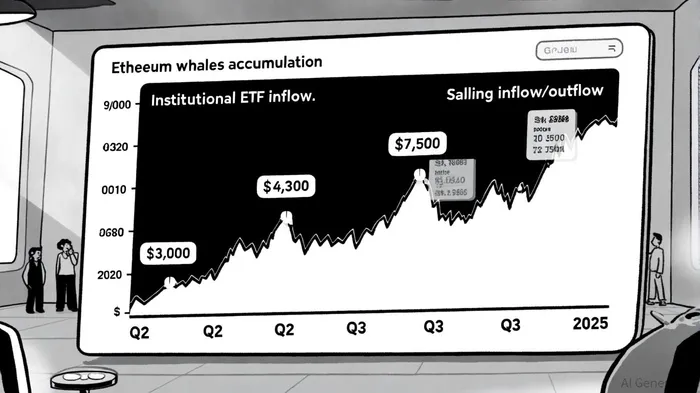
From a behavioral economics lens, whale accumulation acts as a psychological anchor for retail investors. When large holders commit capital, it signals reduced fear of downside risk, encouraging smaller traders to follow. This dynamic is amplified by institutional adoption: Ethereum ETFs have attracted $515 million in inflows since October 2024, with major banks raising price targets to $7,500 [4]. The combination of whale buying and institutional demand creates a self-reinforcing cycle, where perceived scarcity (due to burns and staking) drives upward price momentum.
Whale Selling: Panic or Strategy?
However, the narrative is not uniformly bullish. September 2025 saw a wave of whale selling, including the “7 Siblings” group liquidating $88 million in ETH within 15 hours and address 0x3c9E offloading $4.19 million in a single trade [1]. These actions, coupled with $256 million in Ethereum ETF outflows during the week ending January 14, 2025 [4], highlight short-term bearish sentiment.
Behavioral economics explains such selling as a response to loss aversion and herd behavior. When whales offload assets, it triggers panic among retail investors, who interpret the moves as signals of impending price declines. For example, a $72.88 million whale sell-off in late September 2025 coincided with a $134 million liquidation event, exacerbating downward pressure [1]. This creates a feedback loop: selling begets more selling, as fear overrides rational analysis of fundamentals.
Yet, not all whale selling is panic-driven. Some large holders strategically reduce positions to lock in profits or hedge against macroeconomic risks, such as the Federal Reserve's tightening cycle [4]. The divergence between accumulation and selling underscores the complexity of whale behavior: while some view Ethereum as undervalued, others remain cautious about near-term volatility.
Contrarian Opportunities or Cautionary Flags?
The key question for investors is whether whale losses represent a buying opportunity or a warning. Behavioral economics suggests that contrarian strategies can thrive in such environments. For instance, when whales sell during dips, it often reflects short-term anxiety rather than a fundamental breakdown. Exchange reserves are at cycle lows, reducing immediate selling pressure, and most Ethereum supply is in profit, increasing the likelihood of dip-buying [3].
However, caution is warranted. The “September curse”—a historical underperformance period for Ethereum—has resurfaced in 2025, with prices dipping below $4,000 amid ETF outflows [3]. While technical indicators like the 20-day/200-day EMA crossover and RSI at 71 suggest bullish momentum [2], the market remains vulnerable to further corrections if key support levels ($3,965, $3,900) fail.
Conclusion: Navigating the Psychological Tug-of-War
Ethereum's current landscape is a microcosm of behavioral economics in action. Whale accumulation signals long-term confidence, while selling reflects short-term fear. For investors, the challenge lies in distinguishing between transient panic and strategic reallocation.
A disciplined approach—monitoring on-chain data, technical indicators, and macroeconomic trends—can help navigate this volatility. If Ethereum stabilizes above $3,000 and whales continue to accumulate, the $7,500 target may yet materialize. But until then, the market remains a psychological tug-of-war, where sentiment and behavior will shape outcomes as much as fundamentals.






Comentarios
Aún no hay comentarios