
Ethereum Whale Activity as a Leading Indicator for Market Rebounds
Ethereum Whale Activity as a Leading Indicator for Market Rebounds
The crypto markets are no strangers to cycles of fear and frenzy, but one consistent truth remains: on-chain behavior tells the story of capital allocation long before price action catches up. In Q3 2025, Ethereum's whale activity has emerged as a textbook example of this principle. With institutional demand surging and supply tightening to historic lows, the data paints a clear picture: EthereumETH-- is in the early innings of a powerful bull market.
Whale Accumulation: A Supply Shock in the Making
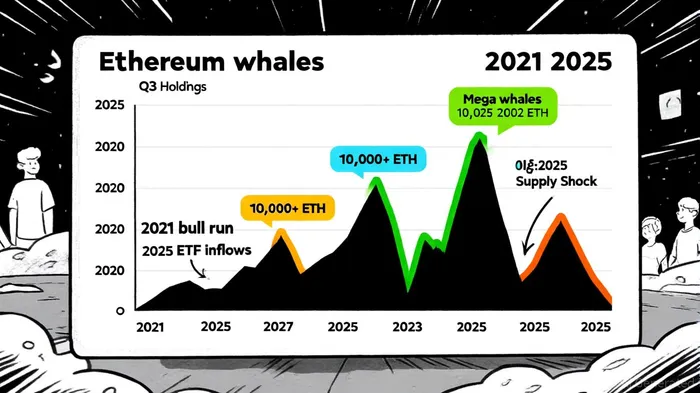
Data from Glassnode and Lookonchain reveals that Ethereum's mid-tier and mega whales have been aggressively accumulating ETH since mid-2025. Wallets holding between 1,000 and 10,000 ETH increased their holdings by 818,410 ETH ($2.5 billion), effectively doubling their positions [2]. Meanwhile, mega whales—wallets with over 10,000 ETH—surpassed 1,200 active addresses, a level last seen during the 2021 bull run [2]. This accumulation isn't just noise; it's a structural shift.
The implications are profound. When whales hoard assets, they reduce circulating supply and signal confidence in future value. In Ethereum's case, this has coincided with a 9-year low in exchange supply, which dropped to 15.28 million ETH as institutions like BlackRockBLK--, Fidelity, and Grayscale snapped up $1 billion in ETH in a single day [1]. BlackRock alone contributed $640 million to this buying spree, underscoring the coordinated effort to secure ETH ahead of potential macroeconomic catalysts.
Derivatives Metrics: The Market is Pricing a Breakout
The surge in whale activity isn't operating in a vacuum. Ethereum's derivatives market has exploded in parallel. Options open interest (OI) for ETH hit a year-to-date high of $16.1 billion, reflecting intense demand for optionality around a potential price breakout [1]. This surge mirrors patterns from 2018, when Ethereum's whale accumulation preceded a rally to $4,800 [2]. Today, the same dynamics are unfolding, but with a critical difference: Ethereum's supply is tighter, and institutional demand is more sophisticated.
Historical Parallels and Capital Allocation Strategy
History has shown that whale activity is a leading indicator of market cycles. During the 2018 bear market bottom, Ethereum whales began accumulating as prices languished below $100. By the time retail investors noticed, the whales had already positioned for a multi-year rally. The same playbook is in motion today.
For investors, the lesson is clear: capital allocation must align with on-chain signals. The current supply shock—driven by whale accumulation and ETF inflows—creates a scenario where Ethereum's price is likely to outperform traditional assets in a risk-on environment. Analysts are already speculating that ETH could challenge all-time highs or even reach five-digit valuations within 18–24 months [2].
The Bottom Line: Whale Activity as a Strategic Lens
Ethereum's whale behavior isn't just a curiosity—it's a masterclass in capital allocation. By analyzing on-chain metrics like large address activity, exchange supply, and derivatives flows, investors can identify inflection points before they become mainstream. The current data suggests that Ethereum is transitioning from a bear market base to a bull market launchpad.
For those who missed the 2021 rally, the 2025 accumulation phase offers a rare opportunity to align with institutional-grade signals. As the saying goes in crypto: “Whales don't swim with the tide—they create it.”





Comentarios
Aún no hay comentarios