
Ethereum Whale Activity and Its Implications for Short-Term Market Sentiment
In the volatile world of cryptocurrency, on-chain data has emerged as a critical tool for decoding market sentiment. Nowhere is this more evident than in Ethereum's ecosystem, where whale activity and institutional behavior are shaping short-term dynamics. As Q3 2025 unfolds, a surge in EthereumETH-- whale transactions and Binance withdrawals signals a pivotal shift in confidence, offering actionable insights for investors navigating the crypto landscape.
Whale Accumulation: A Bullish Signal Amid Institutional Momentum
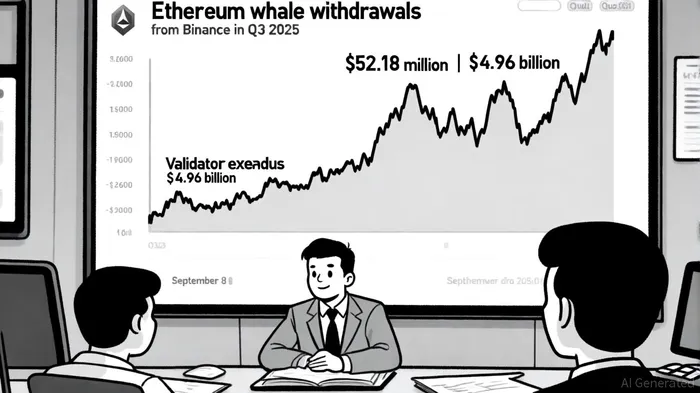
Ethereum's on-chain activity in 2025 reveals a striking pattern of accumulation by large holders. On September 8, 2025, wallet 0x19bA executed a $21.77 million ETH withdrawal from Binance, adding to a total of 12,200 ETH (worth $52.18 million) moved since August 20[3]. This follows a $50 million ETH withdrawal in April 2025, underscoring a trend of whales locking in long-term positions[5]. Such movements are not isolated; data from Whale Alert and ArkhamARKM-- Intelligence shows that Ethereum's Exchange Whale Ratio (EWR)—a metric tracking the proportion of ETH held by whales on exchanges—has declined to its lowest level in nine years[4].
The decline in exchange-held supply aligns with broader institutional demand. BlackRockBLK--, Fidelity, and Grayscale have coordinated ETH purchases through ETFs, with BlackRock alone acquiring $640 million in ETH in a single day[1]. This institutional accumulation has driven Ethereum's price above $4,500, creating a feedback loop where whale activity and ETF inflows reinforce bullish sentiment[1].
Binance Withdrawals: A Proxy for Institutional Strategy
Binance's Ethereum withdrawal patterns further illuminate market dynamics. In late September 2025, over 630,000 ETH ($2.7 billion) was withdrawn from the exchange, with analysts attributing the outflow to whales shifting assets to cold storage or decentralized finance (DeFi) platforms like Aave[1]. This trend mirrors historical patterns where large holders exit exchanges ahead of anticipated price rallies.
However, the narrative is not uniformly bullish. By late September, institutional investors pulled $76 million from Ethereum ETFs in a single day, signaling short-term caution amid volatility[3]. Despite this, total net inflows for Ethereum ETFs since 2024 have reached $13 billion, reflecting sustained long-term demand[3]. The divergence between whale accumulation and ETF outflows highlights a nuanced market: while long-term holders remain confident, short-term traders are hedging against uncertainty.
Strategic Implications for Investors
For investors, Ethereum's on-chain behavior offers a roadmap for navigating near-term volatility. Whale tracking tools like Glassnode and the whale-activity GitHub repository[5] enable real-time monitoring of large transactions, allowing traders to anticipate price movements. For instance, the 18-day Ethereum validator exodus (with $4.96 billion in ETH awaiting withdrawal)[1] suggests a potential liquidity event that could drive short-term volatility.
Moreover, the interplay between whale activity and institutional ETF flows provides a dual lens for strategy. When whales accumulate while ETFs see inflows, the market is primed for upward momentum. Conversely, a divergence—such as whale accumulation paired with ETF outflows—signals caution. Investors should also consider the EWR as a contrarian indicator: a declining ratio often precedes price peaks, as whales reduce their exchange exposure ahead of selling opportunities[4].
Conclusion: On-Chain Data as a Leading Indicator
Ethereum's Q3 2025 on-chain activity underscores the power of whale movements and institutional behavior as leading indicators. While short-term volatility remains a risk, the broader trend of accumulation—by both whales and institutions—points to a resilient market. For investors, the key lies in synthesizing these signals: leveraging tools like Whale Alert to track large transactions, monitoring ETF flows for institutional sentiment, and using metrics like EWR to gauge liquidity risks. In a market where timing is everything, on-chain data is no longer a niche tool—it's a necessity.





Comentarios
Aún no hay comentarios