
Ethereum's Whale Activity and Its Implications for Price Stability and Investor Strategy
The Rise of Institutional Accumulation
Institutional investors are increasingly treating EthereumETH-- as a strategic asset. Bitmine, a major Ethereum treasury company, recently added 33,948 ETH ($135 million) to its holdings, expanding its stake to over 3.1 million ETH-2.6% of the circulating supply, according to an Ambcrypto report. This move aligns with Bitmine's long-term strategy of building ETH reserves for staking and diversifying institutional treasuries. Similarly, BlackRock's $3.5 billion investment in Ethereum, acquiring 0.12% of the total supply, underscores the asset's growing legitimacy in traditional finance, as noted in a Coinotag report.
The shift is not limited to new entrants. Established players like FalconX have also contributed to the inflow, transferring large ETH quantities to addresses linked to Bitmine, according to a Coinotag report. These transactions reflect a broader trend: institutional investors are prioritizing Ethereum's utility in staking, decentralized finance (DeFi), and smart contract ecosystems over short-term volatility.
Historical Patterns and Market Sentiment
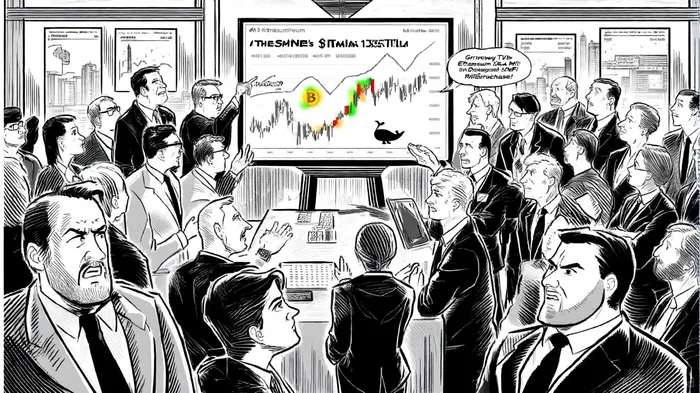
Ethereum's whale behavior has historically mirrored its price cycles. For example, a whale that received 1 million ETH during the 2014 ICO sold 30,300 ETH in 2025 for $99.36 million, while still holding 97,750 ETH worth $391 million, according to a Lookonchain feed. This disciplined exit strategy highlights how large stakeholders can influence liquidity and sentiment. Conversely, Q3 2025 has seen whales adopt a more bullish stance. Santiment data reveals that addresses holding 10,000–100,000 ETH increased their balances by 218,470 ETH in a single week, signaling renewed confidence, as reported in a NewsBTC article.
The market's shift from retail speculation to institutional accumulation is further supported by on-chain data. Large whale orders now dominate spot activity near $4,000, with no major futures liquidations reported, as Ambcrypto reported earlier. This contrasts with 2021's "euphoric" cycle, where retail FOMO drove volatility. Today's environment, however, is characterized by strategic buying, with whales prioritizing long-term value over short-term gains.
On-Chain Metrics and Volatility Correlation
Ethereum's MVRV ratio-a measure of market value relative to realized value-has trended lower in Q3 2025 despite a stable price range of $3,976–$4,956, according to a 99Bitcoins report. This suggests that new buyers are entering at higher costs, while existing holders' profitability has declined. However, the surge in TVL ($90 billion) and staking activity (near all-time highs) indicates tighter liquid supply and capital rotation, which typically correlate with price stability.
Whale activity further reinforces this narrative. Addresses holding 10,000–100,000 ETH have shifted funds from SolanaSOL-- to Ethereum, selling 99,979 SOL to purchase 4,532 ETH, as detailed in a Yahoo Finance article. This migration reflects growing confidence in Ethereum's ecosystem depth and stability, particularly as Layer 2 activity rises by 18% and stablecoin AUM exceeds $275 billion, according to a Bitwise review.
Investor Strategies in a Whale-Driven Market
For individual investors, the implications are clear: Ethereum's price stability is increasingly tied to institutional behavior. During periods of whale accumulation, retail investors should focus on long-term strategies rather than short-term speculation. Diversifying into Ethereum-based DeFi protocols or staking can capitalize on the asset's utility while mitigating volatility risks.
Conversely, during whale exits-such as the 2025 ICO whale's $99.36 million sale-investors should remain cautious. These exits can temporarily increase liquidity but may also signal short-term price corrections. The key is to align strategies with Ethereum's broader adoption trends, such as ETF inflows and regulatory clarity, which have historically supported institutional confidence, as noted in the 99Bitcoins report.
Conclusion
Ethereum's Q3 2025 whale activity paints a picture of a maturing market. Institutional accumulation, rising TVL, and strategic on-chain movements suggest that Ethereum is transitioning from a speculative asset to a cornerstone of institutional portfolios. While volatility remains a factor, the growing alignment between whale behavior and price stability offers a roadmap for investors navigating this evolving landscape.





Comentarios
Aún no hay comentarios