
Ethereum Whale's $3.62M Loss: A Warning Sign for Overleveraged Crypto Investors?
The recent $3.62 million loss by EthereumETH-- whale Huang Licheng-linked to a leveraged ASTERASTER-- position-has reignited debates about the risks of overleveraged trading in crypto markets. While the incident itself is not unprecedented, it serves as a stark reminder of how macroeconomic volatility and speculative positioning can collide to create catastrophic outcomes. As the crypto market matures, understanding the interplay between leverage, macro trends, and whale behavior is critical for investors navigating this high-stakes environment.
The ASTER Whale's Downfall: A Case Study in Leverage and Volatility
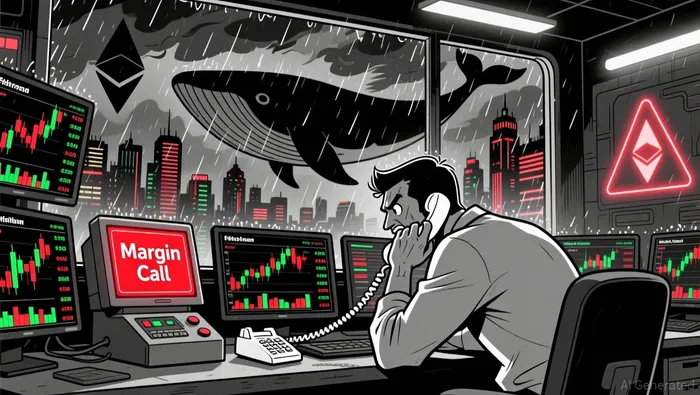
Huang Licheng's leveraged ASTER position, valued at $1.8 million at the time, was hit by a 4.18% price drop in 24 hours, triggering a $3.62 million loss. ASTER's recent 30-day price surge of 2,270.58% had created a false sense of security, masking the inherent volatility of altcoins. This case underscores a recurring theme in crypto: leveraged positions amplify both gains and losses, but the latter can be devastating when market conditions shift rapidly.
The ASTER incident is not an isolated event. In September 2025, the "Red Monday" crash saw $1.5 billion in long positions liquidated within 24 hours, impacting over 400,000 traders. Behavioral data from Leverage.Trading's September 2025 report revealed a defensive shift among traders, with U.S. participants conducting 40% more margin checks than the global average. Yet, even with these precautions, the ASTER whale's loss highlights how leveraged positions remain vulnerable to sudden price swings.
Macroeconomic Headwinds: Rates, Inflation, and the Cost of Leverage
The broader macroeconomic context in 2025 has exacerbated these risks. The Federal Reserve's hawkish stance-marked by three rate hikes-has increased the opportunity cost of holding non-yield-bearing assets like BitcoinBTC-- and Ethereum. For leveraged traders, this means higher borrowing costs and tighter margin requirements. Meanwhile, a Q3 2025 inflation surge to 4.2% has driven capital into cryptocurrencies as a hedge, but this inflow has also inflated valuations for altcoins like ASTER, creating a fragile ecosystem.
The Red Monday crash further illustrates this fragility. As perpetual funding rates turned negative (e.g., Ethereum's funding rate hit -0.0021), traders began paying to hold short positions-a sign of extreme bearish sentiment. This shift was driven by macroeconomic uncertainty, with traders cross-checking data from multiple platforms to manage risk. Yet, as the ASTER case shows, even seasoned investors can be blindsided by liquidity crunches or sudden market rotations.
Whale Activity and the Illusion of Control
While the ASTER loss is alarming, it's worth noting that Ethereum whales have been aggressively accumulating positions in 2025. One whale added 20,000 ETH in late December, pushing their total holdings to 140,000 ETH ($444 million), while another rotated $140 million from Bitcoin to Ethereum. These moves reflect confidence in Ethereum's long-term trajectory, particularly with ETF inflows and declining exchange balances (now at 8.6% of total supply) signaling a tighter supply environment.
However, this optimism often comes with leverage. A separate whale's $537 million Ethereum long position turned into a $20.5 million unrealized loss after an 8% price drop. Such examples reveal a paradox: while whales are positioning for growth, their reliance on leverage exposes them to the same volatility that plagues retail traders. The ASTER incident is a cautionary tale for these actors-proof that even large, well-capitalized players are not immune to market forces.
The Bigger Picture: Risk Management in a Maturing Market
The crypto market's evolution is evident in the increased adoption of risk management tools. During Red Monday, 58% of trading activity came from mobile devices, indicating real-time monitoring of positions. U.S. traders, in particular, demonstrated institutional-like behavior by prioritizing margin checks and liquidation strategies. Yet, the ASTER whale's loss suggests that risk management is still a work in progress.
For investors, the lesson is clear: leverage is a double-edged sword. While it can amplify returns in bullish cycles, it magnifies losses during downturns. The macroeconomic environment in 2025-characterized by rate hikes, inflation, and correlated volatility with traditional assets-has made this risk more acute. As Ethereum ETFs and whale activity drive bullish sentiment, investors must balance optimism with caution.
Conclusion: A Call for Prudence
The Ethereum whale's $3.62 million loss is not just a cautionary tale-it's a warning. In a market where leveraged positions are increasingly common and macroeconomic headwinds persist, overexposure can lead to systemic consequences. While Ethereum's fundamentals remain strong, the ASTER incident underscores the need for disciplined risk management. For investors, the key takeaway is to avoid the trap of assuming that bullish trends will continue indefinitely. In crypto, as in any market, the only constant is volatility.






Comentarios
Aún no hay comentarios