
Ethereum's Vulnerability Amid Geopolitical Tensions: A Derivatives Market Perspective
The U.S.-China trade war has evolved into a high-stakes geopolitical conflict with cascading effects on global financial markets. For EthereumETH--, the interplay of macroeconomic uncertainty, regulatory shifts, and leveraged trading dynamics has exposed critical vulnerabilities in its derivatives ecosystem. This analysis examines how recent tariff escalations-most notably the 100% U.S. tariff on Chinese software imports in October 2025-have amplified Ethereum's price instability and strained derivatives liquidity, while contrasting its performance with Bitcoin's more resilient derivatives market.
Price Volatility: A Macro-Driven Crisis
The October 2025 tariff announcements triggered a seismic shift in Ethereum's price trajectory. According to a report by CoinPedia, Ethereum plummeted 13% to $3,799 within hours of the U.S. policy announcement, erasing $16 billion in leveraged long positions as traders scrambled to de-risk portfolios [1]. China's retaliatory measures, including tariffs on U.S. imports and rare earth material export restrictions, further deepened the selloff, pushing Ethereum down 4% to $4,000 by October 14 [4]. These events underscore Ethereum's heightened sensitivity to geopolitical macro risks, as its derivatives market-dominated by leveraged positions-amplified volatility through cascading liquidations.
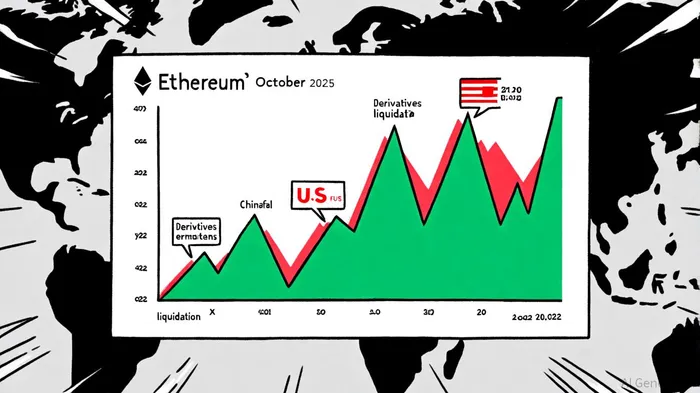
The volatility is notNOT-- merely a function of tariffs but also of Ethereum's structural exposure to macroeconomic trends. As noted by Forbes, Ethereum's price action is closely tied to global trade flows and investor sentiment, with its derivatives market acting as a barometer for risk-off behavior [3]. This dynamic contrasts with BitcoinBTC--, which has historically exhibited lower correlation to trade cycles, offering a potential benchmark for resilience.
Derivatives Liquidity: A Fractured Ecosystem
Ethereum's derivatives market liquidity has been severely tested during the 2023–2025 trade war. Open interest (OI) for Ethereum perpetual futures reached $63.32 billion in October 2025, but this figure masked a 0.83% 24-hour decline amid the tariff-driven selloff [1]. Funding rates, which signal the cost of holding leveraged positions, fluctuated wildly, with Binance reporting rates as high as 0.01% during the crisis [2]. These metrics reveal a market struggling to absorb sudden shifts in demand, particularly as liquidity providers retreated from volatile environments.
Comparative data highlights Ethereum's fragility. While Bitcoin's derivatives market maintained an open interest of $34.2 billion in October 2025, Ethereum's OI lagged at $11 billion-a 29% drop from its June 2025 peak [5]. This disparity reflects Bitcoin's institutional-driven liquidity, which is less susceptible to retail-driven panic. Ethereum's liquidity depth, meanwhile, concentrated closer to the market price, with liquidity tapering off sharply beyond 0.1% price ranges-a vulnerability exploited during the October selloff [5].
Regulatory Crosscurrents: U.S. and China's Divergent Policies
Regulatory developments in both the U.S. and China have further complicated Ethereum's derivatives landscape. The U.S. Commodities Futures Trading Commission (CFTC) has eased rules on crypto derivatives, fostering institutional participation and stabilizing Bitcoin's market [3]. However, Ethereum's derivatives remain concentrated on unregulated exchanges like Binance and OKX, where 97% of trading volume resides [4]. This lack of oversight exacerbates liquidity risks, as seen during the October 2025 liquidation wave.
China's regulatory crackdowns have been even more severe. By 2025, mainland China had criminalized crypto ownership and trading, forcing major exchanges like Binance to cease onboarding local users [1]. This exodus of institutional capital-estimated at a 70% decline in Chinese crypto holdings since 2020-has left Ethereum's derivatives market with a fragmented liquidity base, further amplifying its exposure to geopolitical shocks [1].
Investment Implications and Outlook
Ethereum's derivatives market remains a double-edged sword for investors. While its innovation-driven ecosystem attracts speculative capital, its susceptibility to macroeconomic and geopolitical shocks poses significant risks. The October 2025 tariff crisis demonstrated that Ethereum's price stability is inextricably linked to global trade dynamics, with derivatives liquidity acting as both a magnifier and a victim of volatility.
For investors, the key takeaway is diversification. Bitcoin's derivatives market, with its deeper liquidity and institutional backing, offers a more stable hedge against geopolitical uncertainty. Ethereum, however, retains its role as a high-beta asset, appealing to traders seeking exposure to macro-driven swings but requiring stringent risk management.







Comentarios
Aún no hay comentarios