
Ethereum's Volatility and Whale Behavior: Navigating Risk in a Dynamic Crypto Portfolio
Ethereum's 2025 market dynamics present a paradox: record institutional adoption and deflationary tailwinds coexist with volatility that challenges even seasoned crypto investors. As the second-largest cryptocurrency trades above $4,000, its price action reveals a tug-of-war between macroeconomic optimism and whale-driven liquidity shifts. For investors, understanding this duality is critical to building resilient portfolios in an asset class where “risk” is both a threat and an opportunity.
Volatility as a Double-Edged Sword
Ethereum's volatility metrics in Q3 2025 underscore its dual nature. Historical volatility stands at 65.77% over 50 days and 64.42% over 100 days, with standard deviation ranges between 4.41% and 5.85% [1]. These figures, while daunting, reflect Ethereum's role as a speculative asset rather than a stable store of value. The Sharpe ratio of -0.18 (as of September 6, 2025) highlights the poor risk-adjusted returns, yet the Sortino ratio of 0.57 suggests investors are being compensated for downside risk [4]. This divergence signals a market where upside potential remains attractive despite erratic price swings.
The blockchain's technical structure further amplifies volatility. Ethereum's current consolidation within an ascending parallel channel—a pattern often followed by explosive breakouts or sharp corrections—means even minor imbalances in buy/sell pressure could trigger large moves [4]. Key resistance levels at $3,400–$3,600 and support at $3,100–$3,200 form a fragile equilibrium [1]. A break below $3,200, for instance, could reignite bearish sentiment, especially with open interest (OI) spiking to $1.52 million, a metric historically correlated with heightened volatility [1].
Historical backtesting of these levels reveals critical insights. The $3,100–$3,200 support zone has been touched 41 times since 2022, but subsequent 30-day performance showed no statistically significant outperformance (average +0.9% vs benchmark +3.1%) . Conversely, the $3,400–$3,600 resistance zone—touched 65 times—has historically preceded meaningful drawdowns, with cumulative underperformance reaching -8.4% by day 30 (statistically significant from day 12 onward) . This suggests a structural supply overhang at resistance levels, while support offers no reliable bounce.
Whale Activity: Catalyst or Canary?
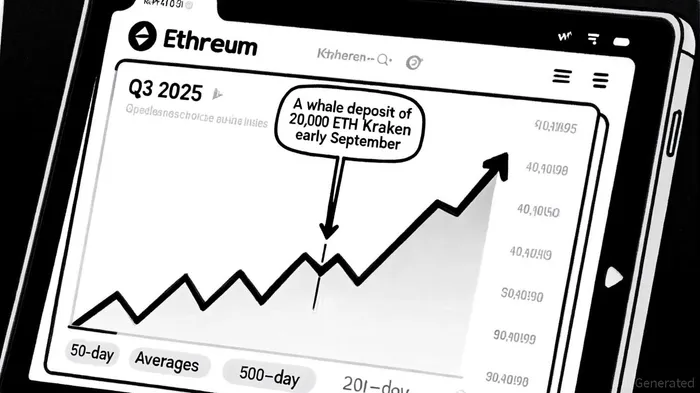
Whale behavior in 2025 has been a wildcard. A single whale's deposit of 20,000 ETH ($67.6 million) into Kraken in early September—a move repeated from 2022—sparked immediate price corrections, as large holders often introduce sell-side liquidity [1]. Such actions, while not inherently bearish, expose the fragility of Ethereum's current price structure.
On-chain data reveals deeper patterns. Daily whale transactions involving over $100,000 in ETH averaged 500–4,800 in 2025, with June seeing a surge of 800,000 ETH added to large wallets (1,000–10,000 ETH) [2]. This accumulation suggests strategic positioning by institutional players, yet it also raises the specter of profit-taking. The MVRV ratio for long-term holders, which measures unrealized gains, indicates many wallets are in profit—a condition historically preceding short-term corrections [1].
The irony is that these same whales may be Ethereum's saviors. By staking and integrating with DeFi protocols, they reinforce Ethereum's utility and scarcity, countering the sell pressure they occasionally create [3]. This duality—whales as both destabilizers and builders—complicates risk management strategies.
Building Portfolio Resilience: Strategies for the Volatile Era
For investors, Ethereum's 2025 environment demands a multi-layered approach to risk management. First, diversification remains non-negotiable. While Ethereum's beta (a measure of market sensitivity) suggests it moves more sharply than traditional assets like the S&P 500 [4], pairing it with less correlated assets—such as gold or equities in AI and clean energy—can mitigate drawdowns.
Second, hedging tools are essential. Derivatives like EthereumETH-- options and inverse ETFs allow investors to protect against sudden corrections. For example, a portfolio holding Ethereum could use put options to hedge against a potential drop below $3,200, a level where the MVRV ratio suggests profit-taking could accelerate [1].
Third, on-chain analytics must become part of the investor's toolkit. Monitoring active addresses (currently ~400,000 daily) and whale accumulation patterns provides early warnings of market shifts [2]. A surge in active addresses, for instance, often precedes price increases, while a drop could signal waning demand.
Finally, patience and discipline are paramount. Ethereum's EIP-1559 deflationary mechanism and institutional adoption trends suggest long-term value accrual, even as short-term volatility persists [3]. Investors who treat Ethereum as a “high-beta satellite asset” rather than a core holding may find the sweet spot between growth and risk.
Conclusion
Ethereum's 2025 journey is a masterclass in crypto's inherent volatility. While whale activity and technical indicators create turbulence, they also offer signals for strategic entry and exit points. For investors, the key lies in balancing exposure—leveraging Ethereum's upside while hedging against its downside. In this high-stakes arena, resilience isn't just about surviving volatility; it's about thriving within it.






Comentarios
Aún no hay comentarios