
Ethereum's Volatility and the Risk of Macro-Driven Liquidation Waves in November 2025
Macro-Driven Liquidation Waves: A November 2025 Case Study
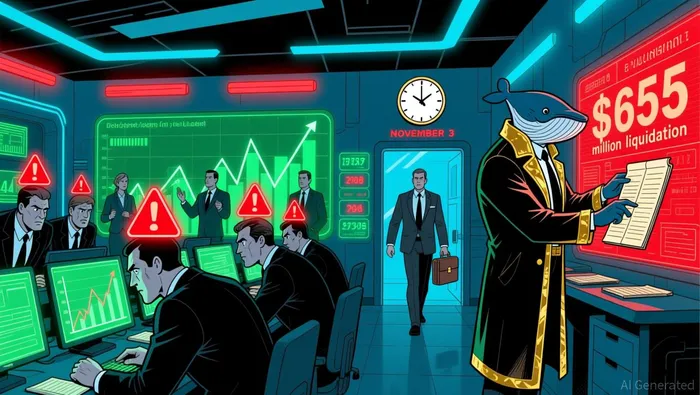
On November 3, 2025, the crypto market experienced a $2 billion liquidation event, with EthereumETH-- accounting for $655 million of the losses, according to a Blockchain Magazine report. This spike was triggered by a rapid price drop to $3,099, exacerbated by leveraged traders' overexposure. Automated stop-loss orders, clustered near key support levels, created a self-fulfilling prophecy: as prices fell, bots executed mass closures, pushing prices lower still. This feedback loop highlights the fragility of leveraged positions in a market where liquidity can evaporate overnight.
The root cause? A combination of macroeconomic factors and on-chain repositioning. A large Ethereum whale borrowed $120 million in USDTUSDT-- via AaveAAVE-- and deposited the funds on Binance, signaling a strategic shift in liquidity rather than a direct bearish bet, according to a Coinotag report. Meanwhile, institutional players like SharpLink Gaming increased their Ethereum holdings by ~5% in two months, deploying $200 million in ETH on the LineaLINEA-- platform to boost yield. These moves reflect a broader trend: while retail traders chase momentum, institutions are hedging downside risk and capitalizing on Ethereum's staking infrastructure.
Strategic Risk Management in a Leveraged Environment
For traders, the November 2025 liquidation event underscores the importance of risk mitigation. Here are three actionable strategies:
Position Sizing and Leverage Caps: Retail traders often over-leverage during bullish phases, assuming volatility will trend in their favor. However, Ethereum's 25% Q4 drop demonstrates the danger of this approach. Limiting leverage to 2–3x and capping position sizes at 5–10% of total capital can reduce exposure to sudden liquidations, as noted in the Blockchain Magazine report.
Hedging with Derivatives: Long-term holders can use Ethereum futures or options to hedge against macroeconomic shocks. For example, deploying a small portion of capital in put options or short-term futures can offset losses if another liquidation wave occurs.
Monitoring Macro Triggers: U.S.-China trade tensions, Fed policy shifts, and Ethereum's Fusaka upgrade (scheduled for December 3) are critical variables. Traders should track these events closely and adjust positions accordingly. For instance, the Fusaka upgrade's potential to improve scalability could drive a rebound toward $3,900–$5,000, but only if macro conditions stabilize, according to a TradingView report.
The Path Forward: Bearish Exhaustion or Bullish Rebound?
Despite the November selloff, on-chain and technical indicators suggest Ethereum may be nearing a bottom. The RSI and MACD are showing bearish exhaustion, while the Crypto Fear & Greed Index remains at historically bearish levels-a potential precursor to a rebound, according to a TradingView report. Institutional confidence is also a tailwind: U.S. spot ETH ETFs recorded $12.5 million in inflows on November 6, ending a six-day outflow streak and pushing total assets under management to $21.75 billion, according to the same TradingView report.
However, optimism must be tempered with caution. The $3,200–$3,350 support zone is critical; a break below this range could trigger another wave of liquidations. Traders should treat this area as a "tripwire," using it to reassess risk exposure and adjust stop-loss levels dynamically.
Conclusion
Ethereum's November 2025 volatility is a microcosm of the broader crypto market's interplay between macroeconomic forces and leveraged trading. While the Fusaka upgrade and institutional inflows offer hope for a rebound, the risk of macro-driven liquidation waves remains acute. For investors, the key is to balance strategic positioning-leveraging Ethereum's long-term fundamentals-with disciplined risk management. In a market where leverage can amplify both gains and losses, survival often hinges on knowing when to hold, hedge, or exit.






Comentarios
Aún no hay comentarios