
Ethereum's Volatility and Long-Term Resilience: A Strategic Case for Buying the Dip in 2025
1. On-Chain Metrics: A Network in Motion
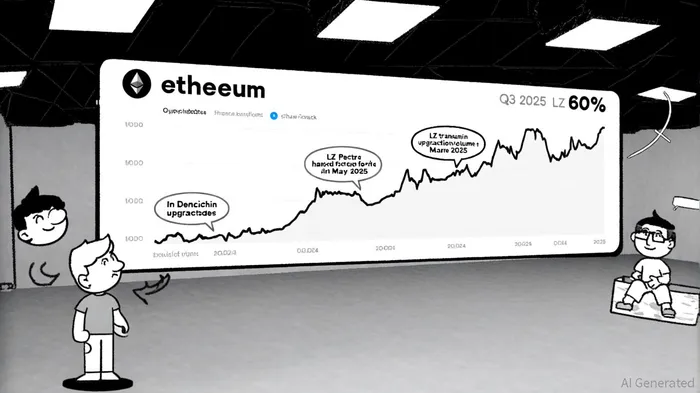
Ethereum's on-chain activity in 2025 tells a story of resilience and adaptation. Daily transactions averaged 1.74 million in Q3 2025, with 60% processed via Layer 2 solutions like ArbitrumARB-- and zkSyncZK--. This shift to L2s has slashed gas fees to $3.78 per transaction, making EthereumETH-- accessible for both retail and institutional users. Meanwhile, daily active addresses hit an all-time high of 680,000, driven by DeFi protocols, NFT platforms, and tokenized real-world assets.
However, fee revenue has declined sharply-down 44% year-over-year in August 2025-as L2s absorb transaction volume, according to The Currency Analytics report. Critics argue this signals a loss of network value, but the reality is more nuanced. Ethereum's role as a foundational layer for decentralized finance (DeFi) and smart contracts remains intact. As Vitalik Buterin noted, L2s are not a threat but an extension of Ethereum's scalability vision.
2. Institutional Adoption: A New Era of Legitimacy
Ethereum's institutional adoption in 2025 has been nothing short of explosive. U.S. spot Ethereum ETFs, approved in July 2024, unlocked $12 billion in inflows by August 2025, with competitive fee structures (e.g., BlackRock's ETHA at 0.25%) attracting large-cap investors, according to a Forbes analysis. Staking yields of 3–6% annually have further cemented Ethereum's appeal as a dual-income asset, with 29% of the total supply staked as of Q2 2025.
Corporate treasuries have also joined the frenzy. Public companies purchased 4 million ETH in Q3 2025, increasing their holdings to 4.63 million ETH (worth $19.13 billion) as of October 2025. BitMine Immersion Technologies, Sharplink Gaming, and The Ether Machine now hold over 4.3 million ETH collectively, signaling a shift toward Ethereum as a strategic reserve asset. This accumulation has tightened the liquid supply, with 40% of ETH locked in staking or held by institutions, creating a supply squeeze that could drive long-term price appreciation.
3. Short-Term Volatility: A Buying Opportunity?
Ethereum's price in 2025 has been anything but stable. After hitting an all-time high of $4,946 in August 2025, the price retraced to $4,215 by Q3's end, and further dipped to $3,880 in October. This volatility has been fueled by macroeconomic uncertainty, the $1.5 billion Bybit hack, and ETF outflows totaling $505 million over four days, according to a Tech-Champion report.
Yet, on-chain sentiment during these dips reveals a bullish undercurrent. Whale activity in October 2025 shifted from selling to accumulation, with large holders transferring ETHETH-- to cold storage and staking pools. Exchange reserves have also plummeted to a nine-year low of $60.8 billion, reducing the available supply for trading and amplifying the potential for a rebound. Technical indicators like the MVRV momentum metric and Crypto Fear & Greed Index (which hit 46 in late September) suggest the market is nearing a bottom.
4. Strategic Entry Points: Buy the Dip, Not the Noise
For long-term investors, Ethereum's current price action presents a compelling case to buy the dip. Key support levels around $3,800–$4,000 have held firm, with whale accumulation reinforcing this floor. If Ethereum breaks above this range, it could test $5,000–$6,000, as predicted by analysts like Ali Martinez.
The Pectra hard fork in May 2025 and future upgrades like sharding will further enhance Ethereum's scalability and efficiency, addressing lingering concerns about network congestion. Meanwhile, macroeconomic tailwinds-such as the GENIUS Act's regulatory clarity for stablecoins and U.S. inflationary policies-position Ethereum as a hedge against traditional market risks.
Conclusion: A Network Built for the Long Haul
Ethereum's 2025 volatility is a symptom of its growing pains, not a sign of weakness. The network's deflationary dynamics, institutional adoption, and technological upgrades create a flywheel effect that favors long-term holders. While short-term dips may test patience, they offer strategic entry points for investors who recognize Ethereum's role as the backbone of Web3.
As the saying goes: "Volatility is your friend if you're in for the long run."






Comentarios
Aún no hay comentarios