
Ethereum's Valuation Dilemma: A Multi-Model Analysis and the Case for Strategic Entry
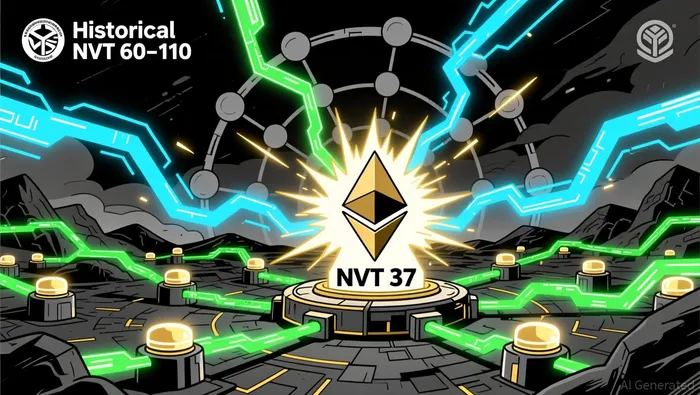
Ethereum's valuation landscape in 2025 is a tapestry of contradictions and opportunities. On one hand, institutional adoption has surged, with EthereumETH-- ETFs driving a $12 billion inflow by August 2025 and 30.4% of the total ETHETH-- supply staked by Q3 2025. On the other, traditional metrics like the Network Value to Transaction (NVT) ratio suggest the network is undervalued, trading at a ratio of 37-far below its historical range of 60–110. This divergence between institutional optimism and on-chain fundamentals raises a critical question: Is Ethereum a bargain, or is the market mispricing its long-term utility?
The NVT Paradox: Undervalued or Mispriced?
The NVT ratio, often likened to a "crypto P/E ratio," compares a network's market capitalization to its transaction volume. For Ethereum, this metric has collapsed to 37 in August 2025, a level not seen since the early days of blockchain adoption. This suggests that Ethereum's transactional utility far outpaces its current market valuation. If we assume a normalized NVT range of 60–110 and apply it to Ethereum's transaction volume (estimated at $7B–$14B in USD terms), the price could range from $4,059 to $11,598 over the next 12 months.
However, this model assumes static transaction volumes and ignores Ethereum's evolving role as a foundational infrastructure layer. The rise of Layer 2 solutions has reduced mainnet blockspace demand, shifting economic capture away from gasGAS-- fees and toward staking yields and DeFi protocols. This transition complicates NVT's relevance, as it no longer fully captures Ethereum's value proposition.
Staking Yields: The Institutional Sweet Spot
Ethereum's staking ecosystem has become a cornerstone of institutional strategy. By Q3 2025, 30.4% of ETH was staked, with annualized yields averaging 3.5%–5%. Innovations like liquid staking and restaking via DeFi protocols have further amplified returns, with ETHZilla Corp reporting 7.5% yields. This dual-income model-staking yields plus price appreciation-has made Ethereum a compelling alternative to traditional fixed-income assets, particularly in a low-yield environment.
Institutional investors are also leveraging Ethereum's programmable nature to hedge against systemic risks in traditional markets. With Ethereum Treasury Companies holding 4.36 million ETH by Q3 2025 (a 260% increase from Q1), the network is increasingly viewed as a "productive yield asset" rather than a speculative play.
Beyond NVT: Discounted Cash Flow and Composite Models
While NVT provides a snapshot of transactional value, Ethereum's intrinsic worth must also account for its staking and DeFi-driven cash flows. Simon Kim of Hashed has developed a real-time valuation dashboard that integrates traditional finance models like Discounted Cash Flow (DCF). His analysis suggests Ethereum is 56.9% undervalued, with a fair value of $4,747.4 versus a trading price of $3,022.3. The DCF model, which factors in staking yields and network security, estimates a fair value of $9,067.8-a 200% undervaluation.
However, not all models align. The Price-to-Earnings (P/E) ratio and Revenue Yield suggest overvaluation, highlighting the inherent volatility of applying traditional metrics to a decentralized asset. To resolve this, Hashed's dashboard weights high-reliability models like DCF and Metcalfe's Law, which emphasize network growth and utility. This composite approach suggests Ethereum's fair value is closer to $4,747–$9,068, depending on the model's assumptions.
The Institutional Imperative: Why Wall Street Can't Ignore Ethereum
Ethereum's institutional adoption is accelerating due to its dual role as both a settlement layer and a yield-generating asset. Total Value Locked in DeFi surpassed $119 billion in Q3 2025, underscoring its importance as the backbone of decentralized finance. Meanwhile, tokenized real-world assets and Layer 2 solutions are expanding Ethereum's utility, creating new demand for ETH as a security and settlement token.
Institutional investors are also drawn to Ethereum's deflationary mechanics post-Merge. EIP-1559's burn mechanism, combined with reduced issuance, has created a net supply contraction during high network activity. This "ultrasound money" narrative reinforces Ethereum's scarcity premium, a critical factor in its long-term valuation.
Strategic Entry: Balancing Risk and Reward
For investors, the case for Ethereum hinges on reconciling its undervaluation metrics with its institutional adoption. While NVT and DCF models suggest a price range of $4,059–$11,598, market conditions and macroeconomic factors will ultimately determine its trajectory. ETF inflows, which increased Ethereum's price from $2,400 to $4,150 in Q3 2025, indicate strong demand, but volatility remains a risk.
A strategic entry point would involve dollar-cost averaging into Ethereum while monitoring key triggers:
1. Staking participation rates-A sustained increase above 35% could signal growing institutional confidence.
2. TVL growth-Breakthroughs in DeFi and tokenized assets could catalyze demand.
3. Regulatory clarity-Further ETF approvals or institutional product launches could drive adoption.
Conclusion
Ethereum's valuation dilemma reflects the broader tension between traditional metrics and the realities of a decentralized, programmable asset. While NVT and DCF models suggest undervaluation, institutional adoption and staking yields provide a compelling case for long-term value. For investors, the key is to balance these perspectives and position Ethereum as a strategic asset in a diversified portfolio. As the network continues to evolve, its intrinsic worth will ultimately be defined by its ability to adapt-just as it has done since the Merge.






Comentarios
Aún no hay comentarios