
Ethereum’s Validator Queue Surge and Restaking Trends as Harbingers of Network-Capacity Scarcity
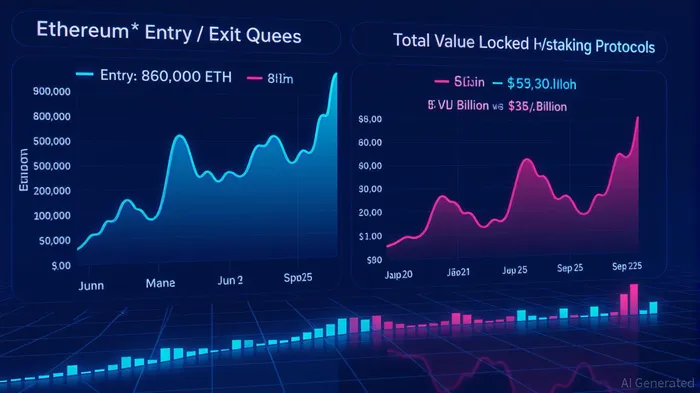
Ethereum’s validator queue has surged to its highest level in nearly two years, with 860,369 ETH ($3.7 billion) waiting to enter the staking network as of September 2025 [1]. This surge reflects a confluence of factors: rising Ether prices, historically low gas fees, and a dramatic influx of institutional capital. Over 70 corporate treasuries have staked large portions of their ETH holdings, while EthereumETH-- ETFs attracted $27.6 billion in inflows during August alone [5]. The validator entry queue’s growth has outpaced the exit queue, which peaked at 1.02 million ETH in August but declined by 20% by early September, signaling reduced selling pressure and a shift toward long-term staking [3].
Network-Capacity Scarcity and Staking Dynamics
The validator queue’s expansion is not merely a liquidity metric—it is a harbinger of network-capacity scarcity. With Ethereum’s validator entry queue requiring an average of 14 days to process new participants [6], the network is experiencing structural constraints akin to a “stakeable” version of Bitcoin’s blockspace scarcity. This dynamic is amplified by Ethereum’s transition to a deflationary monetary model. Staking locks ETH into the network, reducing circulating supply, while EIP-1559’s burn mechanism further accelerates net supply destruction. As of Q3 2025, 35.7 million ETH (31% of total supply) is staked, with 35.3 million ETH staked by May 2025 alone [1]. The interplay of these forces creates a self-reinforcing cycle: higher staking demand increases ETH’s utility value, while reduced supply enhances scarcity-driven price appreciation.
Restaking Protocols and Capital Efficiency
Ethereum’s restaking ecosystem has emerged as a critical driver of network resilience and value accrual. Protocols like EigenLayer, which dominates 85% of the restaking market with $18 billion in TVL [2], enable validators to rehypothecate their staked ETH into Actively Validated Services (AVSs). This innovation transforms staked ETH into a multi-utility asset, generating yield from DeFi, oracleORCL-- networks, and data availability layers without requiring new capital. Liquid restaking tokens (LRTs), such as weETH from EtherFi, further enhance liquidity by allowing stakers to trade or collateralize their positions [4].
The explosion of restaking has also introduced systemic risks, including correlated slashing across AVSs and rehypothecation cascades. However, regulatory clarity—such as the SEC’s July 2025 reclassification of Ethereum as a utility token—has mitigated these concerns, unlocking $43.7 billion in staked assets via protocols like Lido and EigenLayer [6]. Institutional adoption is now accelerating, with Ethereum ETFs capturing 8% of the circulating supply by August 2025 [6].
Institutional Adoption and Network Resilience
Ethereum’s institutional adoption is reshaping its role in global finance. Corporate treasuries now hold 4.7 million ETH ($20 billion), while Ethereum ETPs attracted $4 billion in August 2025 inflows [5]. This capital is not merely staking for yield—it is reinforcing Ethereum’s security model. With 35.7 million ETH staked, the network’s validator base has become a shared security layer for DeFi, tokenized assets, and AVSs. The Pectra and Dencun upgrades, which reduced gas fees by 90% and enabled 100,000 TPS [5], have further solidified Ethereum’s position as the dominant smart contract platform.
Whale activity underscores this trend. Institutional-grade wallets now control 22% of the circulating supply, with 1.2 million ETH ($6 billion) withdrawn from exchanges and staked in Q3 2025 [5]. This shift reduces sell-side pressure and aligns long-term incentives with network health. Meanwhile, Ethereum’s deflationary mechanics—1.32% annualized burn rate—complement staking’s supply destruction, creating a dual tailwind for ETH’s scarcity value [5].
Conclusion: A New Paradigm for Value Accrual
Ethereum’s validator queue surge and restaking trends are not isolated phenomena—they are symptoms of a broader paradigm shift. The network is transitioning from a speculative asset to a foundational infrastructure layer, where staked ETH serves as both a security mechanism and a yield-generating reserve. For investors, this creates a compelling narrative: growing staking demand drives ETH’s utility value, while network upgrades and institutional adoption enhance its scarcity and resilience.
As Ethereum’s validator queue continues to outpace exits and restaking TVL approaches $30 billion [2], the market is pricing in a future where ETH functions as a reserve asset for decentralized finance. This dynamic, combined with favorable monetary policy and regulatory clarity, positions Ethereum to outperform traditional assets in a low-interest-rate environment. For now, the validator queue stands as a barometer of confidence—a metric that suggests Ethereum’s best days are still ahead.
Source:
[1] Ethereum Staking Queue Surges to Two-Year High as Institutions Invest [https://coincentral.com/eth-staking-queue-surges-to-two-year-high-as-institutions-invest/]
[2] Restaking Revolution: How EigenLayer and Liquid Staking ... [https://blog.quicknode.com/restaking-revolution-eigenlayer-defi-yields-2025/]
[3] Ethereum Staking Entry Queue Surges to Two-Year High... [https://cointelegraph.com/news/ethereum-staking-entry-queue-hits-highest-level-for-2-years]
[4] ether.fi (ETHFI) — Institutional Deep-Dive for VCs & Family Offices [https://www.thestandard.io/blog/ether-fi-ethfi----institutional-deep-dive-for-vcs-family-offices]
[5] Institutional Whale Accumulation and ETF Inflows Signal a Strategic Buying Opportunity [https://www.bitget.com/asia/news/detail/12560604933036]
[6] Ethereum's Price Surge and the Onset of a New Expansion [https://www.bitget.com/news/detail/12560604936924]






Comentarios
Aún no hay comentarios