
Ethereum's Upcoming Gas Limit Increase and Its Implications for Network Scalability and Decentralized Finance (DeFi)
Ethereum's journey toward scalability has long been a balancing act between throughput, decentralization, and security. In late 2025, the network achieved a pivotal milestone by increasing its block gas limit from 45 million to 60 million, effectively doubling its base-layer capacity without requiring a hard fork. This upgrade, supported by over 513,000 validators, marks a critical step in Ethereum's roadmap to become a global settlement layerLAYER-- for decentralized finance (DeFi) and machine-to-machine commerce. As the gasGAS-- limit continues to evolve-culminating in proposals like EIP-9698, which aims to scale it 100-fold over four years-Ethereum's ability to process up to 2,000 transactions per second could catalyze mass adoption and drive ETH's token value higher. Let's unpack how.
Technical Foundations: From 45M to 60M and Beyond
The November 2025 gas limit increase was not an isolated event but part of a broader strategy to enhance Ethereum's throughput. Three key enablers made this possible:
1. EIP-7623: Introduced safeguards against excessive block sizes, ensuring validators could handle larger blocks without compromising node performance.
2. Client-Level Optimizations: Node implementations across major clients (e.g., Geth, Nethermind) were optimized to manage higher gas limits efficiently.
3. Testnet Validation: Stable results from testnets demonstrated that the 60M limit could be sustained without degrading network performance.
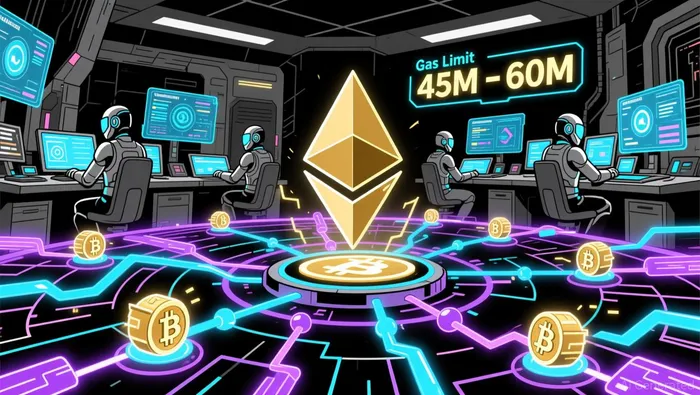
Looking ahead, Dankrad Feist's EIP-9698 proposes a deterministic exponential schedule to scale the gas limit from 36 million to 3.6 billion gas units over four years, starting in June 2026. This gradual approach allows validators and developers to adapt incrementally, avoiding the sudden disruptions seen in earlier hard forks. Crucially, the increase will be implemented via client defaults, bypassing the need for contentious upgrades.
Complementing these changes, the Fusaka upgrade in December 2025 introduced PeerDAS and other infrastructure improvements to enhance data availability for layer-2 (L2) networks. These upgrades position EthereumETH-- as a robust base layer for L2 rollups, which now account for over 58.5% of the network's transaction volume.
DeFi's Resurgence: Lower Fees, Higher Adoption
The gas limit increase has directly reduced transaction costs, making Ethereum more accessible for DeFi users. Average gas fees have plummeted to as low as $0.39 per transaction, a stark contrast to the $50+ spikes seen in 2021. This affordability has reignited DeFi activity:
- Total Value Locked (TVL): Ethereum-based DeFi protocols have rebounded to $100 billion, with platforms like AaveAAVE-- and UniswapUNI-- leading the charge.
- Transaction Volumes: The network now processes 1.7 million transactions daily, with daily active wallet addresses surpassing 700,000 according to data.
- AI-Integrated Protocols: By late 2025, AI-driven DeFi applications are expected to account for 15–20% of activity, leveraging Ethereum's improved scalability for autonomous agent interactions.
Lower fees have also enabled micro-transactions previously deemed unviable, such as fractional NFT trading and yield farming with small capital. This democratization of access is a key driver for mass adoption, particularly in emerging markets where transaction costs were a barrier to entry.
Token Value Dynamics: Scalability as a Catalyst
Ethereum's gas limit increases are not just technical upgrades-they are economic levers that could drive ETH's price higher. Here's how:
- Deflationary Pressures: Post-Merge, Ethereum has transitioned to a deflationary model, with EIP-1559's burn mechanism removing ETHETH-- from circulation during high usage. The increased gas limit amplifies this effect by enabling more transactions, thus increasing the volume of ETH burned.
Institutional Adoption: Tokenized real-world assets and staking participation (30.2% of supply staked) are creating new demand for ETH. As Ethereum becomes the default settlement layer for RWAs, its utility-and thus value-will grow.
Market Sentiment: Analysts project ETH to reach $9,000 by year-end 2025, with long-term forecasts hitting $10,000 or even $100,000 by 2030. These projections hinge on sustained deflationary pressure, successful L2 scaling, and Ethereum's ability to maintain its first-mover advantage in the tokenized economy.
Ethereum educator Anthony Sassano argues that the 60M gas limit is just the beginning. He anticipates a threefold increase to 180 million gas units within the next few years, with some developers eyeing a fivefold jump. Such scalability would further reduce fees, attract more users, and increase ETH's demand as a settlement asset.
Risks and Considerations
While the upgrades are promising, challenges remain:
- Centralization Risks: Larger blocks may strain smaller node operators, potentially leading to centralization. The Ethereum community is monitoring hardware requirements to ensure decentralization is preserved.
- Regulatory Uncertainty: Macroeconomic conditions and regulatory clarity will influence adoption trajectories. A lack of global standards could slow institutional onboarding.
- Competition: Layer-1 rivals like SolanaSOL-- and CosmosATOM-- continue to innovate, though Ethereum's first-mover advantage and robust ecosystem give it a structural edge.
Conclusion: A Network on the Cusp of Mass Adoption
Ethereum's gas limit increases are more than incremental improvements-they are foundational shifts that align with its vision of becoming a global infrastructure for value and computation. By reducing fees, enhancing throughput, and enabling AI-driven DeFi, Ethereum is positioning itself to capture a significant share of the tokenized economy. For investors, this translates to a compelling case: a network that balances scalability with decentralization, while creating deflationary dynamics and utility-driven demand for ETH.
As Vitalik Buterin notes, Ethereum's growth will be "less uniform" in 2026, with targeted increases for computationally heavy operations. This nuanced approach ensures the network remains adaptable, avoiding the pitfalls of over-optimization. For now, the stage is set for Ethereum to cement its role as the backbone of Web3-and its token, ETH, as a store of value in the digital age.






Comentarios
Aún no hay comentarios