
Ethereum's Unstaking Dilemma: Balancing Security and Liquidity in a Maturing Ecosystem
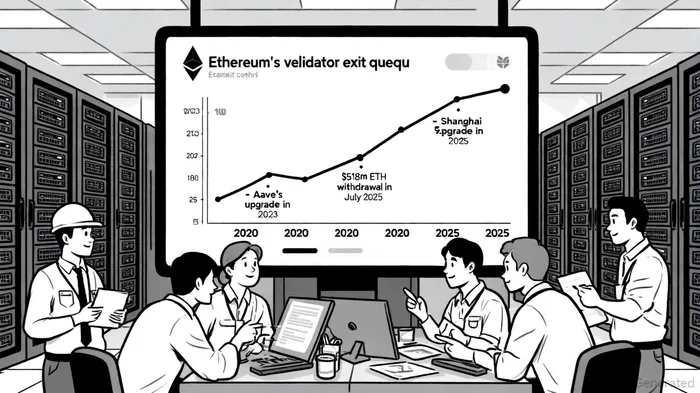
Ethereum's validator unstaking delay mechanism has become a focal point in the broader debate over blockchain design trade-offs. With over 2.5 million ETHETH-- (approximately $12 billion) currently awaiting withdrawal and exit times stretching to 44 days, the protocol's liquidity constraints are no longer abstract concerns but tangible market pressures[1]. This bottleneck, rooted in deliberate design choices to prioritize network security, has sparked a critical question: Can EthereumETH-- sustain its dual role as a secure consensus layer and a flexible financial infrastructure in an era of rising institutional participation and macroeconomic volatility?
The Security Imperative: A Military Analogy in Code
Vitalik Buterin has consistently defended the 43–44 day unstaking delay as a necessary friction point to deter malicious behavior and ensure validator commitment[2]. By analogy, he compares validators to soldiers: just as military service requires discipline and long-term dedication, Ethereum's design imposes a “cooling-off period” to prevent rapid exits that could destabilize consensus or enable coordinated attacks[3]. This logic is operationalized through strict churn limits—only 256 validators can exit per epoch (roughly 6.4 minutes)—which create a natural bottleneck[1].
The rationale extends beyond theoretical security. During the July 2025 surge in unstaking requests—driven by leveraged staking unwinds and rising borrow rates—the exit queue ballooned to 743,800 ETH, temporarily extending wait times to 12 days[4]. Yet, the system functioned as intended, avoiding cascading failures that could arise from a mass exodus. As Buterin notes, reducing delays without addressing underlying risks could undermine the network's trust model, particularly for nodes that intermittently disconnect[3].
Liquidity Risks: A Double-Edged Sword
While security remains paramount, the liquidity implications of prolonged unstaking delays are increasingly hard to ignore. The current backlog has created artificial supply constraints, with 2.5 million ETH effectively locked in a “time-locked” state[5]. This dynamic has cascading effects on DeFi protocols reliant on liquid staking derivatives like stETH and rETH. For instance, Aave's $518 million ETH withdrawal in July 2025 triggered a depeg in stETH and liquidity stress in Curve pools[4]. Such events highlight how Ethereum's exit queue can act as a shock absorber—or a destabilizing force—depending on market conditions.
Retail investors face additional challenges. In a crisis scenario, the inability to access staked funds within days could force panic selling, exacerbating price volatility[1]. Institutional players, meanwhile, are navigating a different calculus. The SEC's May 2025 clarification that staking is not a security has spurred new ETF interest, yet some firms are hedging exposure due to the uncertainty of withdrawal timelines[5]. Analysts like Benjamin Thalman from Figment argue that Ethereum's validator queue has become a barometer of macroeconomic resilience, reflecting the collision of infrastructure risks and capital flows[5].
The Trade-Off Matrix: Security vs. Flexibility
Ethereum's design reflects a classic trilemma: security, scalability, and decentralization. By prioritizing the first, the protocol has maintained robust consensus even during high-stress periods. However, the liquidity costs are mounting. As of September 2025, the exit queue's $12 billion value represents a significant portion of Ethereum's total staked supply, creating a “shadow market” where unstaked ETH is effectively illiquid[3]. This has led to calls for innovations like peer-to-peer exit markets or faster key-switching mechanisms to alleviate congestion[1].
Yet, any solution must avoid compromising the security guarantees that underpin Ethereum's appeal. For example, reducing churn limits without addressing double-signing risks could incentivize malicious actors to exploit timing gaps[3]. Similarly, introducing external markets for validator exits might fragment the network's consensus incentives. The Ethereum Foundation acknowledges these challenges but emphasizes that the current design has “operated as intended,” balancing entry and exit rates to maintain equilibrium[4].
Investor Implications: Navigating the New Normal
For investors, Ethereum's unstaking delays present both risks and opportunities. On the risk side, prolonged liquidity constraints could amplify sell pressure when withdrawals eventually occur, potentially depressing ETH's price. This is particularly relevant for leveraged staking strategies, where forced liquidations might coincide with mass unstaking events[5]. Conversely, the delays could act as a deflationary tailwind if they reduce the effective circulating supply of ETH, especially during periods of high staking yields[1].
The broader lesson is that Ethereum's maturation as an institutional asset is reshaping its risk profile. Unlike early-stage blockchains, where security was the primary concern, Ethereum now faces the challenge of scaling its infrastructure to accommodate complex financial instruments and global capital flows. This transition is not without friction, but it also underscores the protocol's adaptability.
Conclusion: A Delicate Equilibrium
Ethereum's validator unstaking delays are more than a technical quirk—they are a microcosm of the broader tensions shaping blockchain ecosystems. By prioritizing security, the protocol has preserved its integrity during periods of intense demand, but the liquidity costs are becoming harder to ignore. For investors, the key lies in understanding these trade-offs and positioning accordingly: hedging against forced sell-offs while recognizing the long-term value of a secure, censorship-resistant network. As the debate over unstaking mechanisms evolves, one thing is clear: Ethereum's journey is far from over, and its ability to balance these competing priorities will define its next chapter.






Comentarios
Aún no hay comentarios