
Ethereum's Unique Position to Outperform Bitcoin in a Bullish Macro Turn
The debate between BitcoinBTC-- and EthereumETH-- has long centered on their divergent value propositions: Bitcoin as digital gold and Ethereum as programmable money. However, as macroeconomic conditions shift and institutional adoption accelerates, Ethereum's network fundamentals and relative value metrics suggest it is uniquely positioned to outperform Bitcoin in a bullish market turn. This analysis examines why Ethereum's adaptive scarcity model, growing institutional demand, and dominance in decentralized finance (DeFi) infrastructure make it a compelling case for outperformance.
Network Fundamentals: Adaptive Scarcity vs. Fixed Supply
Bitcoin's value proposition hinges on its fixed supply cap of 21 million coins, creating a predictable issuance schedule secured by proof-of-work mining. This model, often described as "digital gold," prioritizes scarcity but lacks mechanisms to adjust supply in response to demand fluctuations. In contrast, Ethereum's proof-of-stake model introduces a dynamic scarcity framework. Transaction fees are burned, and as network activity increases, the supply of ETH can contract. This creates a "native monetary loop" where demand for ETH is intrinsically tied to the network's utility-such as smart contract execution, staking, and rollup activity.
Ethereum's recent upgrades, including EIP-4844 and layer-2 solutions, have further enhanced scalability, reducing gas costs and expanding its appeal as a platform for decentralized applications (dApps) and tokenized infrastructure. Meanwhile, Bitcoin's simplicity remains its strength, but its inability to adapt to evolving use cases may limit its growth potential in a digital-first financial ecosystem.
Relative Value Metrics: The Undervalued ETH/BTC Ratio
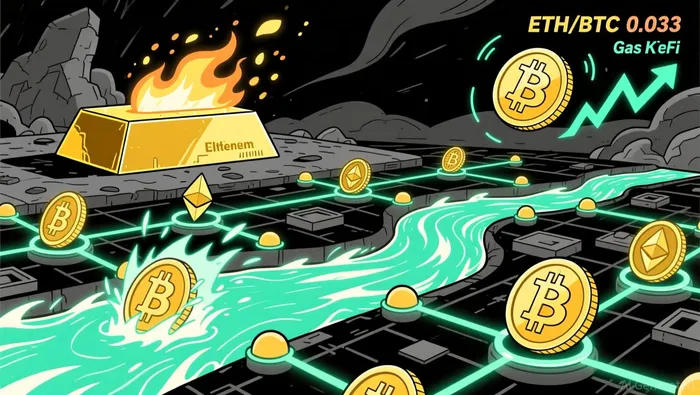
The ETH/BTC price ratio has historically served as a barometer for market sentiment and technological momentum. In November 2025, the ratio stood at 0.033106, a level far below its 2017 peak of 0.148. This suggests Ethereum is trading at a significant discount relative to Bitcoin, even as its ecosystem matures. For context, Ethereum's stablecoin supply reached $165 billion in 2025, and its decentralized exchange (DEX) volume accounted for 87% of the market, with $1 trillion in quarterly trading activity. The ratio's current level also reflects broader market challenges, including increased volatility and uncertainty. However, historical patterns indicate that Ethereum often outperforms Bitcoin when application demand and tokenization narratives gain traction. With the ETH/BTC ratio trading below its long-term average, the asset appears undervalued relative to its fundamentals. Analysts like Tom Lee have made bullish predictions, suggesting Ethereum could trade at 25% of Bitcoin's value, though such forecasts remain contingent on macroeconomic conditions and institutional adoption.
Ethereum's institutional appeal has surged in 2025, driven by robust ETF inflows. Exchange-traded funds (ETFs) for Ethereum totaled $9.6 billion in Q3 2025, surpassing Bitcoin ETFs for the first time. Ethereum ETF assets under management grew by 177% to $28.6 billion, signaling growing confidence in its role as a strategic asset class. This trend is amplified by the Federal Reserve's dovish policy, with 100 basis points of projected rate cuts through 2026. Lower interest rates typically favor risk assets, and Ethereum's utility-driven model may attract capital more effectively than Bitcoin's store-of-value narrative.
Additionally, Ethereum's staking participation rate reached 29.4% of total supply by Q3 2025, locking 35.6 million ETH in staking. This not only enhances network security but also creates supply-side constraints, further supporting price discovery. Meanwhile, Bitcoin's bearish divergence on the weekly time frame raises questions about its ability to sustain momentum in a bullish macro environment.
Conclusion: A Case for Outperformance
Ethereum's unique position in the crypto market stems from its ability to adapt to technological and macroeconomic shifts. Its dynamic scarcity model, institutional adoption, and dominance in DeFi infrastructure create a self-reinforcing cycle of demand and value accrual. While Bitcoin remains a cornerstone of the crypto ecosystem, Ethereum's programmability and utility-driven scarcity make it a stronger candidate for outperformance in a bullish macro turn. As the ETH/BTC ratio suggests, the market may be underestimating Ethereum's potential-a mispricing that could correct as liquidity tailwinds and institutional inflows continue to build.







Comentarios
Aún no hay comentarios