
Ethereum's Undervaluation and Strategic Entry Points in a Volatile Market
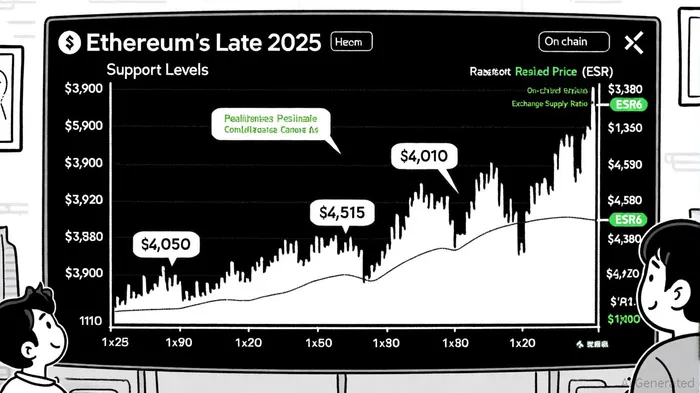
Ethereum's recent price decline below $3,900 in September 2025 has sparked renewed debate about its valuation and long-term potential. While the drop initially triggered bearish sentiment, a closer examination of on-chain metrics, institutional dynamics, and network fundamentals reveals a compelling case for undervaluation. For investors, this presents a strategic opportunity to assess Ethereum's position in the market cycle and identify entry points aligned with its historical patterns.
On-Chain Indicators Signal Undervaluation
Ethereum's price has consistently traded near or below its Realized Price, currently at $1,522.30, suggesting that the market is consolidating around the average cost basis of all ETHETH-- holders [1]. This metric, which calculates the price at which each ETH token was last moved, acts as a dynamic support level. When the market price dips below this threshold, it historically signals accumulation by long-term holders. For instance, the 100k+ ETH cohort—comprising whales and exchanges—has a realized price of $1,188.9. If EthereumETH-- were to fall below this level, even these large holders would be underwater, a rare occurrence that often triggers defensive buying [1].
Further evidence of undervaluation comes from the MVRV Pricing Bands, which indicate Ethereum is below the 0.8 threshold, a zone historically associated with accumulation phases [2]. Similarly, the Mayer Multiple Model shows the price has not crossed 2.4 times its 200-day moving average, a typical overvaluation marker [2]. These metrics align with Ethereum's behavior in 2017 and 2021, periods preceding major price surges.
Structural Supply Constraints and Institutional Adoption
Ethereum's exchange supply has reached a 9-year low, with only 16.3 million ETH held on centralized exchanges [3]. This structural liquidity shortage reduces the immediate supply available for selling, creating upward pressure on price. Concurrently, Ethereum ETFs have attracted over $33 billion in inflows by Q3 2025, driven by institutional demand [3]. These inflows, combined with a surge in DeFi activity and tokenization use cases, underscore Ethereum's role as the dominant smart contract platform.
The Entity-Adjusted Dormancy Flow metric also points to a macro bottom zone, with low dormancy values indicating capitulation followed by accumulation [4]. Recent outflows of 453,000 ETH from exchanges further reinforce bullish sentiment, as traders lock in positions rather than liquidate [4].
Network Upgrades and Technical Catalysts
Ethereum's fundamentals are bolstered by ongoing network upgrades. The Dencun hard fork (EIP-4844) has already enhanced scalability and reduced layer-2 fees, while the Fusaka upgrade in December 2025 is expected to further optimize throughput [5]. These upgrades, coupled with Ethereum's staking mechanism—locking 29–30% of its supply—reduce circulating liquidity and create scarcity [5].
Technically, Ethereum is consolidating around $4,533, with key resistance at $4,530 and $4,800 [6]. A breakout above $4,500 could signal renewed bullish momentum, potentially pushing the price toward $5,000, a level many analysts view as pivotal [6]. However, caution is warranted as descending channels and whale selling activity suggest short-term volatility [6].
Strategic Entry Points and Risk Management
For investors, the current price action around $4,386 offers a strategic entry point. Historical data shows that Ethereum's price often corrects by 10–40% when the NUPL (Net Unrealized Profit/Loss) metric for long-term holders reaches 0.62, a level observed in late August 2025 [7]. This aligns with the recent decline from $4,475 to $4,077, suggesting a potential rebound.
Key support levels at $4,200 and $4,015 should be monitored, as a sustained break below $4,000 could trigger further corrections [7]. Conversely, a retest of $4,530 and a successful breakout above $4,800 would validate the bullish case, with analysts projecting a move toward $5,500 by mid-October [7].
Conclusion
Ethereum's recent price decline below $3,900 masks a broader narrative of undervaluation supported by on-chain metrics, institutional inflows, and network upgrades. While short-term volatility remains a risk, the confluence of structural supply constraints, bullish technical patterns, and fundamental upgrades positions Ethereum for a potential breakout. Investors who recognize this inflection point may find the current price range a compelling opportunity to accumulate, provided they remain mindful of macroeconomic uncertainties and whale activity.






Comentarios
Aún no hay comentarios