
Ethereum's Turbulent Waters: Navigating Outflows, Security Risks, and Arbitrage Opportunities
The EthereumETH-- market in late 2025 has been a rollercoaster, with massive exchange outflows, security breaches, and institutional jitters creating a volatile landscape. For investors, this turbulence isn't just a warning sign—it's an opportunity to spot undervalued assets and exploit market inefficiencies. Let's break down the numbers and strategies.
The Outflow Tsunami: A Double-Edged Sword
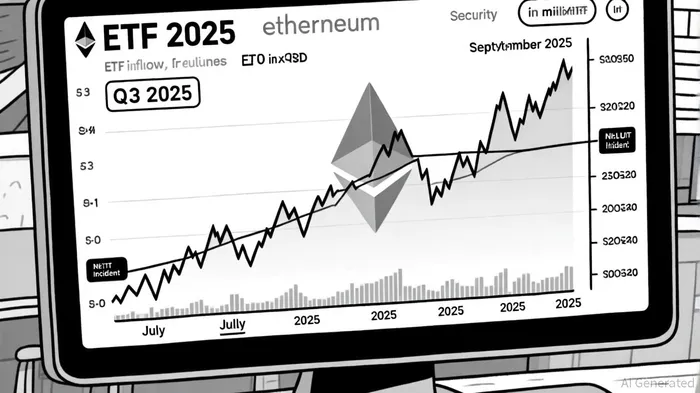
Ethereum ETFs have seen staggering redemptions in Q3 2025. On September 22 alone, spot Ethereum ETFs lost $76 million in outflows, led by BlackRock's ETHA and Fidelity's FETH [1]. Over four days, the total exodus hit $505 million, a sharp reversal from the $33 billion in inflows earlier in the quarter [2]. While this signals short-term institutional caution, it also reveals a critical truth: Ethereum's underlying fundamentals remain intact.
The ETFs still hold $27.52 billion in assets, and Ethereum's market cap share via ETFs stands at 5.45% [3]. This resilience suggests that the outflows are more about portfolio rebalancing than a collapse of confidence. Meanwhile, on-chain data shows over 1.2 million ETH (worth $1.8 billion) leaving exchanges in August, with large holders and “whales” accumulating the asset [4]. This shift to self-custody and staking contracts is reducing immediate sell pressure, potentially setting the stage for a price rebound.
Security Risks: The Hidden Volatility Catalyst
Ethereum's security challenges in 2025 have only amplified market instability. Phishing attacks and wallet hacks accounted for $2.47 billion in losses in the first half of the year, with the Bybit cold wallet exploit ($1.5 billion) and Cetus ProtocolCETUS-- hack ($225 million) dominating headlines [5]. These incidents not only erode trust but also trigger panic selling. For instance, the Bybit breach in February sent Ethereum's price plummeting, compounding the effects of ETF outflows [6].
Emerging risks like EIP-7702 wallet delegation features are now being weaponized by phishing groups, tricking users into granting access to their assets [7]. For investors, this means heightened uncertainty—every security incident introduces a new layer of risk, making Ethereum's price swings even more erratic.
Arbitrage Opportunities: Profiting From Chaos
The volatility and outflows have created fertile ground for arbitrage. Here's how to capitalize:
Price Discrepancies Across Exchanges: With Ethereum's exchange supply at a 9-year low, liquidity is fragmented. Traders can exploit price gaps between centralized exchanges (CEXs) and decentralized exchanges (DEXs). For example, if ETH trades at $4,100 on Binance but $4,200 on UniswapUNI--, a quick cross-exchange trade locks in a $100 profit per ETH [8].
Derivatives and Long/Short Imbalances: Ethereum's derivatives market shows a bullish bias, with 71.2% of accounts holding long positions and a long/short ratio of 2.47 [9]. However, this crowded trade is a double-edged sword. If sentiment shifts, liquidation clusters between $4,100 and $4,478 could trigger sharp corrections. Traders should hedge with inverse ETFs or short-term futures to mitigate risk.
Staking and Supply Dynamics: As more ETH is staked or moved to private wallets, the circulating supply tightens. This scarcity could drive demand higher, especially if ETF inflows resume. Investors holding ETH can stake it for yields (currently ~4-6%) while waiting for a potential price rebound [10].
The Bottom Line: Caution or Opportunity?
Ethereum's current environment is a mix of risk and reward. The outflows and security breaches have created a bearish narrative, but the underlying demand—driven by staking yields, ETF adoption, and DeFi growth—remains robust. For aggressive investors, this is a chance to buy the dip, especially if Ethereum's price reclaims the $4,550 level. For the risk-averse, hedging through derivatives or diversifying into BitcoinBTC-- (which has seen stronger institutional inflows) might be wiser.
One thing is clear: Ethereum's market is far from stable. But in instability lies opportunity—for those who know where to look.





Comentarios
Aún no hay comentarios